
Publications
Heat Pump Buffer Tank: What needs to be considered during planning?
A buffer tank for heat pumps is an essential component of modern heating systems, contributing to higher efficiency, comfort, and supply reliability. It stores surplus thermal energy, prevents frequent on/off cycling of the heat pump, and makes stored energy available when needed. In this way, the heat pump buffer tank optimizes the overall system, extends the service life of the heat pump, and increases economic efficiency. But what exactly is a buffer tank, and why does it play such an important role in heat pump systems? Which types are there—such as conventional, stratified, or bivalent—are available, and how do they differ? The configuration of a hot water storage tank in combination with a heat pump is decisive for making the best use of energy derived from air, ground, or water. The hydraulic integration of the buffer tank is a central factor: it regulates the heat exchange between the heat pump, the buffer tank, and the heating system, and thereby determines the overall efficiency of the installation. This raises the question of whether the integration of heat exchangers into hot water systems is advisable.
This article provides comprehensive information about buffer tanks for heat pumps: from the fundamental principles and different storage types to system design and hydraulic integration. In addition, it highlights the added value of using the Polysun simulation software for planning and optimizing buffer tank systems.
What is a buffer tank and Why is it important for heat pumps?
A buffer tank in a heat pump system is an insulated water tank that serves as a thermal storage unit for space heating in buildings. It stores surplus thermal energy from heat generation either on a short-term or seasonal basis, making it available whenever required. The buffer tank is equipped with multiple hydraulic connections, allowing the stored energy to be supplied to different heating circuits. This design enables the integration of additional components such as solar thermal collectors, fresh water stations, or radiators.
The combination of a heat pump buffer tank and a heat pump prevents unnecessary cycling of the heat pump, i.e., frequent on/off operation. Instead, the heat pump can transfer the generated thermal energy into the tank water for temporary storage. Additional optimization strategies, such as charging the buffer tank during periods of lower electricity prices, operating outside of noise-sensitive times, or integrating power-to-heat applications, provide further advantages.
By ensuring balanced system operation, the buffer tank primarily enhances heating efficiency and extends the service life of the heat pump. Furthermore, the system guarantees a high level of supply security, since sufficient thermal energy is always available in storage.
Heat pump with buffer tank design: different hydraulic connections
The setup of a heat pump with a buffer tank can be divided into three main sections: heat generation, thermal storage, and the heating system. The most common hydraulic configurations are illustrated in the following diagrams, using an air-to-water heat pump as the heat generator, a buffer tank, and a floor heating system.
In conventional buffer tank systems, the storage tank is directly integrated into the circuit. In this case, the heating water from the heat pump is routed either into the buffer tank or directly into the heating system. Inside the buffer tank, the supply water mixes with the stored water and distributes evenly. The following diagram shows the simplest heat pump buffer tank system with only one circuit.

Another option for combining a heat pump with a buffer tank is the direct connection of the two components via a T-piece pipe. This setup allows the direct supply of an underfloor heating system while at the same time storing excess heat in the buffer tank. Heating water is drawn from the warm layer of the buffer tank and used to heat the domestic hot water via an external heat exchanger. The advantage of this configuration is that the circuit of the heat pump and the hot water tank is completely separated from the domestic hot water circuit. This ensures protection against Legionella, i.e. the prevention of bacterial growth in the storage tank, and guarantees the hygienic requirements for domestic hot water.
The following diagram illustrates the setup of a heat pump buffer tank with an external heat exchanger and a domestic hot water circuit.

In many larger buildings, it is desirable to use additional energy sources alongside a heat pump. By means of an internal heat exchanger in the form of a coil inside the buffer tank, solar thermal collectors can easily be integrated. This creates a bivalent system with different temperature levels. The integration of solar thermal energy reduces the load on the heat pump and increases the overall stability of the system. Various consumers, such as space heating and domestic hot water, can be efficiently integrated into this system. An external heat exchanger also enables the separation of the domestic hot water circuit from the heating circuit of the heat pump and the buffer tank. This allows the consumers to be controlled independently while ensuring the hygienic standards of domestic hot water.
The following diagram illustrates the setup of a heat pump with a buffer tank and integrated solar thermal collectors.
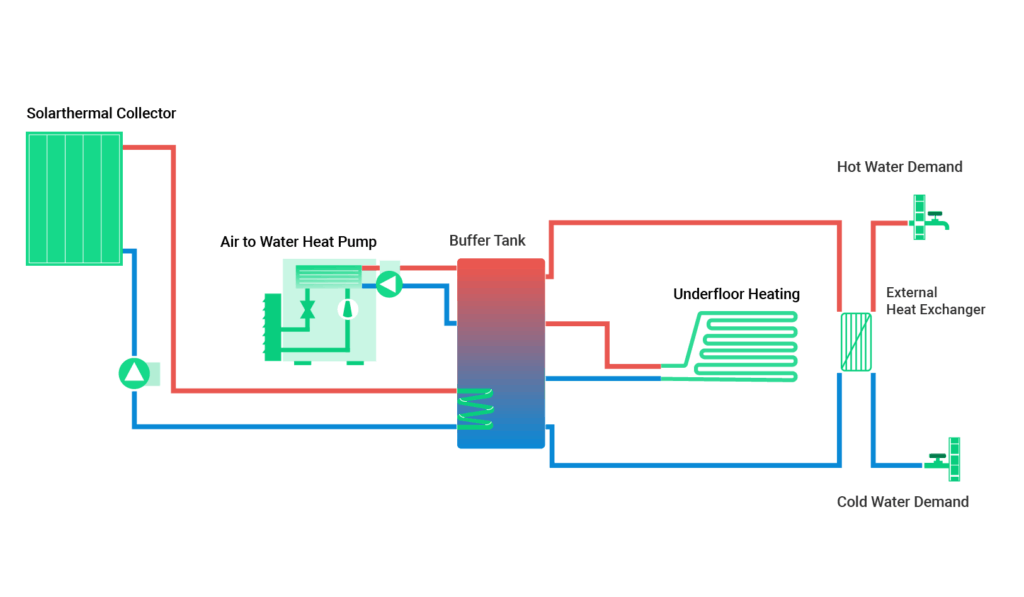
Buffer tanks can be connected either in parallel or in series. In a parallel configuration, the hot water tank is hydraulically integrated between the heat pump and the heating system. This allows the heating water to flow either directly into the heating circuit or via the buffer tank, depending on demand. In a series configuration, all heating water first passes completely through the heat pump buffer tank before entering the heating circuit.
For more detailed information on parallel and series connection of buffer tanks with heat pumps, please refer to our blog article on this topic.
Use cases for buffer tanks in heat pump systems
Buffer tanks for heat pumps are used in a variety of building types, especially in larger and more complex heating systems. The following section lists typical applications along with their respective purposes:
| Single-family house | Even heat distribution throughout the building |
| Multi-family houses | Efficient load shifting, decoupling of heat generation and consumption, integration of multiple energy sources |
| Hotels | Compensation for fluctuating heat demand during the day, improved comfort |
| Commercial buildings | Reduction of peak loads, large storage volumes, economical operation |
| Office buildings | Balancing fluctuating usage, energy savings |
| Hospitals | High supply reliability, ensuring continuous heat supply |
| Public buildings | Sustainable and reliable heat supply |
Which types of buffer tanks are there and what are their differences?
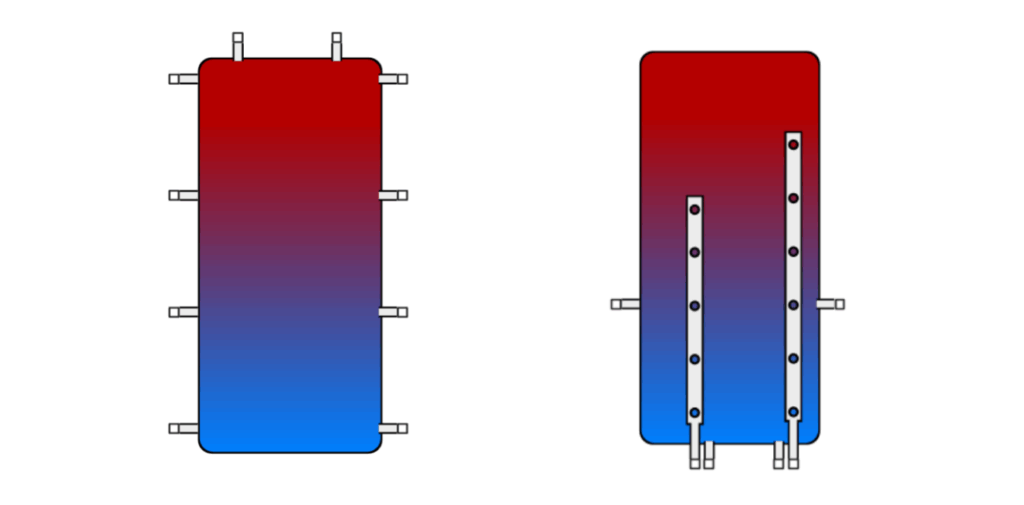
In general, four main types of buffer tanks can be distinguished in heating systems. These types are illustrated below.
Conventional buffer tanks
These tanks are directly integrated into the heating circuit of the heat pump and the heating system. The heat pump transfers the hot water into the buffer tank, where it mixes with the stored water. This allows the desired temperature to be achieved within the tank. Ideally, there are no significant temperature differences inside the buffer tank. This type of storage is suitable for small heating systems without complex hydraulics. In addition, costs are low and installation is simple. However, disadvantages include lower efficiency in heating circuits compared to other types of tanks and suboptimal integration of solar thermal systems.
Stratified buffer tanks
A stratified hot water tank is divided into several temperature zones, with warmer water at the top and cooler water at the bottom. These zones are formed by boundary layers that are determined by the density of water at different temperatures. The temperature stratification can be achieved either by directly introducing the heating water into the layer with the corresponding temperature or by using stratifier lances. These lances are located inside the tank and have lateral openings. The incoming hot water flows through the lance until it reaches a zone with a similar temperature. At this point, the water enters the buffer tank. By filling the tank slowly in this manner, the layers do not mix, ensuring that water at different temperatures is always available for the heating system.
When required, the heating circuits draw optimally tempered water from the appropriate layer, which increases the efficiency of the heating circuits. A stratified buffer tank can thus supply multiple systems with different flow temperatures. Furthermore, the stratification allows efficient integration of solar thermal systems and reduces the load on the heat pump. Disadvantages include higher costs as well as more complex installation and maintenance.
Bivalent buffer tanks
These tanks utilize two different energy sources. In addition to the heat pump, solar thermal collectors, electric heating elements, fossil-fuel boilers, or pellet boilers can serve as heat sources. The additional energy sources are connected to the storage water either directly or via a heat exchanger.
Bivalent buffer tanks reliably supply heating systems with hot water and are also suitable for combination with a domestic hot water circuit as a combined heat storage. They provide high supply reliability and can be efficiently integrated with renewable energy sources. Disadvantages include the complex construction and higher costs. Furthermore, a control system is required to optimally coordinate the different energy sources.
Integrated buffer tanks
hese hot water tanks are directly integrated into the heat pump. They are very space-saving, as the heat pump and the storage tank are combined, eliminating the need for additional installation space. Integration within the heat pump also results in lower heat losses during energy transfer. This type of heat pump buffer tank is particularly suitable for single-family homes or small buildings. However, disadvantages include the relatively small storage volume and limited possibilities for integrating solar thermal systems or a domestic hot water circuit.
Simulation in Polysun – What added value does the software provide?
The simulation of a system in Polysun offers numerous advantages for the optimal sizing of a heat pump buffer tank. For efficient energy management the following factors should be considered:
- Storable thermal energy or the storage capacity of the tank
- Hydraulic integration (series, parallel, or decoupled from the heat generator)
- Required flow temperatures for the heating circuits
- Control and regulation of the components
- Integration of additional energy sources such as solar thermal or geothermal
- Building characteristics, especially heating load and energy demand
- Energy requirements for the hot water storage tank
Possibilities of the simulation in Polysun
Using a simulation software such as Polysun, these factors can also be optimally coordinated for more complex applications in larger buildings. The following added values result:
- Energy cost savings of up to 40%: The cost-effectiveness of heat pump systems can be improved. The optimized energy supply variant can save up to 40% of energy costs compared to an unoptimized system.
- Determination of key parameters for sizing: The simulation allows precise coordination of storage volume, flow temperatures for heating circuits, heat generator capacity, and the number and position of hydraulic connections according to the building’s heat demand.
- Realistic simulation of dynamic load profiles: All relevant components – heat pump, buffer tank, consumers, and additional energy sources such as solar thermal or photovoltaic – are considered. This ensures optimal dimensioning of the thermal storage and, if necessary, the reduction of heat pump capacity.
- Avoidance of typical planning errors: Problems such as too frequent cycling of the heat pump become visible. Such planning errors lead to lower efficiency, reduced comfort, and shortened equipment lifespan.
- Hydraulic integration of the buffer tank: Different variants, such as parallel or series connection, can be simulated to determine the technically and economically most appropriate solution.
- Extensive component catalog with templates: Numerous templates accelerate the planning process of heat pump sizing, while details such as defrost cycles, variable operating points, or temperature differences can be precisely simulated.
- Calculation of seasonal performance factors: The efficiency of heat pump systems with a buffer tank can be represented realistically, significantly increasing planning reliability.
- Simulation of control strategies: An intelligent control system can automate load shifting (electricity consumption during off-peak hours), optimization of self-consumption, and forecast-based operational optimization.
We have compiled the hydraulic diagrams of the most commonly used heat pump systems with buffer tanks in practice in a separate blog.
FAQ
How to hydraulically supply different usage areas in a building (heating circuits, domestic hot water, individual room control)?
In a heat pump system with a buffer tank, the storage plays a central role in supplying the various usage areas of a building. The heat pump first delivers the generated heat to the buffer tank, which acts as a thermal storage unit for the heating system.
Via heat exchangers, the individual heating circuits – such as underfloor heating or radiators – as well as domestic hot water can be supplied with heat according to demand. Especially in systems with individual room control or varying user profiles, the buffer tank ensures system stability by compensating for fluctuations in temperature and flow rate.
This protects the heat pump and provides more efficient and even heat distribution throughout the building. In this way, the storage tank supplies all areas – heating circuits, domestic hot water, and individual rooms – optimally with heat. The configuration of a heat pump with a buffer tank is described earlier in this article.
How can the buffer tank be integrated into the hydraulic scheme (flow, return, mixing, or stratified storage)?
A buffer tank can smooth the temperature in the return line, increase the water volume, and thus reduce the cycling of the heat pump. This simple and efficient method is particularly suitable for smaller systems or retrofits.
In the flow line, the tank serves as a direct energy source, hydraulically decouples the heat pump from the heating circuits, and ensures stable flow temperatures. A disadvantage is higher heat losses. This solution is typically used in multi-family buildings.
As a hydraulic separator, a buffer tank decouples the flow rates and supplies multiple heating circuits with different temperatures. This more complex but ideal solution is used in large buildings such as hotels or hospitals.
Stratified (layered) buffer tanks work most efficiently by storing different temperature levels. They are ideal for bivalent systems, offering maximum efficiency and flexibility, but they are more expensive and complex.
More information on hydraulic schemes for can be found here.
How can solar thermal, district heating, or a peak load boiler be integrated into a heat pump system with buffer tank?
Solar thermal, district heating, and a peak load boiler can be integrated into a heat pump system with a buffer tank in a way that allows the heat pump to operate efficiently and reliably absorb peak loads.
For solar thermal systems, the collectors are usually fed into the top of the buffer tank, utilizing the hottest layer. This allows domestic hot water and heating circuits to be partially or fully supplied by solar energy, while the heat pump charges the lower section.
District heating is typically connected via a plate heat exchanger and can feed directly into the buffer tank to cover demand during high loads or maintenance periods of the heat pump.
Peak load boilers – for example, gas or oil boilers – are also integrated at the top or in a special high-temperature zone of the buffer tank. They supply heat during very cold outdoor temperatures or high domestic hot water demand and ensure that flow temperatures remain stable.
In this way, all energy sources are combined, with the buffer tank acting as a hydraulic decoupler and flexible energy storage unit.
What impact does the size of the buffer tank have on the annual performance factor (APF) of the heat pump?
The size of the buffer tank has a significant impact on the annual performance factor (APF) of a heat pump, as it influences the operating behavior. A sufficiently large hot water storage allows longer operating times and reduces the frequent on/off cycling of the heat pump. Short cycling consumes additional energy and lowers efficiency. A smooth operating profile therefore increases the average APF.
In addition, the tank ensures that the heat pump operates predominantly at low flow temperatures, which improves efficiency. Peak loads are covered by the buffer tank, so the heat pump is not forced to operate inefficiently at high output. Overall, a properly sized buffer tank leads to stable temperatures, reduced cycling, and a higher annual performance factor.