
Overview
Data Center Heat Reuse: Regulatory Requirements, Typical Use Cases and Optimal Planning
Why sustainable energy concepts and data center heat reuse are becoming ever more relevant
Data centers are the backbone of digitalization, but they also consume a lot of energy. Thus, a forward-looking approach is to reuse waste heat from data centers to enable higher efficiency. Data centers are becoming increasingly significant in terms of total energy consumption in Europe. For instance, data centers in Germany consumed approximately 20 billion kWh of electricity in 2024. This accounts for about 3.7% of the country’s total electricity consumption. According to current projections, the electricity demand of data centers in Germany will rise to between 25 and 37 billion kWh by 2030, with 31 billion kWh being a realistic midpoint. The Borderstep-Institute predicts, that if the overall consumption does not increase significantly, the share of data centers in total power demand could rise to 6–7%. Therefore, data centers represent an increasing portion of total energy consumption in Germany.
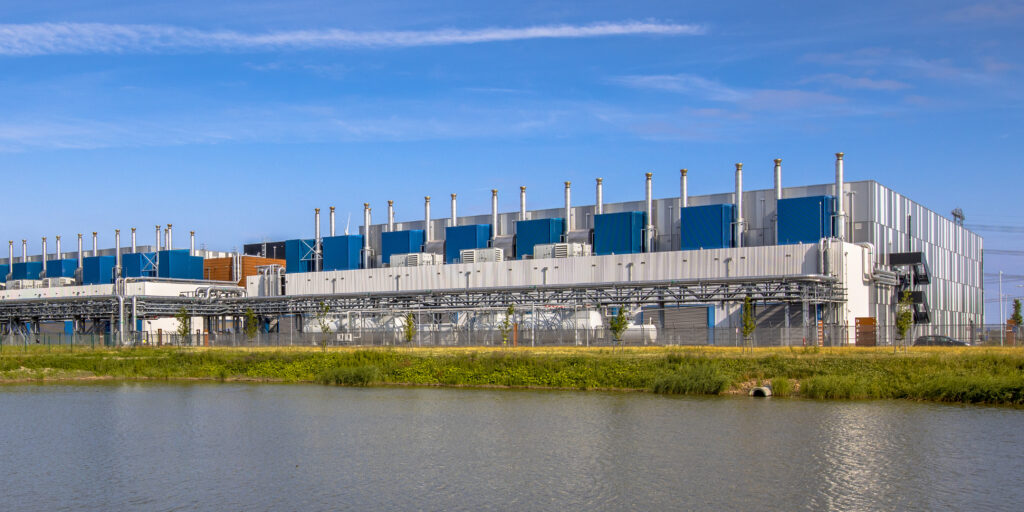
The primary drivers of this growth are the increasing deployment of artificial intelligence (AI) and cloud computing, as well as the growing digital interconnection of the economy and society. Experts expect the use of AI and high-performance computing systems to continue to grow.
These transnational trends lead to large investments, new major projects, and increased demand for energy, space, cooling, and regulation.
For instance, the EU plans to triple data center capacity by 2030 through the Cloud and AI Development Act. This act will simplify permitting procedures, focus on sustainable construction and energy concepts, and promote European cloud providers.
Due to the increasing electricity consumption and regulatory requirements of data centers, the topic of data center heat reuse is becoming more important in Europe. The following describes how waste heat from data centers can be utilized and planned optimally.
Data center heat reuse: Current and future regulatory requirements
Recent regulatory frameworks and technical standards have made the recovery of server waste heat a mandatory component of modern energy concepts in data centers.
Germany: Energy Efficiency Act and obligation for waste-heat reuse
The new Energy Efficiency Act (EnEfG) clearly regulates data center heat reuse in Germany. Starting July 1, 2026, new data centers must provide proof and utilize at least 10% of their generated waste heat. This percentage increases to 15% in 2027 and to at least 20% in 2028 (assuming technical and economic feasibility).
There are also threshold values and reporting obligations for existing data centers.
Operators must report data on waste-heat potential to the Federal Office for Economic Affairs and Export Control’s (BAFA/BfEE) central platform annually.
Starting in July 2025, operating an energy and/or environmental management system (EnMS/UMS) with a focus on heat balance and energy efficiency measures (e.g., ISO 50001, ISO 14001, EMAS) will be mandatory.
Additionally:
Within two years, new data centers must achieve a PUE (Power Usage Effectiveness) of no more than 1.2. For existing plants, the target is 1.5 by 2027 and 1.3 by 2030. PUE is the ratio of a data center’s total power usage to the power used by IT devices. An ideal PUE of 1.0 means no additional energy is needed for cooling, the power supply, or infrastructure.
Starting in 2027, data centers must meet their entire electricity demand with renewable energy.
Waste heat should be used on-site, via local heat networks, or for adjacent buildings, provided that it is technically and economically feasible.
Relevant standards and guidelines for planning, construction and operation:
- EnEfG § 16 ff. for waste-heat recovery.
- ISO 50001, ISO 14001, EMAS (mandatory for EnMS/UMS).
- DIN EN 50600 (data-center standards for energy-efficiency and cooling).
- F-Gas Regulation (EU/2024/573): stricter refrigerant regulation, promoting new cooling systems (e.g., liquid cooling)
Switzerland: Cantonal obligation for waste-heat reuse
In Switzerland, the use of data center waste heat is becoming more common in cantonal building and energy legislation.
- According to § 13a EnerG (and Art. 6, para. 3 in Zurich and § 30a BBV I), data centers with over 2 GWh of waste heat must supply their excess heat to third parties at cost price if they cannot use it themselves.
- Regional structure plans must include facilities with an energy demand of more than 5,000 MWh.
- During the permitting process, it must be proven that heat extraction at the building site is feasible (e.g., heat transfer point).
Austria
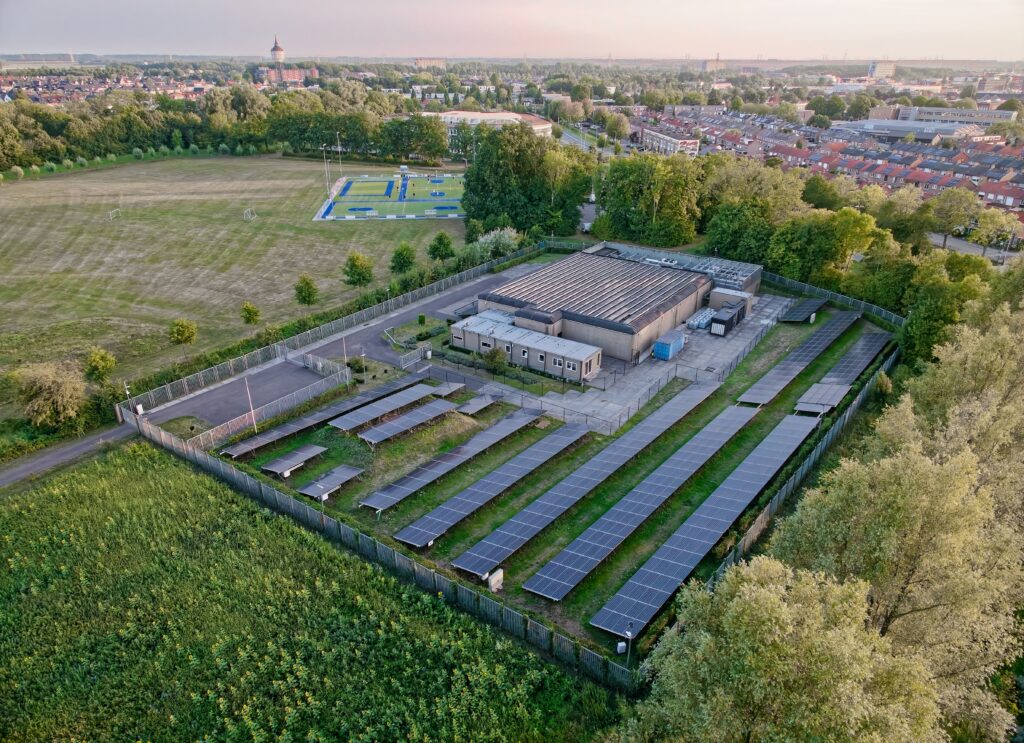
In Austria, innovative projects, such as large public buildings and hospitals in Vienna and its surrounding areas that are heated with server waste heat, serve as role models. In Vienna, local regulations and subsidies encourage the use of server waste heat (500 kW and above) for local heating networks.
Scandinavia and EU
Northern European countries go further:
- For example, Finland, Sweden, Denmark, and Norway already routinely integrate data center waste heat into district heating networks.
- The EU’s revised Energy Efficiency Directive (EED) requires the utilization of industrial waste heat and mandates that member states establish a waste heat action plan by 2030. Directive 2023/1791/EU includes specifications for integrating data center waste heat into renovation strategies and heat network planning.
UK and USA
Although there are no binding obligations for server waste heat reuse in the UK yet, several pilot projects are underway in London and Manchester where waste heat is integrated into municipal heat networks. Measures are being implemented on a voluntary basis within the framework of the BREEAM certification system and in accordance with ISO 50001. Stricter requirements are under discussion as part of the EU alignment and net-zero targets.
In the USA, there are no comprehensive obligations yet. The drivers are state subsidy programs, the Department of Energy (DOE), and local net-zero strategies.
Data center power consumption: Overview and share of usable waste heat
The following graphic illustrates the typical distribution of data center power consumption.
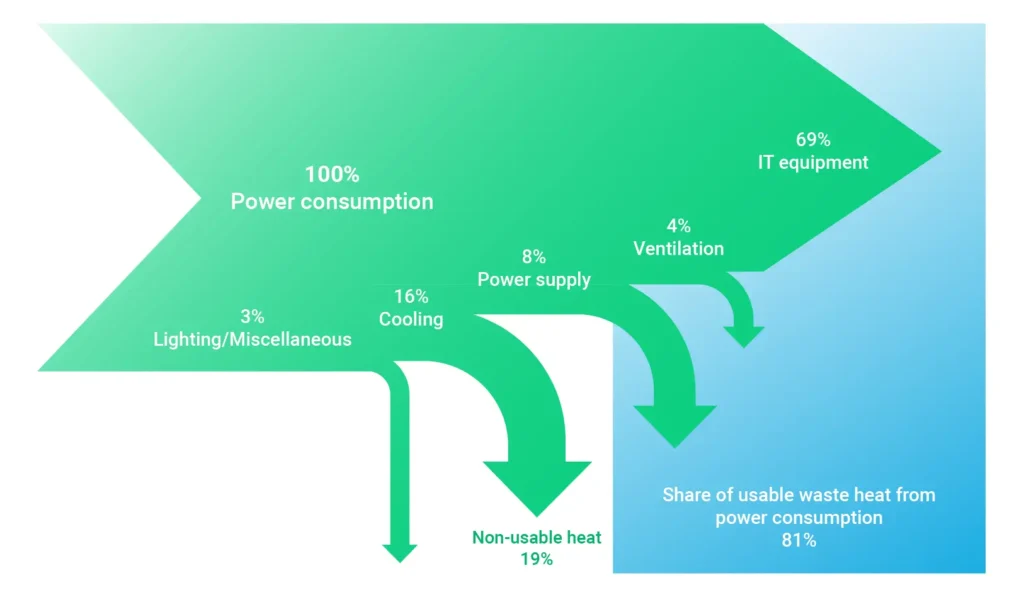
Sixty-nine percent of consumption is attributable to IT equipment, followed by 16% for cooling, 8% for the power supply, 4% for ventilation, and 3% for lighting and other uses. Notably, 81% of the total electricity consumption is converted into usable waste heat, which presents a significant opportunity for efficient heat reuse. Only 19% remains unusable.
How can the energy efficiency of a data center be increased and its operating costs reduced?
The main leverage points emerge from the electricity consumption and regulatory requirements. The most important levers for mechanical, electrical, and plumbing (MEP) and heating, ventilation, and air conditioning (HVAC) engineers are:
- Cooling with maximum efficiency
- Optimizing server and IT infrastructure
- Using renewable energy
- Increasing waste-heat utilization
- Energy management and monitoring
- Further technical measures include modernizing uninterruptible power supply (UPS) and backup systems, as well as integrating photovoltaic (PV) systems and building management systems for load optimization and self-generation.
How can the waste heat of a data center be utilized?
Data centers generate large amounts of heat around the clock from servers and IT infrastructure. Rather than releasing unused waste heat into the environment, it is used for heating and hot water. Data centers can supply residential and commercial buildings with this heat. Modern integrated energy systems allow for the direct or indirect injection of waste heat into heat networks or local heating systems via server waste heat.
How does the technical system for data-center heat reuse work?
First, the waste heat from the servers is extracted from the data center’s internal cooling circuit using heat exchangers. Then, an intelligent control system decides how to handle the heat by continuously monitoring parameters such as:
- The temperature in the data center (i.e., current server cooling demand)
- The temperature level of the extracted waste heat
- The supply temperature of the district or local heat network
- External temperature and forecasts for the heat demand of connected consumers
How can heat pumps be integrated for the waste-heat utilisation of data centers?
Heat Pumps are controlled based on these data. The principle is illustrated by the following example:
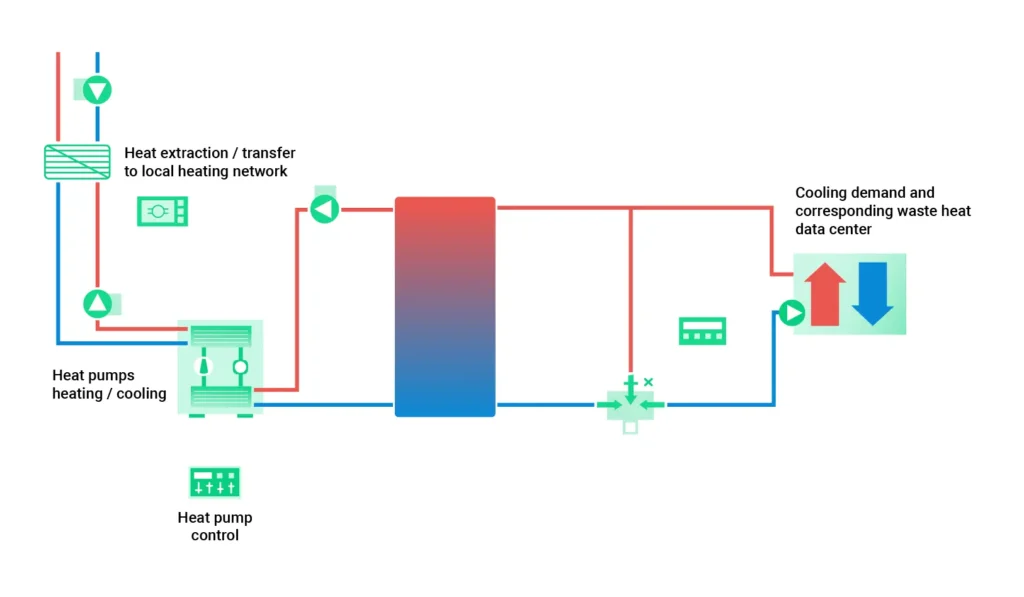
The heat pump(s) in a data center can be controlled based on the following criteria:
- Direct usage of waste heat: If the cooling-water temperature is high enough, the heat is fed into the heat network without intermediary.
- Activation of the heat pump: If the temperature is insufficient, the heat pump automatically activates and raises the temperature to the required supply level.
- Load management: The heat pump runs at high server-load (i.e., high waste-heat) with higher output; at low load it throttles or shuts off to avoid unnecessary electricity consumption.
- External-temperature dependent control: On warm days the heat pump is preferred, providing both cooling for the data center and usable heat for consumers; on colder days excess heat is fed into the network directly without additional pumping.
- Optimization according to electricity prices or CO₂-factor: Modern systems can also consider variable electricity tariffs or the current CO₂ intensity of the grid to operate the heat pump as sustainably as possible.
What are the critical success factors for waste-heat reuse from data centers via heat pumps?
Heat pumps often play a key role in data center heat reuse because they raise waste heat to a usable temperature and can contribute to cooling. However, integrating them must ensure that the demands of the data center and the heat network (or heat end users) are met. Three aspects are decisive: capacity, efficiency (COP), and redundancy.
- Capacity depends on the continuous waste heat stream of the data center and the maximum potential heat demand of the users. Heat pumps are often not sized for the full waste heat load, but rather in a modular fashion (e.g., 30-70% of the total load). Storage solutions (e.g., buffer or ice storage) enable additional load shifting and reduce the required peak capacity of the heat pumps.
- COP (Coefficient of Performance): Efficiency depends heavily on temperature levels. For cold local heat networks or neighbor supply, high COP values (3.5–6) are possible since only moderate temperature increases are required. For traditional district heating networks (60–70 °C), the COP typically decreases to 2.5–3.5, necessitating a careful economic analysis. The seasonal performance factor (SPF) is used to evaluate real operation with varying loads.
- Redundancy: Since IT cooling must never be compromised, the heat pumps must be redundantly designed. The N+1 or 2N principle is often used. If one unit fails, the remaining heat pumps can cover the workload. Additionally, cooling towers or free-cooling systems operate in parallel, ensuring waste heat can be discharged even without heat pump operation. Modular heat pump solutions offer advantages here because individual modules can be shut off during maintenance or failure without endangering the system’s overall function.
How can redundancy and fail-safety of the data center be combined with heat provision?
The fail-safety and redundancy of a data center can be reconciled with heat provision by prioritizing IT cooling and using waste heat recovery as a secondary source. This is technically ensured via hydraulic decoupling, redundant cooling circuits, and automatic bypass and cooling tower/heat exchanger systems. Thus, faults in the heat network do not affect data center cooling. Operational strategies, such as the “best effort” principle, ensure that heat is only delivered when IT cooling is secured. Fallback mechanisms guarantee the safe discharge of waste heat in case of malfunction. Organizational measures, such as defined SLAs, clear supply boundaries, and backup systems on the consumer side, provide additional planning security. Best practice measures include N+1 redundancy for heat pumps, dual return cooling paths, storage integration for load buffering, and continuous monitoring with building management system (BMS) integration.
As a result the IT infrastructure remains maximally fail-safe, while waste-heat reuse serves as a reliable but clearly subordinate energy source.
In practice, the combination of waste heat reuse and high safety standards has only been implemented selectively thus far. Although robust technical solutions are available, they are more prevalent in new builds than in existing plants.
Typical Use-Cases for Data-Center Heat Reuse
Depending on the country and local conditions, the use cases for large data centers vary across Europe. The most common use cases, along with their associated hydraulic schemes and key planning questions, are:
- Data Center District Heating (with heat pump to 60-75 °C)
- Bidirectional cold Data Center district heating networks with decentralized heat pumps (anergy networks)
- Direct supply of neighbors (e.g., swimming-pool, greenhouse, campus)
- Free Cooling Data Centers via external air, lake- or seawater and heat recovery
Data Center district heating (with heat-pump to 60-75 °C)
The data center’s waste heat is fed into municipal or regional district heating systems via a heat exchanger and a large heat pump (temperature lift to 60–75 °C, depending on the network), or cascade heating for higher supply temperatures.
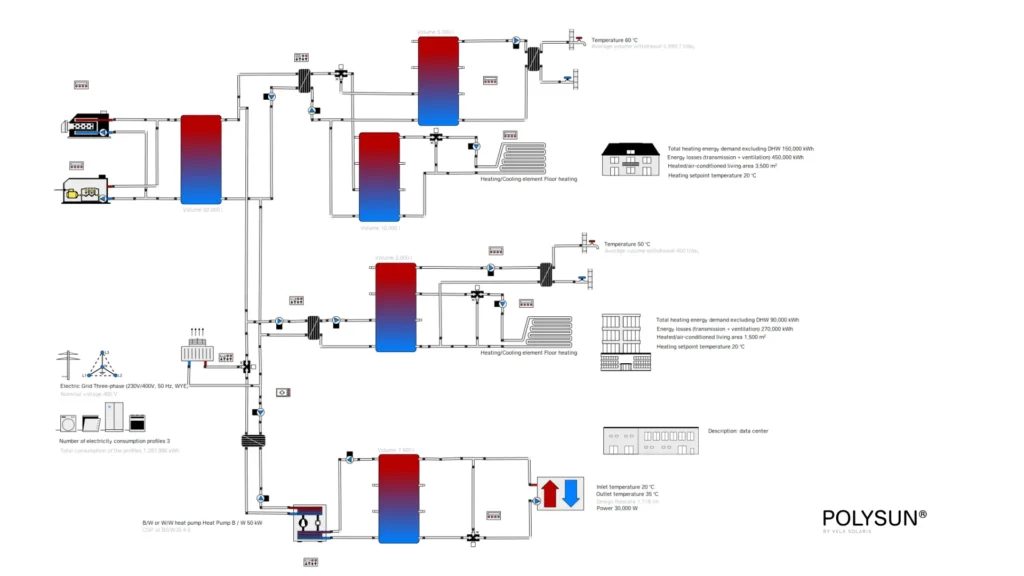
The heat network is fed via a central heat station; in addition the data-center waste heat is injected. When heat demand decreases in spring or summer the data-center waste heat is discharged via an air/water heat-exchanger.
These solutions are ideal for cities with developed district-heating infrastructure, such as in Northern Europe, the Netherlands, Germany, Switzerland, UK and Ireland.
The injection into a local network is sensible, if a network is near the data center (max 1-3 km away), a year-round demand is present, and the network operator uses low return temperatures (< 40 °C) or large heat pumps.
Does the data-center waste heat alone suffice or are heat pumps needed to reach the network temperature?
In most cases, the waste heat from a data center is insufficient to supply a conventional district heating network with water at temperatures between 60 and 70 °C. Therefore, heat pumps or other temperature-elevation methods are usually necessary. Typically air- or water-cooled data centers deliver exit temperatures of about 30–45°C.
What are the investment and operating costs compared with conventional heat-generation?
Economic viability must be assessed on a case-by-case basis. Simulation tools such as Polysun allow you to compare different system variants in the early planning phase. In general: The investment costs of a heat pump solution are usually 5-10 times higher than those of a conventional gas boiler. With a high coefficient of performance (COP) and favorable electricity prices, the levelized cost of heat for injection into a conventional network can be lower than that of gas. Reusing data center waste heat is considered carbon neutral and improves the CO₂ balance. Subsidies may cover up to 40% of investments, significantly improving viability.
Bidirectional cold data center district heating with decentralized heat pumps (anergy network)
The data center feeds its waste heat, which is between 20 and 35 °C, directly into a local heating network. The connected buildings (apartments, offices, schools, etc.) each have decentralized heat pumps that raise the temperature to 45–65 °C locally.
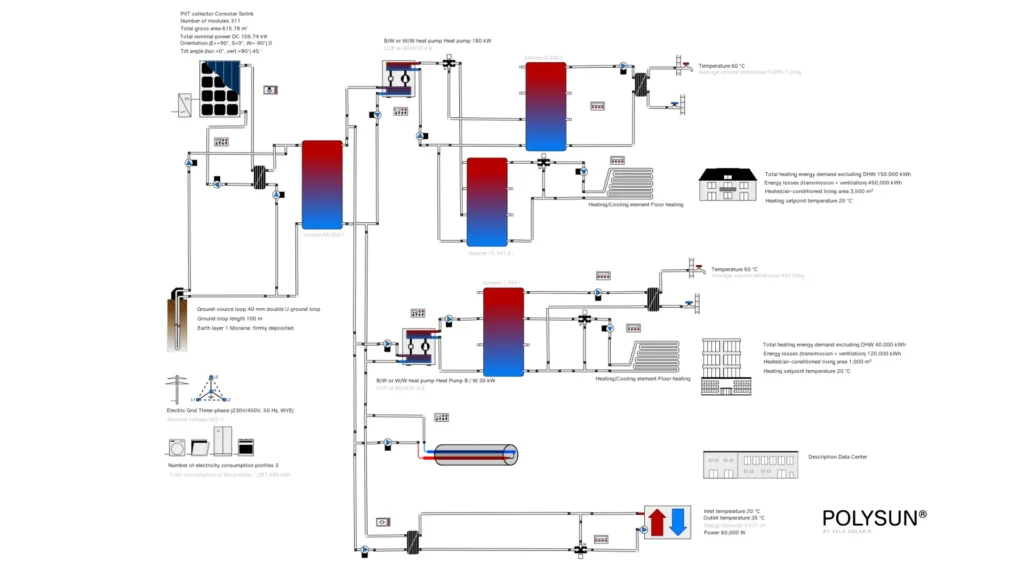
Data center waste heat is used to stabilize and slightly raise the network temperature. In the summer, the buildings can feed excess heat back into the network via the same system. This heat can be used for data center cooling via the regeneration of a borefield, for example, or disposed of via a wastewater heat exchanger. Thus, a bidirectional system emerges.
The advantages are clear. Due to the low temperatures, there are minimal network losses and heat pumps operate at high efficiency. A year-round synergy also arises between the data center and the district.
What interfaces and control strategies are required to flexibly and reliably provide heat and cooling?
Special interfaces and control strategies are required to provide flexible and reliable heat and cooling in a bidirectional local heating network.
A hydraulically bidirectional interface station serves as the primary connection point between the data center and the local network. It is equipped with heat exchangers and valve technology that enable heat injection and cold return. To ensure precise control, sensors that measure temperature, pressure, and flow are installed at various points in the system. These sensors continuously record current values and transmit them to the central control system. Additionally, communication occurs with higher-level energy and building management systems. These systems use weather data and load forecasts to dynamically and efficiently control heat pumps, storage, and the interface station.
Control strategies are often model-predictive, using load and weather forecasts to plan the optimal operation of heat pumps, storage systems, and interface stations. Cooling the data center is prioritized to ensure maximum operational safety. Waste heat is only used when possible; otherwise, the system handles bypass or cooling-only operation. Supply and return temperatures and mass flows are continuously regulated to ensure a stable network temperature. Furthermore, the system is equipped with threshold and fallback mechanisms that automatically switch to conventional cooling or heat sources in case of malfunctions, thus avoiding failures.
These technical interfaces and sophisticated control strategies allow the bidirectional local heating network to efficiently use data center waste heat, buffer load peaks, and ensure a secure and continuous supply of heat and cooling.
Direct supply of neighbors (e.g., swimming-pool, greenhouse, campus)
A data center’s waste heat can be used efficiently on-site, even if there is no local or district heating network nearby. In these cases, heat is delivered directly to neighboring buildings or facilities. This method typically involves a low-temperature ring circuit combined with one or more heat pumps. The heat pump raises the temperature of the data center waste heat to meet user requirements.
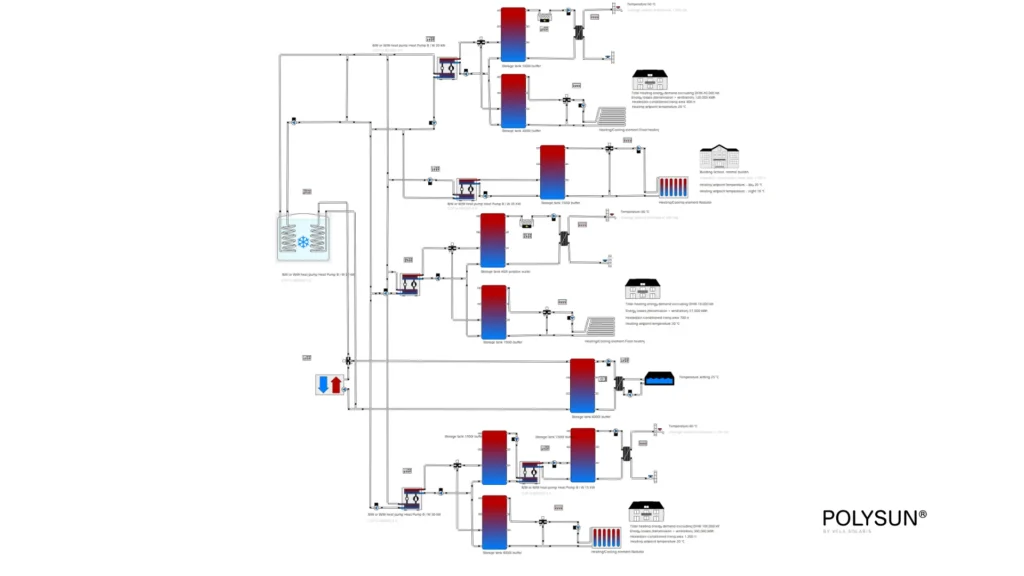
The data center feeds its waste heat into the ring circuit. If the main consumer is a swimming pool, for example, the system diverts excess heat to an ice storage unit. Local heat pumps then use the ice storage as a heat source to supply the remaining buildings. Thanks to the data center’s constant waste heat stream, the ice storage can be designed more compactly and cost-efficiently.
Office complexes and campus solutions are particularly suitable fields. If a data center is located near a university, office park, or government complex, its waste heat can be fed into a local distribution system. There, the temperature is raised to 55–70 °C for use in space heating or hot water supply. This creates a stable, energy-efficient heat supply in a closed area.
Single large consumers can also benefit, including swimming pools, sports halls, event halls, and large retail premises. These facilities have a continuous heat demand throughout the year, especially for hot water supply and large-area heating. A direct connection to the data center provides these facilities with a reliable heat source while making good use of the data center’s waste heat.
Additionally, there are industrial processes in which data center waste heat can be used, such as drying products, heating greenhouses, and aquaculture. These applications require temperatures between 25 and 45 °C. If the temperature of the waste heat is insufficient, heat pumps can raise it to 55–70 °C. This makes it possible to reliably supply even more demanding processes.
Which operational strategy balances peak loads?
Peak loads are balanced through a combination of short-term buffering, predictive operation based on forecasts, and seasonal storage management. Together with flexible heat pump control and backup systems, this creates a robust control strategy that optimally couples the load profiles of the data center and consumers.
In the following a typical control strategy for direct supply of an office complex is described:
- At the short-term level (minutes to hours), buffer storage and intelligent control algorithms are employed. These absorb load peaks by temporarily storing excess waste heat or by activating supplementary heat. The system is often controlled via supply temperature or pressure control and augmented with load forecasts based on weather and consumption data.
- At the mid-term level (day-to-week loads), forecast-based operational management can be implemented to predictively integrate heat pumps and storage. For instance, heat pumps would be operated preferentially during periods of low electricity prices or high waste heat availability, while storage systems would be deliberately charged or discharged.
- The control strategy for seasonal balancing (summer/winter) emphasizes storage management. Large seasonal storage systems (e.g., ice storage, ATES, or pit storage) are continuously charged in the summer to meet the district’s heating needs in the winter.
- Another key lies in hybrid regulation with prioritization. This type of regulation prioritizes the data center’s supply security while flexibly handling waste heat usage for the district. To this end, the operator integrates peak demand boilers or additional heat generators into the district network as backup to cover supply shortfalls in extreme cases.
What business models are feasible (contracting, self-supply, cooperation with utilities/municipalities)?
Depending on the region and project structure, different business models are possible for integrating neighbors into a data center waste heat concept. In Germany, cooperation with municipal utilities is prevalent, as approximately 14-15% of households are connected to district heating networks, which are ideal for integrating data center waste heat. Across Europe, around 43% of district heating volumes originate from renewable sources or waste heat. Contracting models, in which an energy service provider installs and operates the infrastructure and sells heat to district users, are becoming more prevalent, especially in innovative projects or when the data center does not want to assume supply risk. Self-supply by the data center is rare and mainly suitable for compact districts with clearly defined boundaries and short piping lengths.
Free cooling data centers via external air, lake- or seawater and data-center heat recovery
Another way to use data center waste heat is to combine free cooling with heat recovery. Free cooling uses natural cold sources directly, largely avoiding the need for energy-intensive compression chillers. This method is particularly common in Northern Europe, where ambient temperatures are low enough for server rooms to be cooled solely by external air or indirect adiabatic methods for large parts of the year. In such climates, 60-80% of the hours in a year can be covered without the use of conventional compression chillers.
In addition to outside air, water sources such as lakes, rivers, and the sea offer excellent cooling potential. Through hydro-thermal networks, cold water from these natural sources is fed directly into data center cooling circuits. The captured temperature rise can then be used to provide heating for surrounding buildings or entire district heating systems via heat pumps. These coupled systems deliver both cooling for the data center and heat for the city.
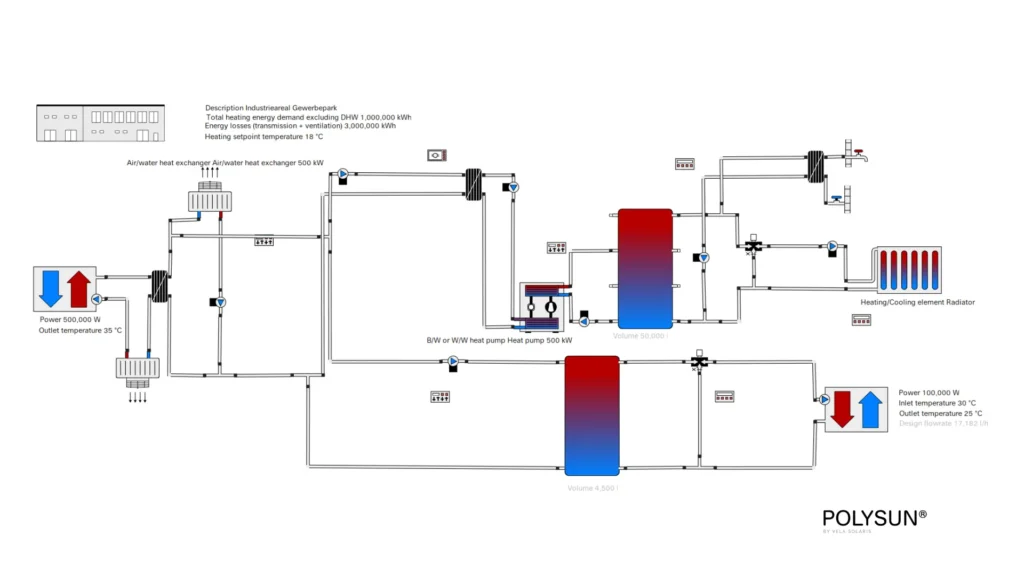
In the above example, the data center is primarily cooled via outside air. Waste heat is used for heating or industrial processes. Any excess heat can also be released from the roof.
How many annual hours are usable for free cooling with air or water?
The effectiveness of free cooling depends heavily on the source and local climate. Outside air can be used for free cooling whenever the air temperature is below the necessary cooling fluid temperature of the data center, which is typically between 18 and 24 °C. Therefore, free cooling by outside air is mainly possible in autumn, winter, and spring, and on cooler summer nights. In Central Europe, this results in an approximate range of 1,000 to 2,000 operating hours per year. However, hot summers significantly reduce usage.
Using lake or sea water as a cooling source is more feasible because the water temperatures are more stable year-round. Cooling is possible as long as the water temperature is below the data center’s desired temperature. Depending on the location, water source type, and flow conditions, an experience range of 3,000 to 4,500 usable hours per year results. Deep sea layers and cold currents, in particular, allow for nearly year-round free cooling.
In terms of heat recovery, only waste heat that can be extracted at usable temperatures can be utilized. This means that heat recovery is particularly efficient in the winter and during the transition months. However, active cooling is usually required during the hot summer months, and the usable waste heat is limited.
Using plant simulation programs adds significant value. These tools allow for the detailed modeling of annual profiles of outdoor temperatures, water source temperatures, data center load, and cooling demand. This enables precise estimation of free cooling operating hours and optimization of storage system, heat pump, and bypass system sizing.
How do the operating costs compare with conventional cooling by compression chillers?
Although operating costs can be significantly reduced compared to mechanical cooling, they depend strongly on the source and the system’s design and utilization.
With outside-air cooling, operating costs are primarily due to pumps, fans, controls, and the occasional mechanical chiller. Since fewer energy-intensive compressors are used, energy savings can be considerable, depending on the location, air temperatures, and data center load.
Additional investment and operating costs arise from lake or seawater cooling due to the need for water pumps, heat exchangers, and piping infrastructure. However, energy consumption is still markedly lower than with mechanical cooling because the cooling source has stable temperatures throughout the year. Studies and case studies show that operating costs can be substantially reduced, especially with deep-sea or river water cooling.
Heat recovery increases economic benefits by using data center waste heat to heat adjacent buildings or districts. This reduces the need for external heat generation and indirectly amortizes the cooling infrastructure. When combined with free cooling sources, the total cost of heating and cooling can be considerably lower than a system based solely on mechanical compression chillers.
How can the system for data-center heat reuse already be optimized in the early planning phase?
Dynamic system simulation allows for the accurate planning and verifiable documentation of data center waste heat projects. With software tools such as Polysun, one can realistically model complex heat pump systems with multiple heat sources, cascade heating, or step boosters. Additionally, one can simulate different storage technologies, control strategies, and connections to local or district heating networks in detail.
We consider not only the technical components, but also dynamic influencing variables such as weather and load profiles, tariff structures, and variable electricity prices. Based on these factors, system sizing, hydraulic design, and control optimization are conducted using reliable, seasonal operational profiles. For example, undesirable start-stop cycles of heat pumps can be avoided, part-load efficiencies can be increased, and energy consumption for pumps and compressors can be significantly reduced. These simulation-supported optimizations allow for reductions in operating costs of up to 40%, for instance, through optimal storage management and predictive operational strategies.
Simulation software like Polysun transparently illustrates CO₂ reductions by showing how waste heat reuse from data centers, combined with heat pumps, reduces emissions. This takes into account the electricity mix used and the heating and cooling systems that are replaced.
More use cases for waste heat utilization can be found on the feature page waste heat recovery
FAQ
How does the reuse of waste heat affect the PUE of the data center?
Operators significantly improve their climate balance by deploying innovative technologies, planning efficiently and optimizing regularly—an essential factor in the fast-changing field of sustainable, cost-efficient IT-infrastructure. Measures such as efficient cooling, precise air-management, virtualization and heat recovery directly impact the reduction of the PUE value.
How is the PUE calculated?
The Power Usage Effectiveness (PUE) is an internationally established metric for evaluating the energy efficiency of data centers. It is calculated by the following formula:
PUE = Total energy consumption of the data center ÷ Energy consumption of the IT hardware.
Total energy consumption encompasses all electrical consumers in the data center — not only the servers but also cooling, lighting, ventilation, UPS, controls etc.
The IT energy consumption includes only the electrical energy used directly for servers, storage and network components.
An ideal PUE value is near 1.0, which means that almost all the consumed energy is used for IT-load. In practice efficient data centers today achieve values between 1.2 and 1.4 depending on location, cooling concept and use of heat reuse.
The utilization of waste heat can impact the PUE indirectly by lowering the cooling demand, or be evaluated by the Energy Reuse Factor (ERF), that designates the fraction of reused energy.
What does N+1-redundancy mean?
N+1-redundancy ensures that if one heat pump fails, the remaining heat pumps can take over operations. Operators additionally deploy cooling towers or free-cooling systems in parallel so that waste heat can still be safely discharged even without heat-pump operation. Modular heat-pump solutions allow operators to shut off individual modules during maintenance or failure without endangering overall function
Image Sources:
1 Rudmer Zwerver, Shutterstock