
Publications
Advanced District Heating Software for Municipal Planning
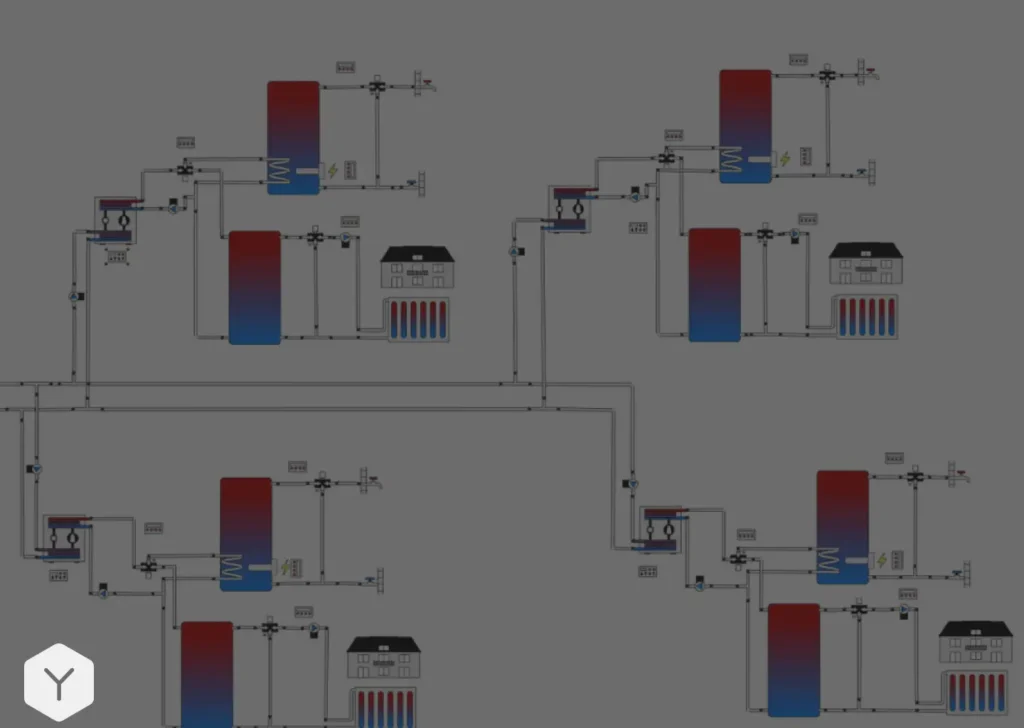
District heating software now forms the backbone of modern, sustainable energy transition projects in municipalities. Towns and cities are legally required to develop long-term heat supply strategies that replace fossil fuels and maximise renewable resources. In the past, such planning relied on static maps and spreadsheets. Today, the complexity of hybrid energy systems and strict regulatory demands mean that robust data analysis, scenario simulation, and powerful digital tools are essential for effective district heating design.
Specialised district heating software enables local authorities, energy companies, and planners to create tailored, sustainable heat supply concepts. These platforms provide accurate, data-driven simulation of multiple heat supply scenarios, supporting strategic supply decisions that balance climate goals, economic efficiency, and long-term resilience. For more on advanced features for district heating and cooling systems, see District Heating and Cooling Systems.
Types of District Heating Software
There are several key categories of district heating software:
- GIS-based planning tools, which visualise geo-data to help identify optimal sites for heat sources, networks, and energy infrastructure.
- Simulation software focused on energy flow, network performance, and assessment of supply scenarios, including renewable integrations and district demand simulations.
- Planning and optimisation solutions, which support strategic decision-making and investment analysis.
- Central data platforms that aggregate energy data for municipal planning.
Benefits of Energy Modelling and Simulation in District Heating Design
Simulation software enables municipalities to model different district heating scenarios, supporting well-informed decision-making. City planners can accurately predict heat demand for in their district heating design, assess both current and potential energy sources, and evaluate the economic efficiency of various supply options. This empowers local authorities to develop heat supply concepts that are long-term, practical, and sustainable.
A district heating software using simulation and energy modelling provides the following advantages:
- Optimised energy supply: The software allows direct comparison of different energy sources such as district heating, heat pumps, solar thermal, or biomass.
- Cost reduction: Simulation helps avoid inefficient investments and identifies the most cost-effective, long-term solutions.
- CO₂ savings: Targeted analysis reveals which measures will achieve the greatest emissions reductions.
- Future-proofing: By modelling a range of scenarios, cities can become more resilient to future energy prices and regulatory changes.
- Transparency and a solid decision-making foundation: Municipalities receive reliable data, supporting fact-based decisions
Comparison of District Heating Software
The following section presents a selection of software tools for district heating design, along with their main advantages and disadvantages.
Polysun
Provider: Vela Solaris AG, Stadthausstrasse 125, CH-8400 Winterthur, Switzerland
Polysun is an advanced simulation software that supports municipalities in analysing different district heating supply scenarios. It enables the detailed modelling of energy flows within local and district heating networks and the integration of renewable energy sources.
| Type | Simulation software |
| Pro | |
| Cons |
Greenventory
Provider: Greenventory GmbH, Georges-Köhler-Allee 10, 79110 Freiburg, Germany
Greenventory combines GIS technology with energy data analytics to provide municipalities with a visual platform for heat supply planning.
| Type | GIS-based analysis and planning software |
| Pro | |
| Cons |
INFRA
Provider: LBD-Beratungsgesellschaft mbH, Mollstraße 32, 10249 Berlin
INFRA is designed for planners, consultants, utilities, and network operators, offering planning and analysis in line with current regulatory requirements. Its geo-data-based algorithms create a digital twin down to building level for reliable decision-making on investments and deployment strategies.
| Type | Planning and optimisation software |
| Pro | |
| Cons |
Hotmaps Toolbox
Provider: EU Project
The web-based HOTMAPS tool quantifies and visualises energy demand, calculates heat network economics, and analyses trends in energy consumption and renewables.
| Type | GIS-based analysis and planning software |
| Pro | |
| Cons |
ENEKA.Energieplanung
Provider: ENEKA GmbH, Germany
The GIS tool ENEKA.Energieplanung supports spatial analysis and planning of energy infrastructure. It enables determination of energy demand, renewables potential, and heat network optimisation.
| Type | GIS-based energy planning software |
| Pro | |
| Cons |
Gaia
Provider: enersiseurope GmbH, Switzerland
The GIS tool Gaia visualises and analyses energy and climate data. It’s designed to help cities and utilities plan decarbonisation strategies, optimise networks, and identify savings opportunities.
| Type | GIS-based software for energy flow visualisation |
| Pro | |
| Cons |
SOPHENA
Provider: C.A.R.M.E.N. e.V., Deutschland, Germany
Sophena is a free open-source software tool for the technical and economic planning of heating plants and district heating networks. The software primarily targets municipalities, energy consultants, and engineering offices and focuses on system design, cost-efficiency analysis, and emissions assessment.
| Type | Simulation software |
| Pro | |
| Cons |
Fluidit Heat
Provider: Fluidit Oy, Finland
Fluidit Heat is a high-performance simulation software designed for comprehensive, year-round modelling of district energy networks. It supports optimization of energy consumption, supply temperature management, and demand flexibility with detailed dynamic simulations.
| Type | Simulation software |
| Pro | |
| Cons |
Leanheat Network
Provider: Danfoss, Denmark
Leanheat® Network combines thermo-hydraulic modelling and AI-based forecasting to optimize district heating network operations. Key features include hydraulic and thermal condition simulation, supply temperature optimization, and high-precision weather forecasting.
| Type | Simulation and operational optimization software |
| Pro | |
| Cons | |
Sweco District Heating Solutions
Provider: Sweco Group, Sweden / UK
Sweco offers consultancy-backed software and services for district heating master planning, network optimisation, feasibility studies, and design implementation, with a focus on urban energy systems.
| Type | Planning software & services |
| Pro | |
| Cons | |
Conclusion from the software comparison
The comparative analysis of district heating software reveals a diverse range of tools tailored to different planning and operational needs. Simulation-focused tools like Polysun and Leanheat offer detailed dynamic modelling essential for optimising complex heat networks, while GIS-based and planning-oriented platforms such as Greenventory and INFRA excel in spatial analysis and strategic decision-making. Selecting the right software depends on project scale, technical expertise, and goals—whether prioritising deep simulation capabilities, comprehensive data integration, or user-friendly interfaces. Overall, leveraging specialised district heating software empowers municipalities and energy providers to design robust, cost-efficient, and carbon-reducing heat supply systems aligned with evolving regulatory demands and climate targets.

What features exist in Polysun to support district heating design?
Polysun also supports the design of district heating and cooling systems, enabling planners to model more advanced network types.
It supports low-temperature systems (4th and even 5th generation), where heat is transported at ambient temperatures, significantly reducing losses. The software allows combining different generation components (e.g., heat pumps, geothermal probes, CHP, waste heat, solar) in a central energy centre to optimise performance. Virtual testing of control strategies lets you simulate how the system reacts under different load patterns—optimising for cost, efficiency, and CO₂ emissions.
It also computes heat losses in distribution pipes, which is essential for designing an efficient district heating network. Multiple system variants can be compared to find the best configuration; e.g., different combinations of generation, storage, and control.
The software supports CO₂-emissions calculations, helping to evaluate how different designs contribute to decarbonisation. Economic analysis is integrated too: the tool helps to find the most cost-efficient solution by considering investment, operation, component lifetimes and possible funding.
How Polysun Supports All Project Stages to Maximise Efficiency and Savings
Simulation software such as Polysun is invaluable throughout all stages of a district heating project—from early-stage feasibility studies and preliminary design, through to detailed engineering and implementation. In the initial concept phase, it models and compares multiple heating scenarios, helping planners identify the most sustainable and cost-effective options. During detailed design, Polysun simulates energy flows, heat losses, and system controls to optimise network performance. Finally, during implementation, the software supports virtual commissioning and operational strategy testing, significantly reducing the risk of costly adjustments onsite. This end-to-end digital approach not only improves decision-making quality but can also reduce project time and costs by up to 20%, accelerating the path to resilient and efficient district heating systems.
What is the most important capability to look for in district heating design software?
The most essential capability is accurate energy-flow simulation. District heating projects depend on precise modelling of heat generation, storage, distribution, and consumer demand. Polysun excels here by providing high-resolution, time-series simulations that reflect real operating conditions—offering a far deeper understanding of system performance than static planning tools or GIS-only platforms.
How does Polysun compare to GIS-based tools such as Greenventory or Hotmaps?
GIS tools are excellent for spatial planning and identifying suitable zones for district heating, but they lack detailed thermo-hydraulic simulation.
Polysun complements GIS tools by providing:
– Dynamic simulation of heat supply systems
– Evaluation of different generation technologies and control strategies
– Heat-loss calculations in distribution networks
– CO₂ and economic analysis
Many organisations use GIS tools for the early mapping stage and Polysun for the engineering and optimisation stages.
What benefits does Polysun offer for municipal feasibility studies?
Municipalities typically need to assess multiple strategic options quickly. Polysun offers:
– Rapid modelling of district heating concepts
– CO₂-reduction potential assessment
– Cost comparison for investment and operation
– Validation for funding applications or political decision-making
– Transparent documentation for public stakeholders
It is particularly valuable in early heat-transition planning phases.
Is Polysun suitable for TGA/MEP engineers working at the building level?
Yes. Polysun is widely used by engineering consultancies for:
– Detailed building-level demand modelling
– Heat-interface unit (HIU) modelling
– Integration of decentralised heat pumps
– PV, PV-T, and solar thermal evaluation
– Hybrid system design
This allows TGA/MEP engineers to connect buildings seamlessly to a district heating system and evaluate their impact on the network.