

Efficient calculation of district energy systems
Heat network simulation enables accurate design and sizing. Modeling allows different scenarios to be considered and the effects of different operating configurations and environmental influences to be predicted. This leads to better use of resources and increases the efficiency of the overall district energy system.
What are the different types of district heating networks?
A district heating network is an infrastructure that transports heat in the form of hot water or steam from a central source to various consumers such as residential buildings, industrial plants or office buildings.
It is an efficient way to provide heating and cooling to multiple buildings or facilities without each one requiring its own generation plant. There are several types of heating networks, depending on requirements and technology. Here is a selection:
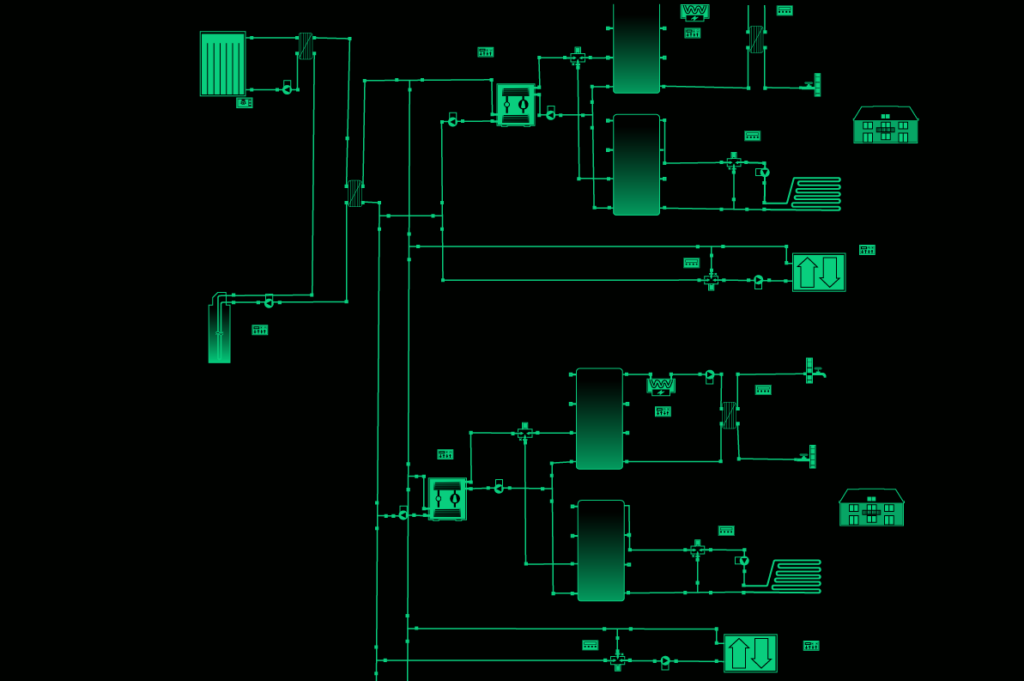
District Heating (1st – 3rd Generation)
1st to 3rd generation district heating are probably the most common types of heating network. Heat is usually transported at a high temperature level from a central source (e.g. combined heat and power, biomass cogeneration or waste heat from industrial processes) to consumers via insulated pipes.
These networks are particularly common in urban areas and in some cases have been in use for decades.

Low Temperature District Heating
Low Temperature District Heating and Cooling, also known as 4th and 5th generation district heating (and cooling) uses a similar infrastructure to district heating, but the transport medium is at low to ambient temperatures instead of hot water.
The heat is provided locally in the buildings by heat pumps or other heating technologies. This significantly reduces heat losses through the pipes.
Process Heat
Process heat refers to heat flows needed in industrial production processes. These heat flows can be provided directly or through a heat network.
In many cases, industrial waste heat sources are used to increase energy efficiency and reduce CO2 emissions.
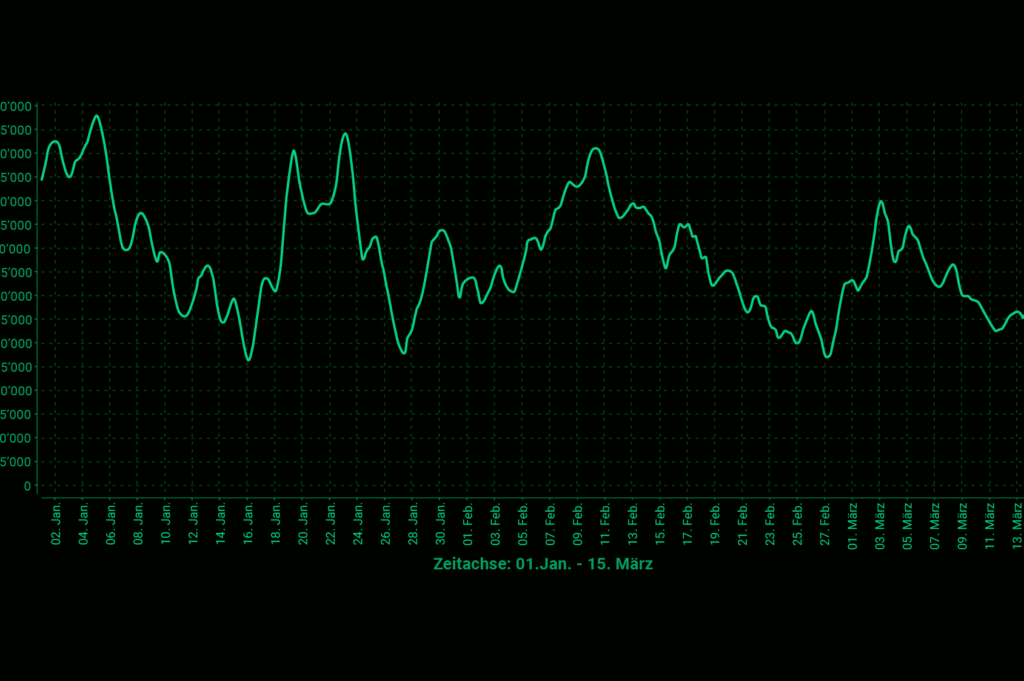
Demand Planning for Heat Supply – Different Consumer Profiles
Demand planning is a central element in the planning of heating networks. It takes into account the different consumption profiles of the connected buildings or industrial plants, which can vary depending on the season, time of day and usage. A precise analysis of consumption patterns can be used to develop customized heat supply solutions that meet both capacity and flexibility requirements.
It is not unusual that at the beginning of a heating network project little information is available about the consumers. Simulation can be used to test initial design ideas based on assumptions. Later on in the project, the input of consumption data makes the operational management and sizing of the heat generators more precise.
The energy center – the heart of district heating

An optimal district heating network requires a sophisticated combination of technologies and components. Heat generators are installed in the energy center and optimally coordinated with one another. All common technologies can be combined and optimized in Polysun, including:
- Hybrid Solar Panels (PV-T): These systems combine the generation of electricity through photovoltaics with the supply of solar heat. They are particularly useful in integrated systems with heat pumps and can reach their full potential in district heating networks.
- Heat pump: Extract heat from eg. the air, geothermal probes or groundwater. Heat pumps are very efficient and can be used in almost all regions and at all temperature levels.
- Geothermal probes: These geothermal probes extract heat from the earth and are an attractive solution, especially in areas with constant temperature conditions.
- Combined Heat and Power Plants (CHP): These components generate electricity and heat simultaneously by burning gas or biomass. They are an ideal solution for centralized heat supply and help reduce CO2 emissions.
- Waste Heat Recovery: Waste heat from industrial processes can be efficiently integrated into the heating network to make the most of the energy source.
Why customers use Polysun software to design district heating networks

System Integration made easy
- Integrating sustainable power generation directly into the heat generation plants
- Optimizing the design of all components in the sytem
- Determining the most economical operating mode

Design Hybrid Systems
- Integration of geothermal and solarthermal energy
- Combination of several sources for heat pumps for best efficiency
- Bivalent or multivalent systems with heat pumps and boilers

Test Control Strategy Virtually
- Sophisticated control and regulation concepts can be considered in the system simulation
- Timestep-analysis allows detailled insight as early as possible and helps to determine errors

Saving Time
- Quick comparison of different system solutions
- Continuous working throughout all phases of the project
- modular systems with a level of detail according to given information
Professional Basis for Funding and Tenders
- validated models provide transparent results
- aggregation of all input data and parameters in only one fileDatengrundlagen in einer Datei
- easy-to-read results
Further Options
- consider special local requirements such as:
- regeneration ratio of seasonal storages
- limited permit of operation during night times
- compliance of temperature-boundary-conditions
Virtual Testing of Control Concepts
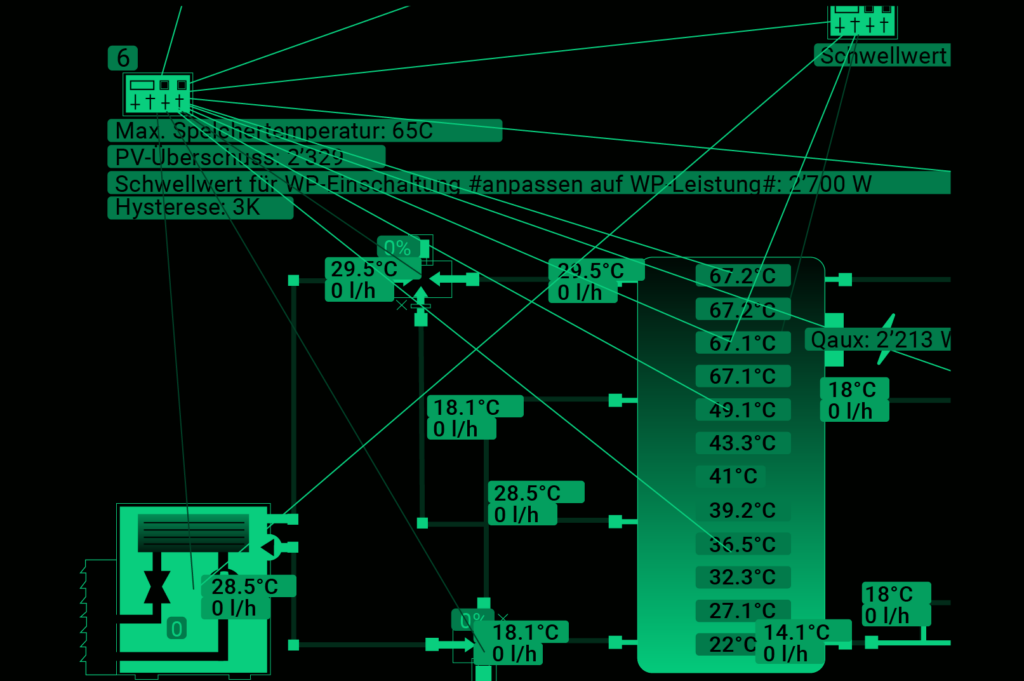
In a Polysun simulation, the control and regulation of the individual generator components can already be tested and optimized. This means that all components of a district heating network, such as heat generators, storage and distribution systems, can be virtually connected and tested in different scenarios. Thereby the optimal control strategy can be developed, which adapts the operation of the heating network to different loads and conditions and uses synergy effects to reduce operating costs.
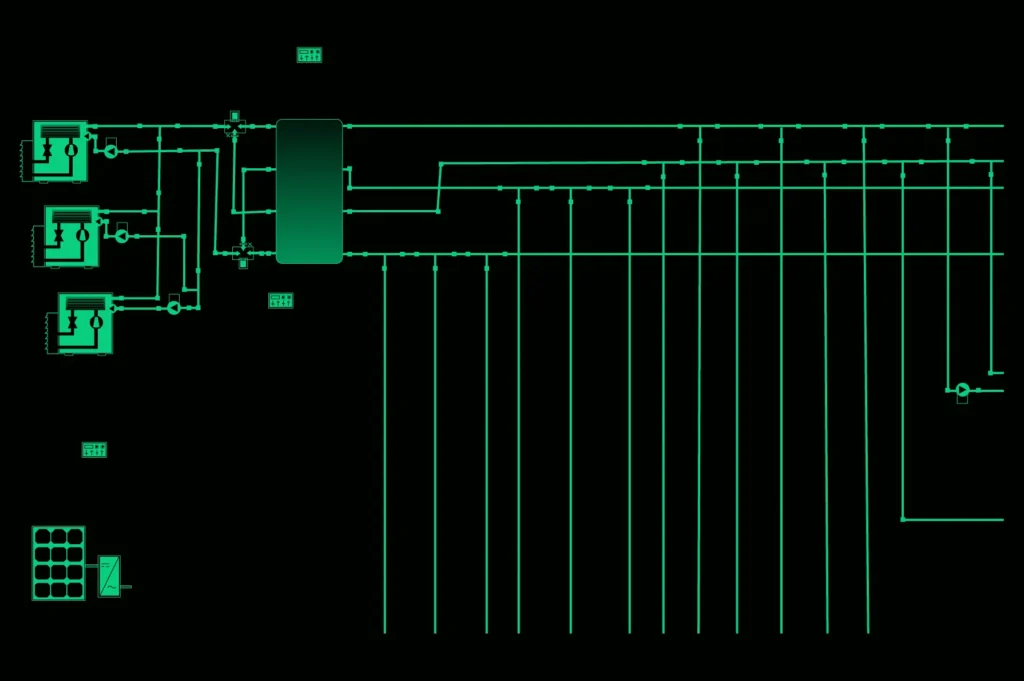
Calculation of heat loss through pipes – why is it important?
Calculating heat losses in the pipe network is essential for maximizing the efficiency of a heating network. Heat losses are caused by heat radiation to the surrounding ground during the transport of thermal energy. By calculating and optimizing pipe losses, losses can be minimized, making the energy supply more cost-effective and environmentally friendly.
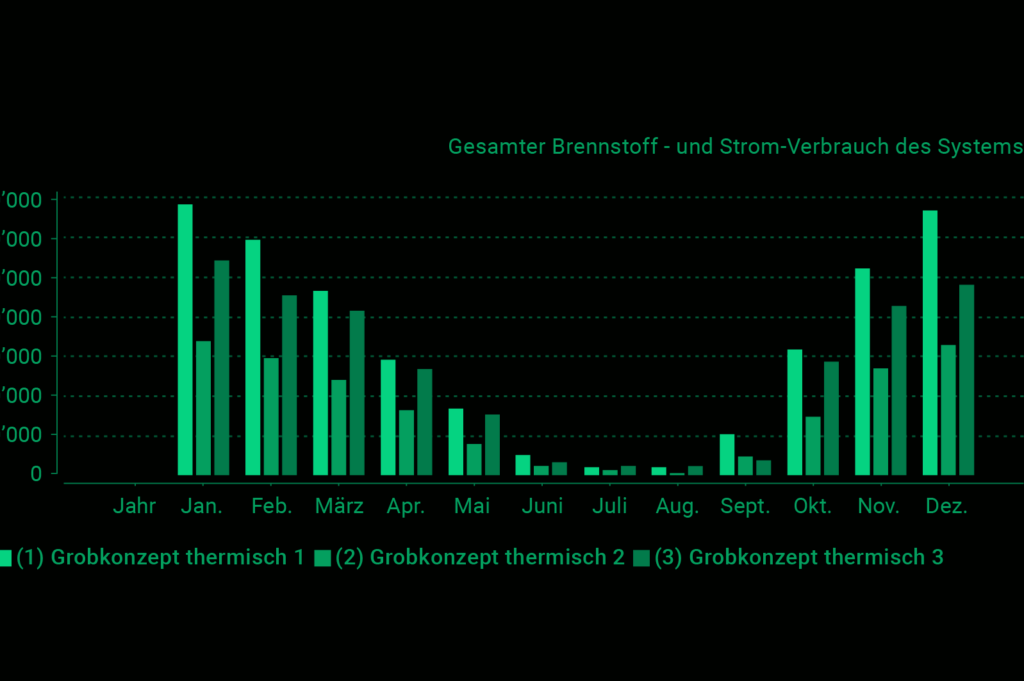
Comparison of different system variants
Technical system comparison helps to verify the efficiency, robustness and dimensioning of different system configurations and components. Multiple combinations of heat generators, piping infrastructure and control systems are compared to find the most appropriate solution for the project. Comparison of new construction versus renovation of existing networks can be considered.
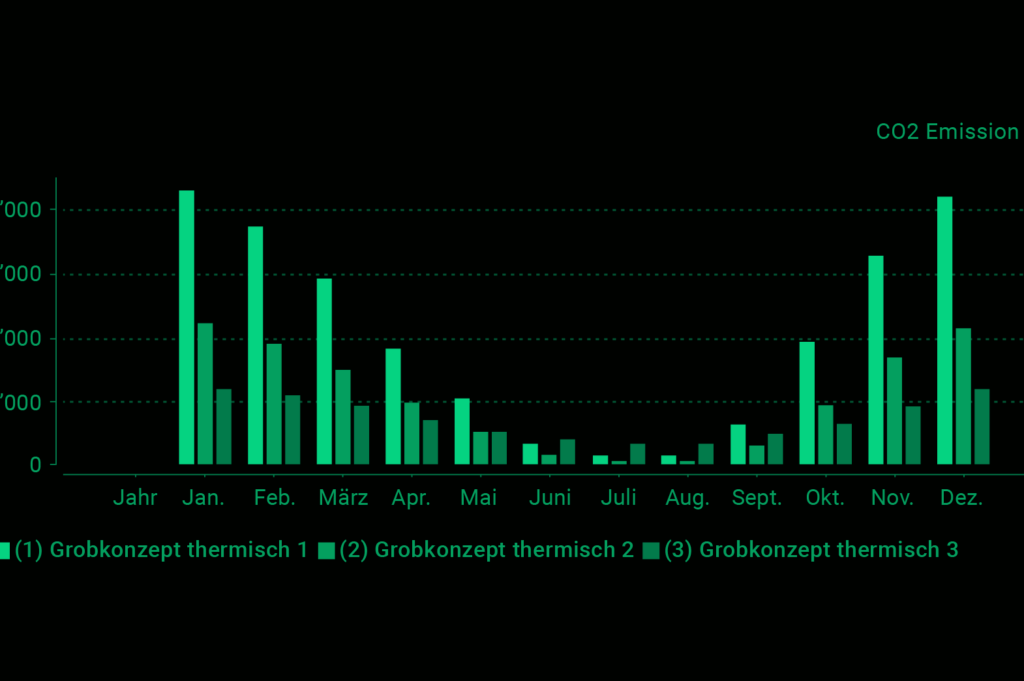
CO2– emission reduction in district heating
The decarbonization of heating networks is at the heart of an environmentally friendly energy supply. CO2(eq)- emissions can be significantly reduced through the use of renewable energies such as solar thermal, geothermal or PV electricity, as well as the use of waste heat from industrial processes. The combination of efficient thermal storage and intelligent control systems can further reduce CO2 -emissions while ensuring security of supply.
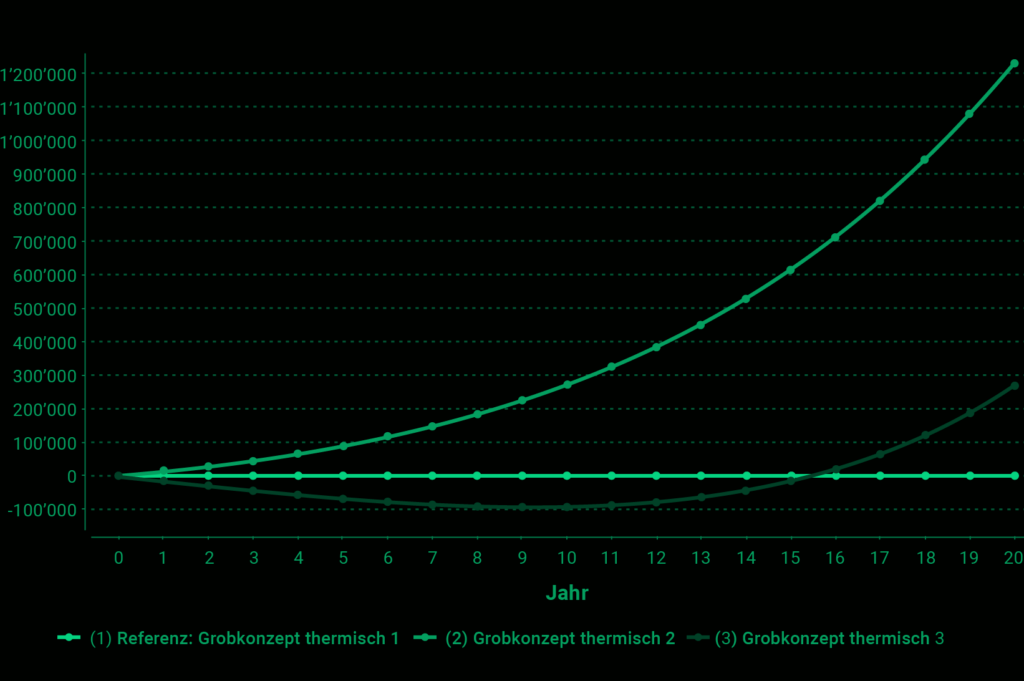
Economic efficiency of district energy systems- How to find the optimum?
The economic viability of district heating depends on various factors, such as investment costs, operating costs, the service life of the components and the expected revenue. In order to find the optimum solution, all relevant variables must be taken into account and a detailed comparison made between the different solutions. A precise analysis of the economic viability, taking into account CO2 -emissions and energy savings, is essential to ensure the long-term profitability of a heating network. In addition, funding opportunities and legal framework conditions must be included in the calculations.
FAQ
How to determine the primary energy factor for the district heating system?
A Polysun simulation provides all relevant results to easily calculate the primary energy factor for the energy mix of the heating network. Different specifications for the individual primary energies can be taken into account.
What is the simulation time for a district heating network in Polysun?
Polysun is particularly characterized by the fact that simulation results are available within a very short time. Compared to simple and small systems, the simulation time for district heating networks is slightly longer due to their complexity – however, the results are usually available within a few minutes. The calculation time can be influenced by the complexity of the energy system, the dimensioning and control of the components, and the hardware characteristics of the computer.
How can I get supported in learning how to use Polysun efficiently?
Depending on your level of knowledge and experience with Polysun, we offer individual support and training. Particularly in the case of complex energy systems such as heating networks, we leave it up to you to decide to which extent you would like to take advantage of our support – get in contact!
Are there references where Polysun is used for district heating design
There are many references where many engineering offices successfully use Polysun for district heating design, for example, in local district heating projects or urban district heating projects. Just contact us and we will provide you with additional insights and find a solution for your problem.