
News
Heat pump control: Which settings and components optimize the combination with photovoltaics?
The combination of heat pumps and photovoltaic (PV) systems offers great potential for reducing electricity consumption and increasing energy efficiency.
The heat pump converts the self-generated photovoltaic electricity into useful heat. For the heat pump sizing, the control of the heat pump is the key factor in reducing the consumption of electricity from the grid, thus reducing the annual operating costs. How can self-consumption, grid consumption and costs be optimized?
On behalf of SwissEnergy, Prof. Dr. David Zogg of Smart Energy Engineering GmbH investigated the topic of “Optimal control of heat pumps in combination with photovoltaics”. In practical projects, different heat pump control systems were examined to see how they can be optimized and what is technically possible today. Over the course of the year, the various options for controlling the heat pump were modeled using the Polysun heat pump design and simulation software. The results and findings were presented in a webinar and are summarized in this blog post.
Importance of the heat pump control
The heat pump control system plays a critical role in the efficiency and economy of the entire heating system. An optimized control system can significantly reduce electricity consumption, thus helping to achieve climate targets and counteract rising electricity prices. According to the Swiss Federal Office of Energy, around 600,000 heat pumps are expected to be installed in Switzerland by 2030, almost doubling the current number. Germany’s ambitions are even higher, with more than 6 million heat pumps installed.
Solar panel heat pump control: What options are available in practice today?
The hydraulic scheme below with the corresponding controllers was used to model the different heat pump control systems. The results of the different options for controlling heat pumps with photovoltaics are visualized using a reference period from the simulation in Polysun. The model is based on the practical examples presented in the webinar. The model contains programmable controllers for controlling the heating, domestic hot water, which controls the heat pump, and a controller for the mixing valve (heating controller). These controllers have been programmed differently to model the different variants.

Model for planning and optimizing the heat pump control
Heat pump control: Option no optimization
.

Heat pump control without optimization. Hot water production takes place during the day
The solar system and the heat pump are not connected by a control system. This means that the use of the heat pump cannot be synchronized with the availability of solar energy and therefore cannot be optimized in terms of self-consumption of photovoltaic electricity.
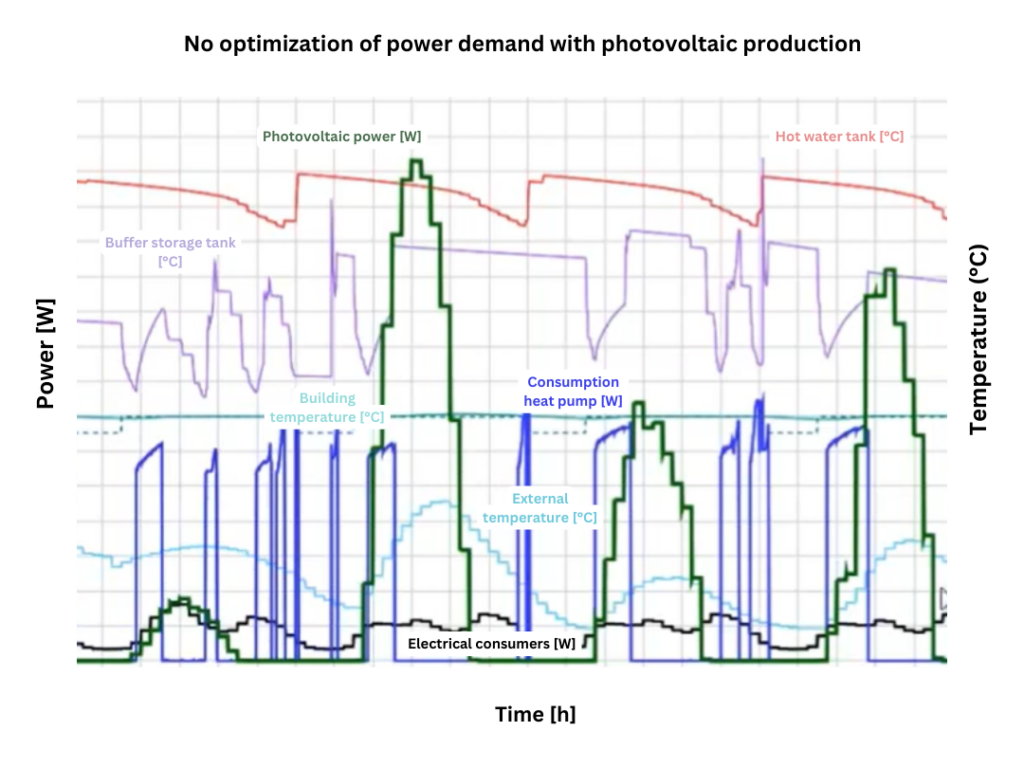
Heat pump control without optimization: Example simulation in Polysun, where electricity consumption of the heat pump (blue) is not optimized with production of photovoltaic power (green curve)
As an additional variant, an example with an additional battery is shown in the webinar. This battery is charged when solar energy is available and is usually immediately discharged by the heat pump in the evening. In practice, there are many examples of batteries that can only buffer a small amount of energy for the heat pump. This is because the possible battery size is often limited in practice. On the one hand because of the amount of excess electricity produced and on the other hand because of the many bad weather days when the battery cannot be charged. A heat pump requires a relatively constant amount of electricity.
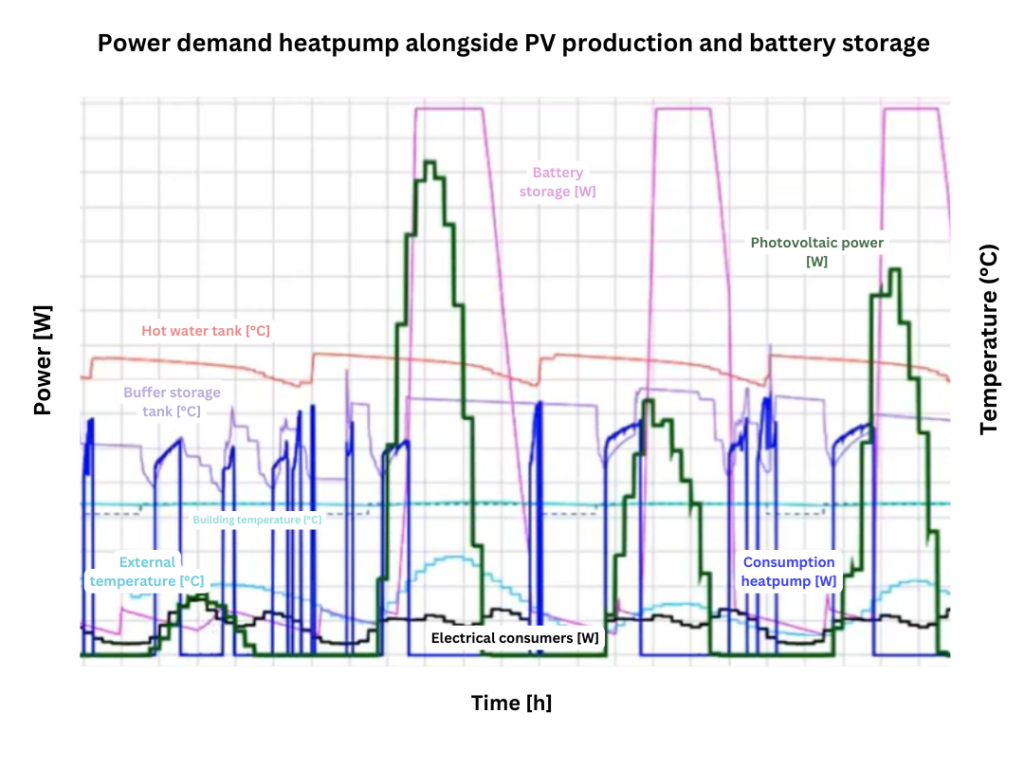

Automatic optimization option with daytime temperature increase of buffer tank, hot water tank and heating
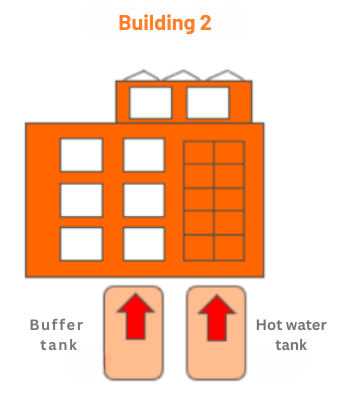
Heat pump control: Illustration of the control daytime temperature increase of the buffer tank, hot water tank and room temperature
By increasing the temperature in the buffer tank, the energy consumption of the heat pump is optimized with the energy generation from the photovoltaic system.
This requires at least two types of thermostats. There should be a programmable thermostat on the radiator and a termostat to control the room temperature. This allows the room temperature and buffer tank to be programmed during the course of the day. This system is cheap to implement, but on days with low solar radiation, without an intelligent system, the heat pump will consume a lot of energy due to the lack of solar power.
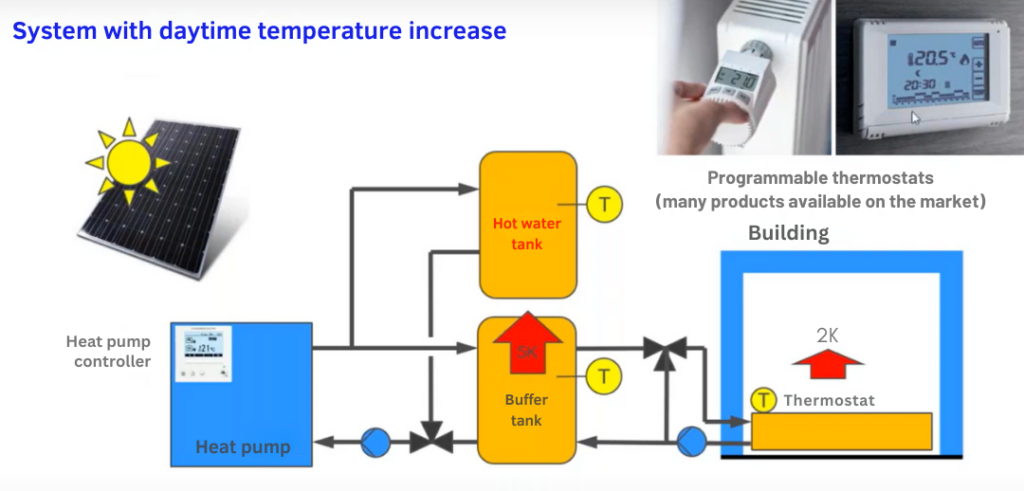
Control diagram daytime temperature increase of the buffer tank and room temperature.
Today’s standard is heat pumps with the SG-Ready option. The heat pump is connected to an energy manager. This allows the temperature of the buffer tank or hot water tank to be intelligently controlled depending on the solar power generation. The mixing valve ensures that the temperature in the building does not become too high. The SG-Ready interface recognizes 4 operating status: blocked operation (mode 1), normal operation (mode 2) encouraged operation (mode 3), and ordered operation (mode 4). Further information can be found in the webinar.
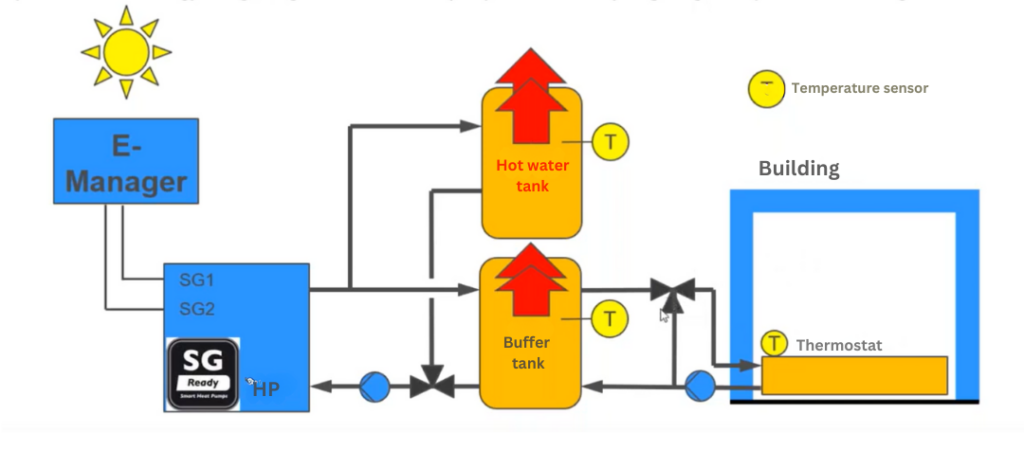
Heat pump control with SG-Ready interface for temperature increase of buffer tank, hot water tank using photovoltaic energy
On days with high electricity generation from photovoltaics, the storage temperature is increased. The storage tanks empty quickly when energy is required for the heat pump at night. The storage capacity of the technical storage systems is limited as the storage tanks are relatively small. This is shown in the simulation below.
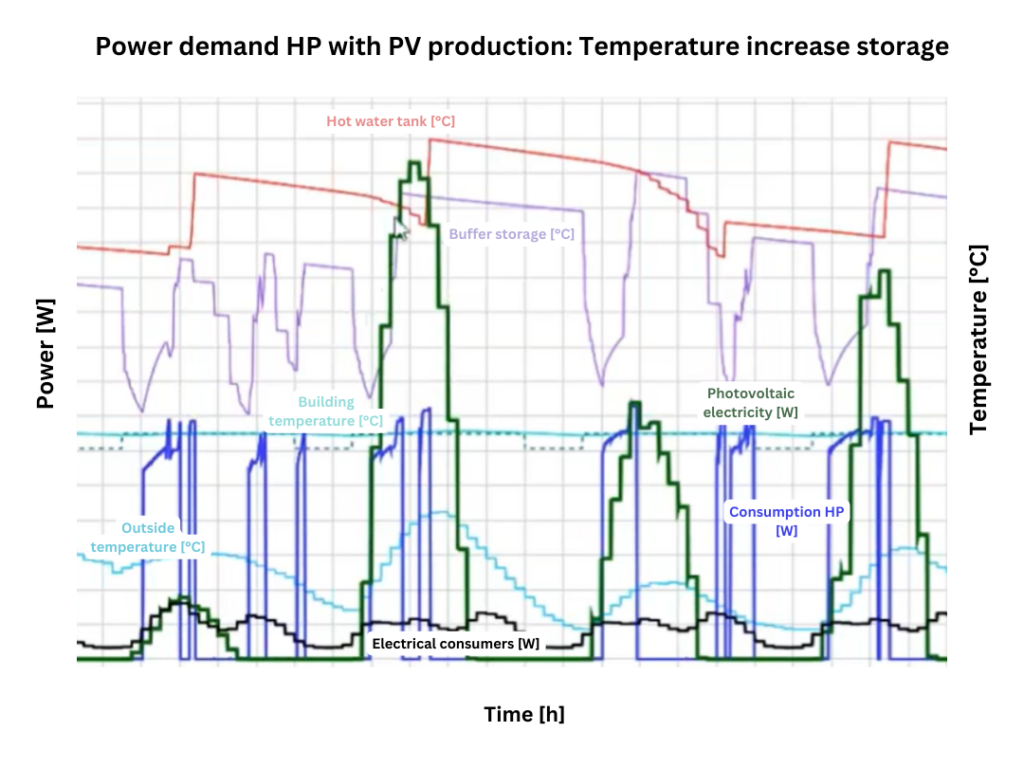
Heat pump control with SG-Ready interface: Example simulation in Polysun, where the temperature of the buffer tank (purple) and the hot water tank (red) is increased on days with higher photovoltaic production (green curve).
In addition to increase the temperature of the technical storage units, a battery can be added and intelligently controlled by an energy manager. This means that after the temperature of the technical storage unit has been raised, the excess electricity production from the PV is stored in a battery. The energy manager must include a battery storage system or a battery storage system must be retrofitted, which is relatively expensive.
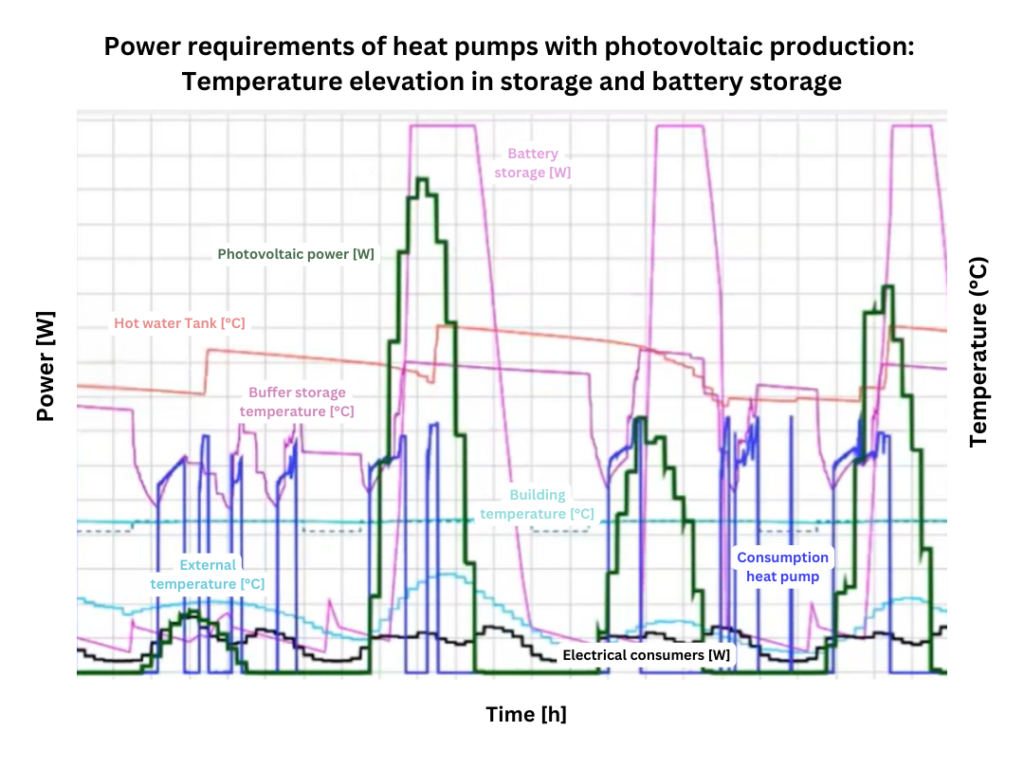
Example simulation in Polysun, where the temperature of the buffer storage tank (purple) and the hot water storage tank (red) is increased with higher photovoltaic production (green curve). The excess photovoltaic electricity is stored in a battery
The battery is discharged by the normal household electrical consumption, but not by the heat pump, as the buffer storage tank has been increased.
When is a PV-heated electric immersion heater worth considering for domestic hot water?
The basic idea is that the electric immersion heater is additionally switched on during periods of high photovoltaic electricity production.
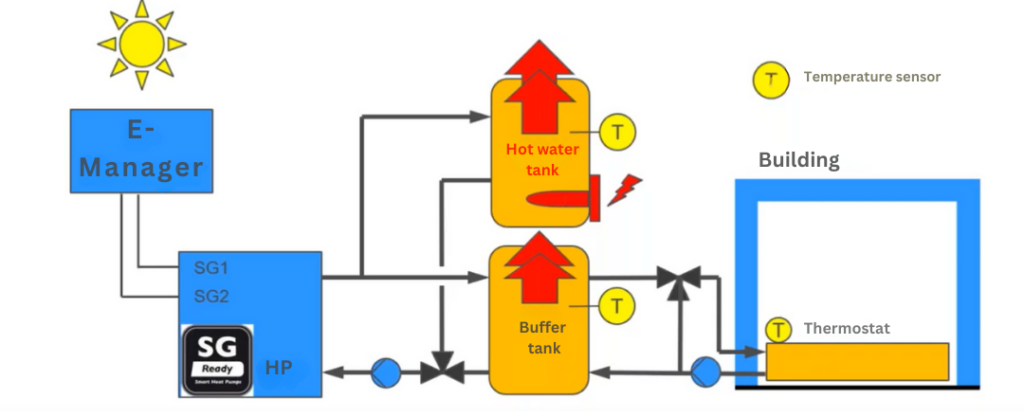
Control unit with SG-Ready interface to raise the temperature of the buffer tank, hot water tank using photovoltaic energy Additional electric immersion heater for further use of photovoltaic electricity
The use of the PV immersion heater raises the temperature even further. If a heat pump is used at the same time, the use of an electric immersion heater is of no benefit in most cases, as the higher temperature causes more losses and the immersion heater is three times less efficient than the heat pump.

Heat pump control: option for complete thermal management of the entire building
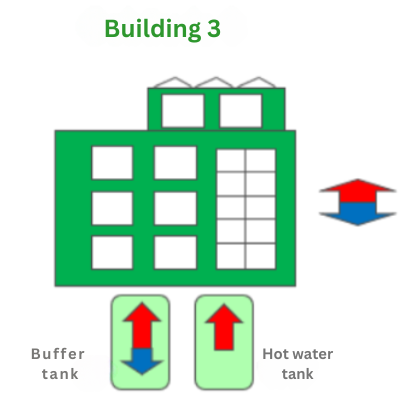
Control system with complete thermal management of the entire building
Lowering the flow temperature of the heat pump at night to reduce consumption no longer makes sense in modern, well-insulated buildings. The flow temperature of the heat pump and the storage temperature are now raised during the day for two reasons. On the one hand, to increase self-consumption of the electrically produced photovoltaic electricity and, on the other hand, air heat pumps have a higher outside temperature during the day, which increases efficiency. This daily increase can be programmed to be fixed or intelligently variable depending on the electricity production from photovoltaics.
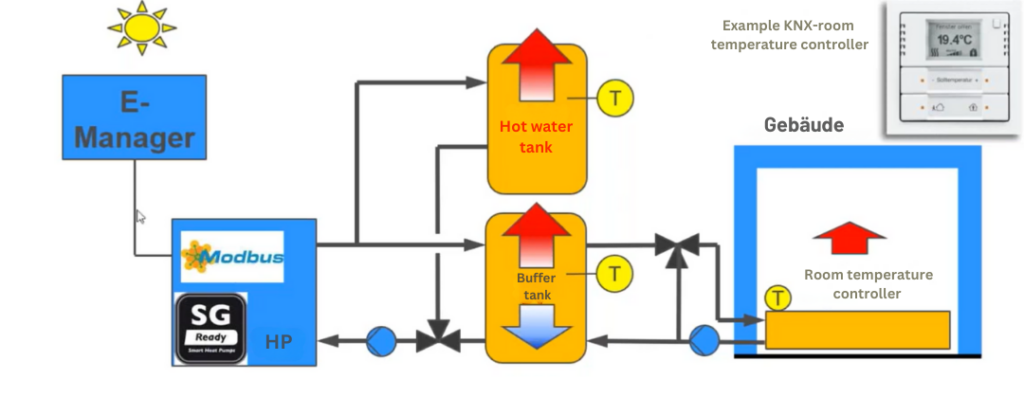
The heat pump can be variably controlled and the heat pump is speed-controlled. There is a room temperature controller that is connected to the energy manager (BUS). This enables active temperature management, as the energy manager influences the target temperature in the building and monitors the temperature curve.
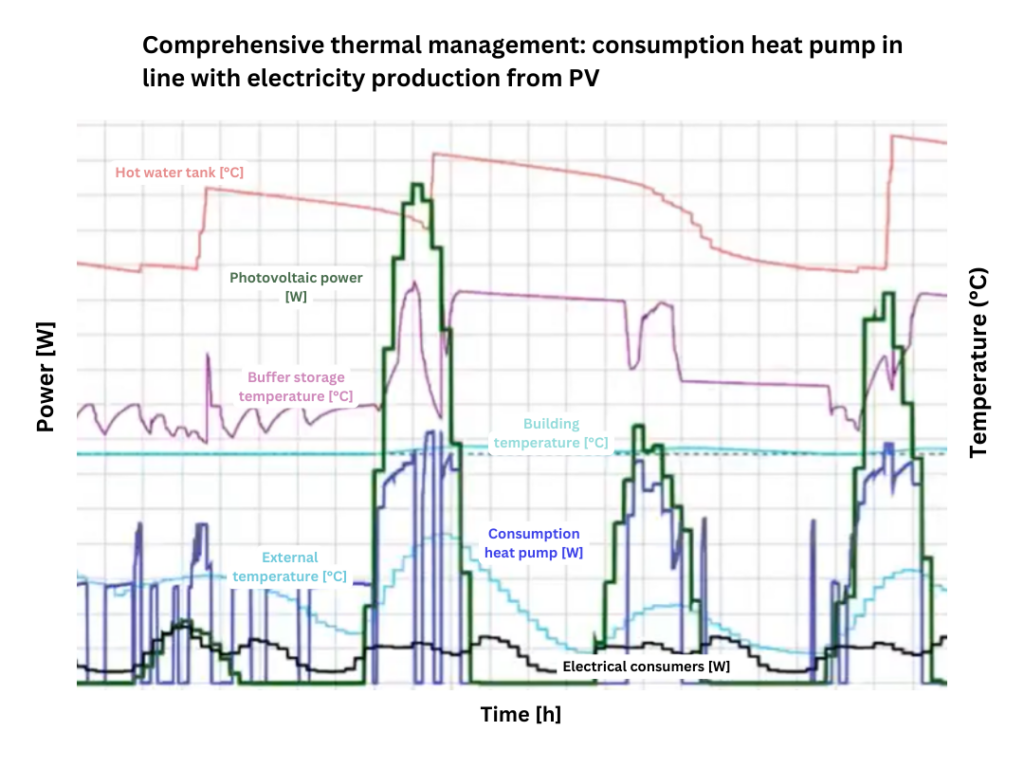
Example simulation in Polysun, where photovoltaic electricity production and heat pump electricity consumption are perfectly coordinated with complete thermal management by storing energy in the building.
The heat pump runs longer during the day and shorter at night. When photovoltaic electricity production is higher, the room temperature is slightly increased by 1 degree (turquoise). The output of the heat pump is greatly reduced on days without a PV surplus, as the energy stored in the building can be used. Inverter heat pumps can be operated at a greatly reduced speed on bad weather days, which further minimizes the energy requirement.
What is the most efficient heat pump set up with solar panels?
The following advantages and disadvantages of the individual control variants can be summarized
| Pro | Cons | |
| No optimization: Heat pump and PV system are not connected. Solar power cannot be used specifically. | Less effort is required to optimize the control system | Low self-consumption and high grid dependency. |
| Fixed-schedule daily temperature increase of the buffer tank and room temperature during the day | Cost-effective, rapid amortization (approx. 6-7 years) | Increased grid consumption on days with low solar production |
| Intelligent SG-Ready control: Temperature increase of buffer tank, hot water tank during the day. Increased grid consumption on days with low solar production | More efficient use of solar power, especially in summer | Higher investment costs compared to simple solutions with a fixed schedule. The amortization period is 10 years |
| Additional battery storage | High investment costs and limited efficiency in winter Higher energy losses, poor economic efficiency | |
| Additional electric immersion heater | Higher energy losses, poor economic efficiency | |
| Complete thermal management with dynamic adjustment of room and storage temperatures to solar power production and outside temperatures | Maximum efficiency, self-consumption, and cost-effectiveness. Long-running times of the heat pump during the day reduce night consumption and thus grid consumption | High demands on control and inverter technology |
Conclusion regarding the various heat pump control systems
The most efficient heat pump control in combination with a photovoltaic system is a decisive factor for the energy efficiency and cost-effectiveness of buildings. Targeted settings and the use of intelligent control technology can reduce electricity consumption from the grid and increase economic efficiency. It is important to optimally combine the control of the heat pump, the energy demand coverage of the building, and the power generation by photovoltaics and to consider the use of the right additional components such as buffer storage and mixing valves in the planning.
Prof. Dr. David Zogg draws the following conclusions from the practical examples examined:
- The control strategies presented in the webinar and summarized in this blog have proven themselves in practice
- Simulation and reality match well
- Thanks to simulation, the optimum settings can be found in advance
- Thermal management brings additional energy efficiency
- The use of electric immersion heater should be avoided wherever possible
- Thermal storage units are cheaper than batteries
- The integration of thermal management will be even easier in the future thanks to standardized interfaces
Setting up a heat solar panel heat pump: What should you look out for?
The optimum adjustment of the heat pump to the electricity production from the solar pannels is crucial for energy efficiency. The following points should be observed:
- Temperature management: the control system should be set so that the flow temperature of the heat pump is raised during the day in order to maximize self-consumption. This can be achieved by specifically raising the temperature of the technical storage tanks and room temperature during photovoltaic production.
- Avoid night setbacks: In modern, well-insulated buildings, it often makes sense to minimize or completely avoid night setbacks. This ensures that the room temperature remains constant and the heat pump can work more efficiently.
- Use of storage options: The use of thermal storage in the building can further increase efficiency. The storage of surplus energy from photovoltaics can be specifically controlled by the heat pump in order to maximize self-consumption.
- Control technology: The use of intelligent control technology that is tailored to the specific needs of the building can significantly increase efficiency. The sensors and controls should be optimally adjusted to achieve the desired results.
Due to the complexity of the heat pump control system and the various additional options for optimizing the systems, for example, using additional components, it is advisable for the planner, energy consultant, or project manager to simulate the heat pump control system using different variants over the year in planning software and to evaluate the optimum energy system using the control logic. The controller settings (threshold values, release times, etc.) must be optimized individually for each heat pump sizing project. The variants shown in the webinar and solar panel heat pump this blog are stored in Polysun as templates and can be used accordingly.
Speakers:
Prof. Dr. David Zogg, Smart Energy Engineering GmbH
Hanna Gäbelein, Vela Solaris AG
Sources:
Sources: https://smart-energy-engineering.ch/wp-content/uploads/2023/09/10636-2023.07.02_Planungsgrundlagen-PV-WP-Emob_DE-publiziert.pdf