
Overview
Heat Pump Schematic Diagrams: TOP 6 Practice-Proven Solutions
Estimated reading time: 1 minute
The first step in installing an efficient heat pump is to create an expertly planned schematic diagram. This diagram has a significant influence on system temperatures, heat pump run times and, ultimately, the efficiency and cost of the heat pump system.
This article presents and explains the functionality of six commonly built, practice-proven heat pump schematic diagrams. These diagrams are partly based on recognised standards, such as those of the Swiss organisation for heat pump planning (Wärmepumpen-Systemmodul, or WPSM) and the German trade association for heat pumps (Bundesverband Wärmepumpen, or BWP). The remainder stems from the practical planning of medium to large heat pump systems.
Examining different heat pump layouts reveals the influence of design choices on the performance of the entire energy system. Through detailed diagrams, we analyse air-source, water-source and geothermal (ground-source) heat pumps, while also addressing the challenges involved in designing large systems exceeding 50 kW.
Table of Contents
- How to Find Optimal Heat Pump Schematic Diagram
- Air Source Heat Pump Diagram with Buffer Tank in Switzerland (WPSM): Serially Connected Buffer Tank
- Air Source Heat Pump Diagram with Buffer Tank in Germany (BWP): Parallel Buffer Tank
- Air Source Heat Pump Diagram with Combined Buffer Tank
- Heating and Cooling with a Geothermal Heat Pump: Explained in Diagram
- Cascade Heat Pump Schematic Diagram
- Central Heating System Diagram: Combi Boiler with Heat Pump
- Diagram of Air Source Heat Pump with Pellet/Wood Heating
- How to Identify the Optimal Variant for a Specific Project or Application?
- FAQ
How to Find Optimal Heat Pump Schematic Diagram
In order for a heat pump diagram to fulfil its function reliably, it must be coordinated with both the heat generation (e.g. the heat pump itself) and the consumers (e.g. floor heating or domestic hot water demand). During the planning phase, several key questions must be answered:
- How should a heat pump be connected to a buffer tank? Read this article to find out what needs to be considered during buffer tank planning.
- How should the heat be generated? Should it be via a single heat pump, a cascade of several heat pumps, or a central heating system that combines a heat pump and a boiler?
- What inlet temperatures are required by the consumers (e.g. floor heating, radiators and the domestic hot water station), and how can these be reliably supplied by the hydraulic diagram without any unwanted mixing or unnecessary energy losses?
To simplify the planning process, there are established standards available, such as WPSM (CH) and BWP (DE). These provide guidelines for dimensioning and define proven heat pump schematic diagrams.
Air Source Heat Pump Diagram with Buffer Tank in Switzerland (WPSM): Serially Connected Buffer Tank
The Heat Pump System Module (WPSM) is the Swiss standard for planning and commissioning heat pump systems with a capacity of up to approximately 15 kW. It includes tried-and-tested hydraulic schematic diagrams that maximise efficiency and ensure stable operation.
One of the most common hydraulic diagrams for heat pumps with buffer storage tanks is explained below. This is then compared to a hydraulic diagram for the same application according to the German BWP standard.
WPSM Schematic 4: Air Source Heat Pump Diagram with a Serially Connected Buffer Tank
Air source heat pumps are by far the most commonly installed type of heat pump. They are often used for preparing hot water and heating.
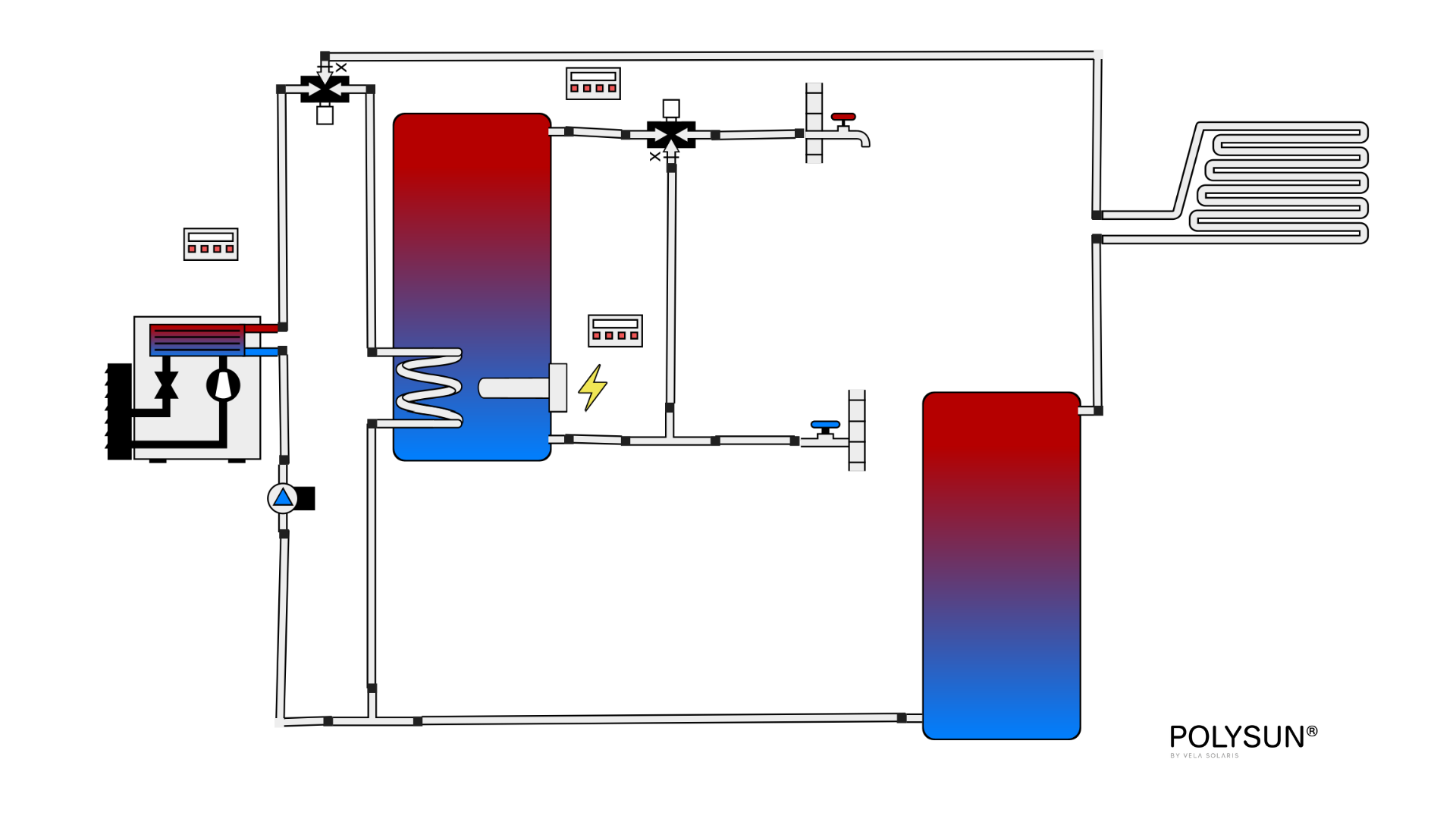
The air source heat pump diagram shows a buffer tank integrated into the hydraulic diagram after the floor heating. WPSM recommends adding a buffer tank to a hydraulic diagram if the water content of the radiators or floor heating is low. This increases the water content, enabling longer running times for the heat pump and avoiding cycling.
One crucial aspect is the correct arrangement. The domestic hot water tank must be connected before the heating circuit in the diagram; otherwise, the buffer tank would also be heated up every time hot water is drawn, reducing the system’s efficiency.
Air Source Heat Pump Diagram with Buffer Tank in Germany (BWP): Parallel Buffer Tank
While the Swiss WPSM standard provides schematic diagrams for heat pumps in systems of up to around 15 kW, the BWP guidelines offer general recommendations. The following BWP heat pump schematic diagram shows a four-connection buffer tank connected in parallel to the heat pump. Its purpose is the same as that of the WPSM diagram: to provide hot water and heating.
BWP Schematic 3: Air Source Heat Pump Diagram with Four-Connection Buffer Tank
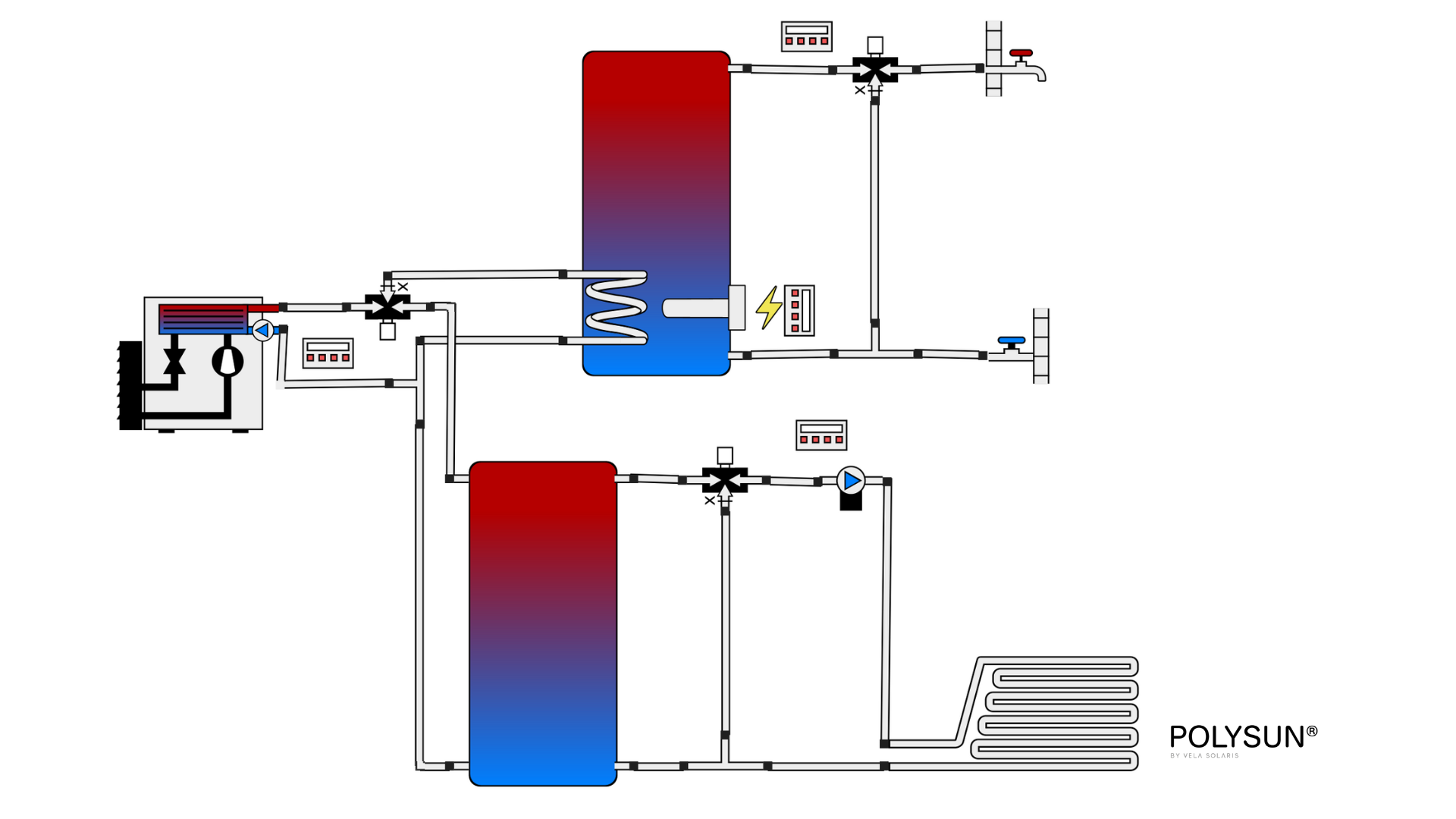
In the BWP hydraulic diagram two storage tanks are connected in parallel, with the buffer tank having four connections. The heat pump is connected to the top of one of the storage tanks. The heat generation is hydraulically decoupled from the consumers, which enables simple and stable operation.
Buffer Tank Diagram: Comparison WPSM and BWP
In the WPSM diagram, the buffer tank is connected to the hydraulics circuit after the floor heating system. This allows the heat pump to supply hot water directly to the floor heating. Since there is no intermediate storage in the buffer tank, efficiency increases. The COP value of the heat pump improves by around 0.2 throughout the year.
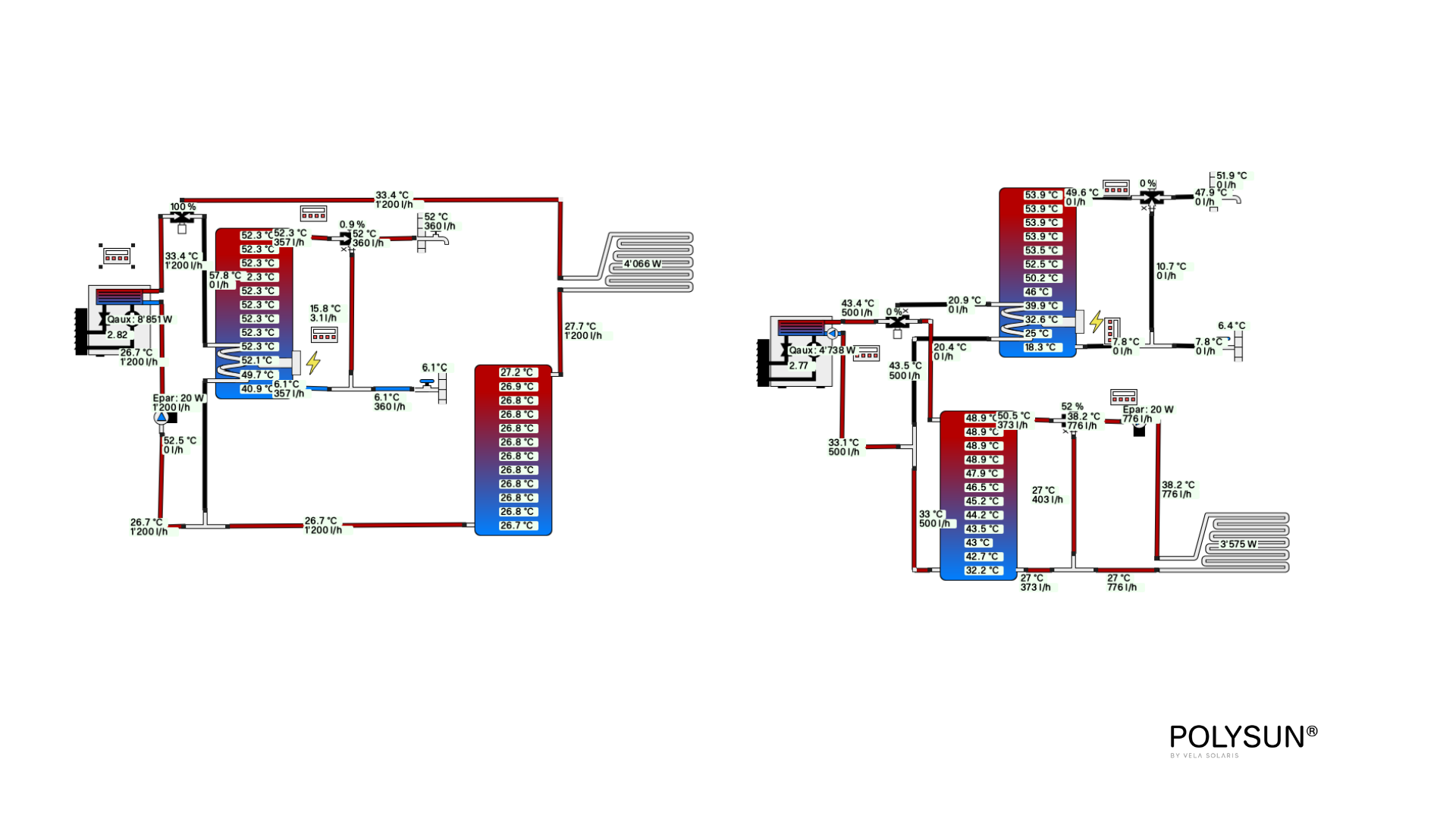
| Aspect | WPSM Scheme 4 | BWP Scheme 3 |
| Buffer tank Integration | Serial, after the floor heating | Parallel using 4 connections |
| Advantages | The direct supply of the heating circuit increases efficiency | Simple and proven hydraulic decoupling |
| Disadvantage | Created specially for up to 15 kW | Lower efficiency when compared to the WPSM scheme |
This example illustrates how buffer tanks can be integrated into heating circuits either in series or in parallel, and how this affects the efficiency of heat pumps. For more information on hydraulic schematics with multiple buffer tanks and the serial or parallel integration of buffer tanks in heating circuits, please refer to our technical article, ‘Buffer Tanks in Parallel or in Series‘.
Air Source Heat Pump Diagram with Combined Buffer Tank
When a heat pump is intended to provide both space heating and hot water for domestic use, the question arises as to whether they should be combined in one tank (a combined buffer) or in two separate tanks. Due to space savings and efficiency gains, combined buffer tanks are popular in new builds and are currently used in around 40% of new heat pump installations.
The following diagram shows an air source heat pump system comprising a combined buffer tank and a heat interface unit.
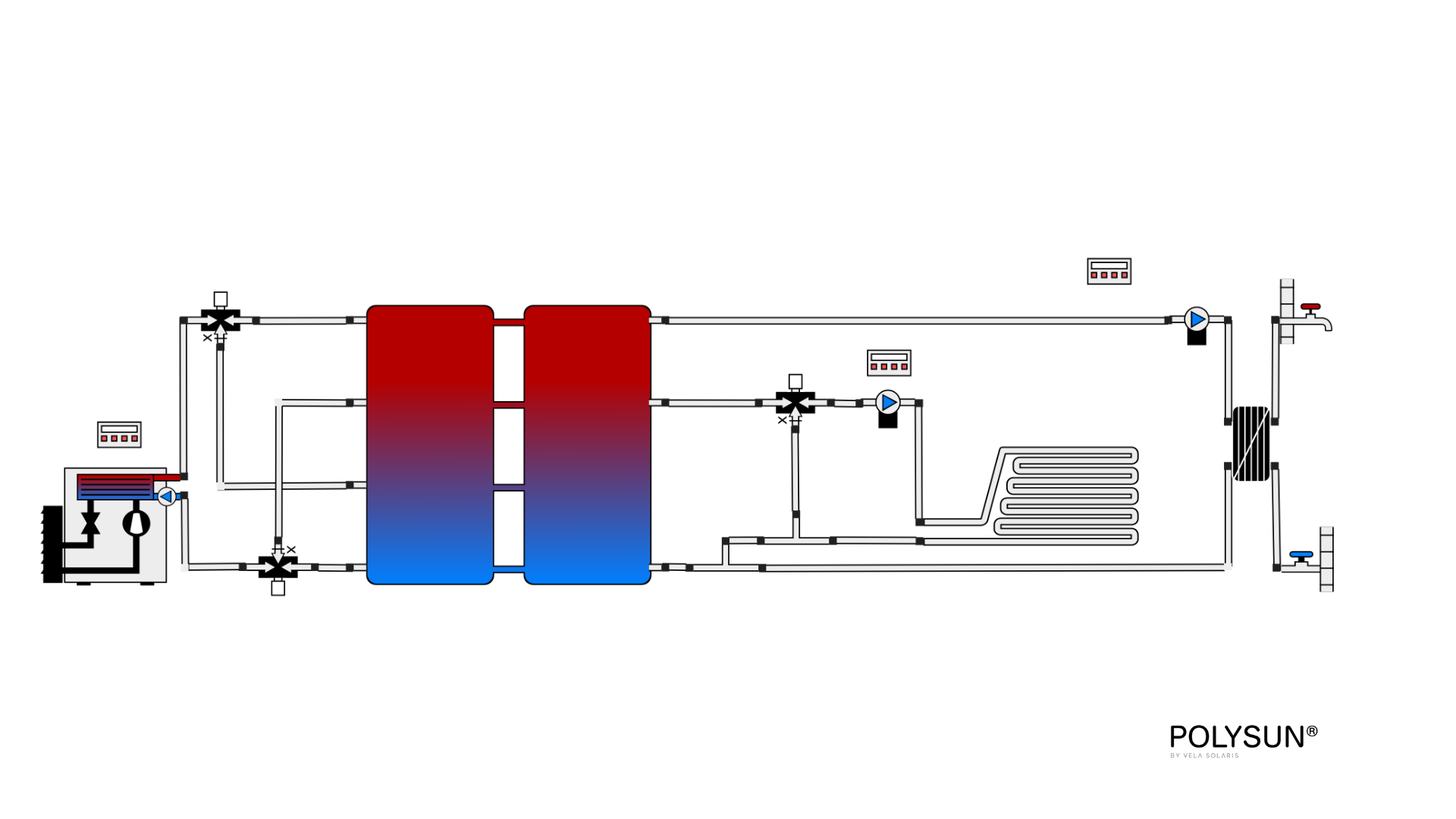
The following schematic diagram shows a heat pump that not only provides heating and hot water for domestic use, but also includes a chilled buffer storage tank for cooling purposes.
Heating and Cooling with a Geothermal Heat Pump: Explained in Diagram
As summer temperatures rise, the demand for cooling solutions to maintain a comfortable indoor environment throughout the year is increasing. Integrating a chilled water buffer into a hydraulic system with a polyvalent heat pump (4-pipe heat pump) is an efficient solution for meeting the building’s heating and cooling requirements.
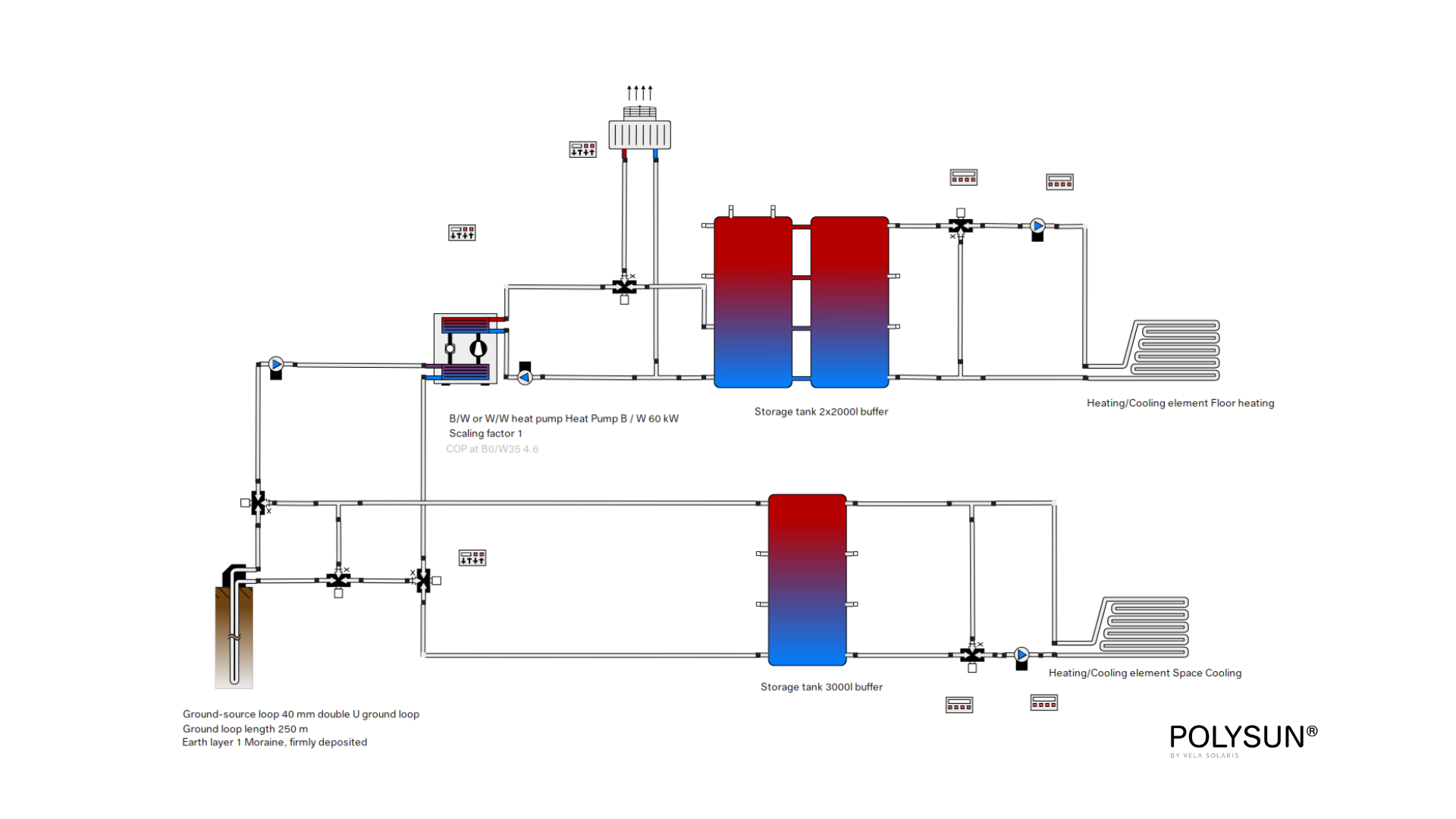
The diagram here shows a geothermal heat pump, in contrast to the previous examples which were based on air source heat pumps. This hydraulic diagram also incorporates the supplementary air-water heat exchanger, which has been specifically integrated for cooling purposes. It offers full flexibility, covering two operating modes: heating and cooling. The following animations illustrate this.
Geothermal Heat Pump Diagram: Heating Explained
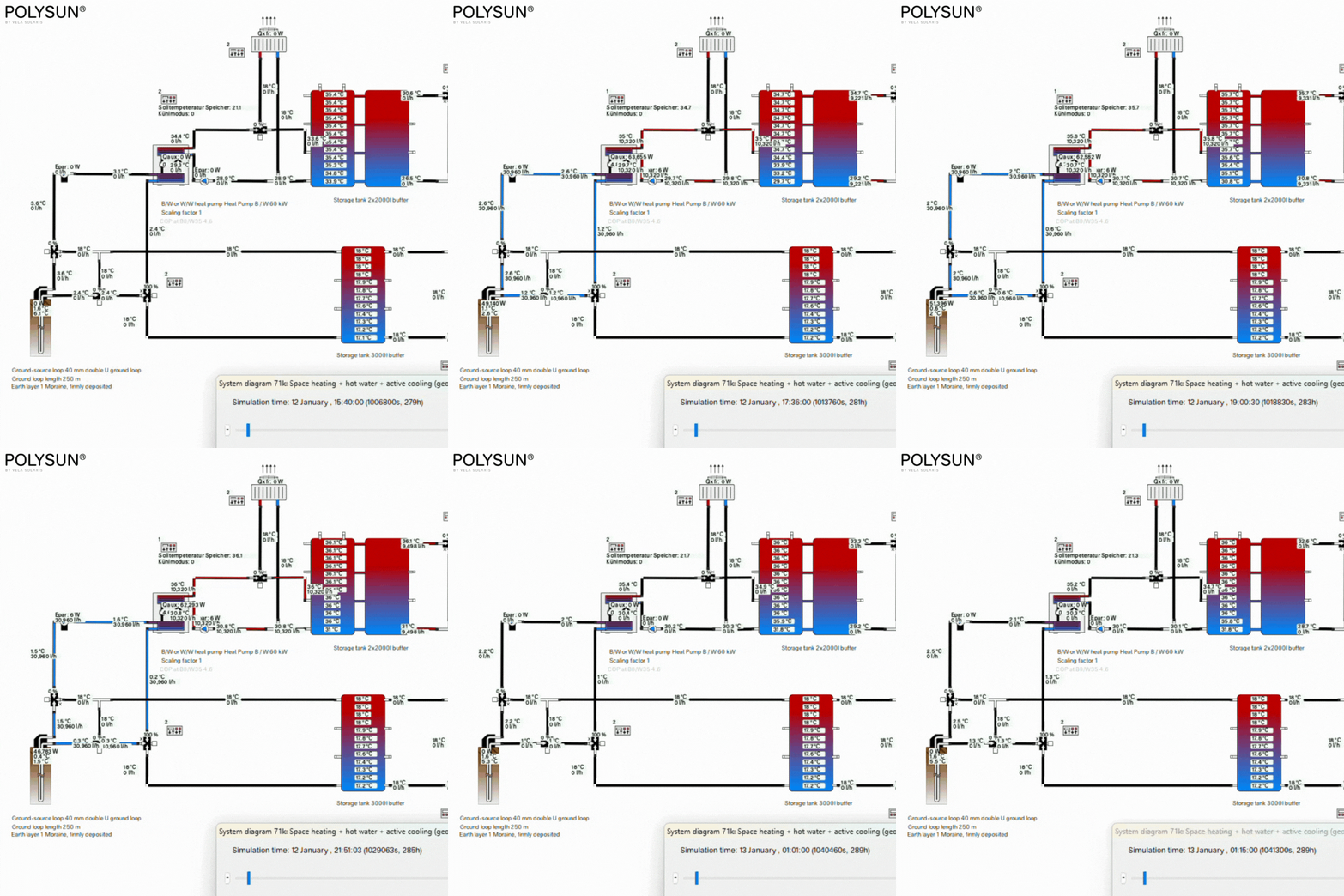
In heating mode, the heat pump extracts thermal energy from the geothermal loop. This is evident because the outlet temperature from the probe is higher than the inlet temperature. The heat pump then uses electricity to raise this environmental heat to the required target flow temperature on the secondary side. The buffer tank absorbs and transfers the generated heat to the underfloor heating system as required, efficiently meeting the building’s heating needs.
Geothermal Heat Pump Diagram: Cooling Explained
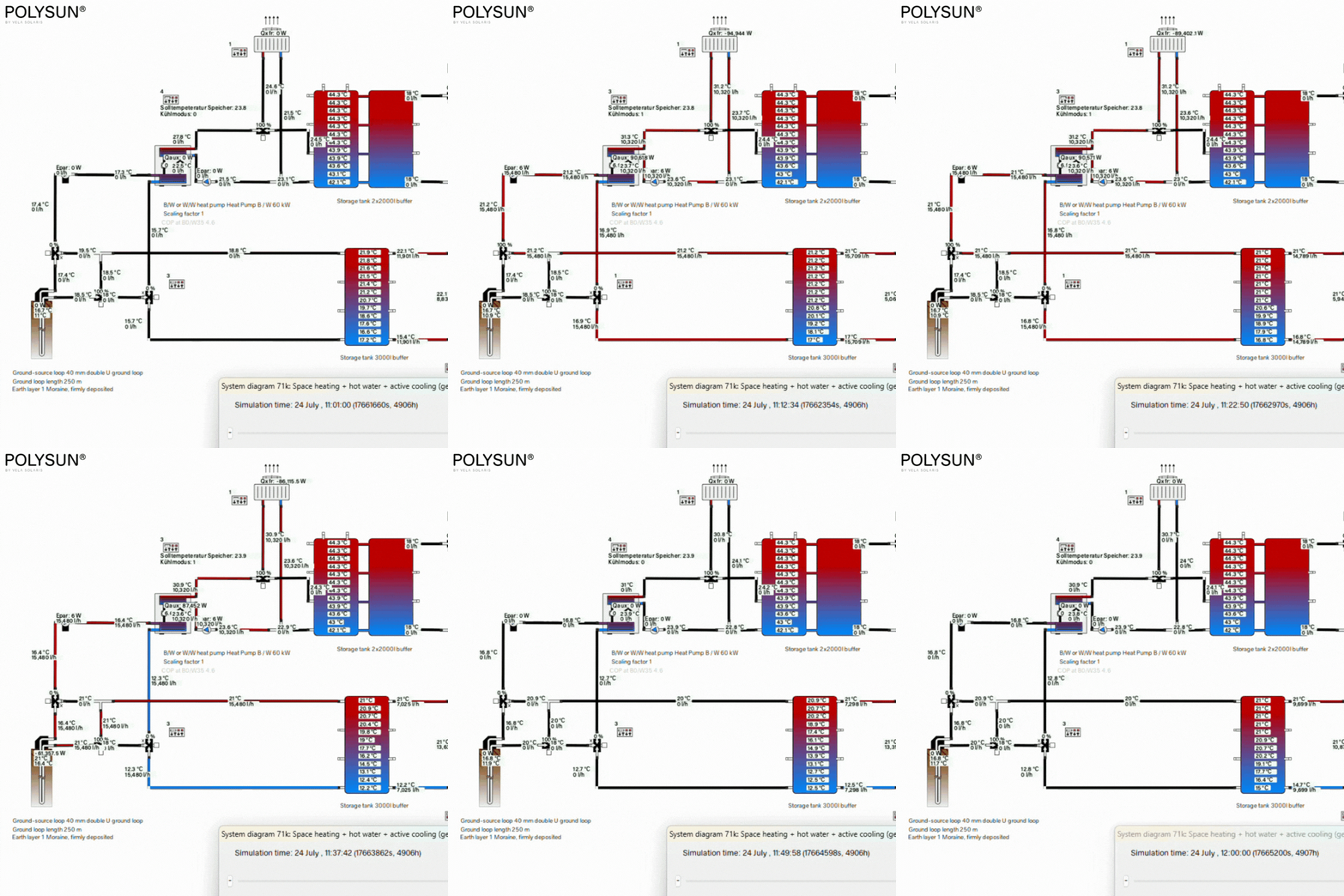
In cooling mode, it is essential to maintain the temperature of the chilled buffer tank — and, consequently, the cooling element — below the target temperature. The heat pump accomplishes this by actively lowering the chilled buffer tank’s temperature and dissipating excess heat to the environment via the air-water heat exchanger.
Additionally, the hydraulic diagram incorporates the geothermal loop into the process. The heated carrier medium first flows through the ground, releasing heat, before re-entering the heat pump pre-cooled. This process results in thermal regeneration of the geothermal loop and offers advantages such as reduced drilling costs. Further information can be found here.
Water Source Heat Pump Diagram: Heating and Cooling
Water source heat pumps offer superior efficiency and lower upfront costs in comparison to standard geothermal heat pumps. This objective is realised through the effective use of water’s high thermal conductivity, as opposed to soil. Should a reliable groundwater source be available on your project site, it is an option that could save you the expense of drilling deep boreholes.

For projects with higher heating demand, extending the diagrams may be necessary. Cascade systems are an efficient solution for projects with large heating demands, as demonstrated in the following diagram.
Cascade Heat Pump Schematic Diagram
For large systems (50 kW+), a planner or an engineer is typically involved in designing an optimal, customized heat pump diagram. Larger systems are more complex due to the combination of heat pumps in a cascade configuration and the need to meet various requirements. The following diagram illustrates a system comprising three air-source heat pumps arranged in cascade.
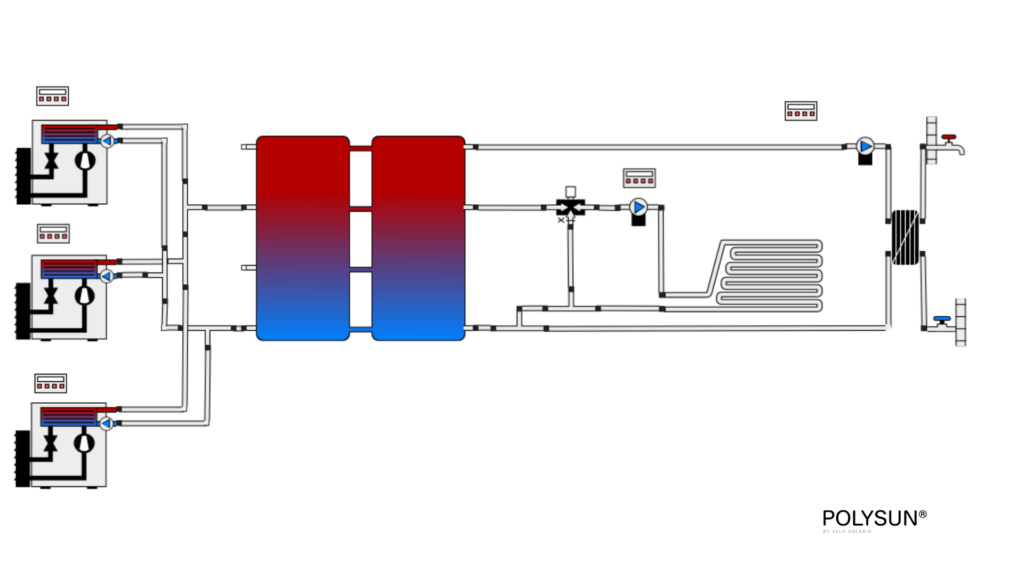
Please refer to our article for more information on the design of heat pump cascades, including configurations in parallel or in series.
Central Heating System Diagram: Combi Boiler with Heat Pump
Older, poorly insulated buildings often require inlet temperatures exceeding 55 °C. Hybrid systems combining heat pumps with gas boilers are highly effective in such conditions. Base loads remain with the heat pump for maximum efficiency. Gas boilers are only activated during extreme cold weather or periods of peak demand. This configuration fulfils all Building Energy Act (GEG) requirements by covering at least 65 percent of the heat load with the heat pump.
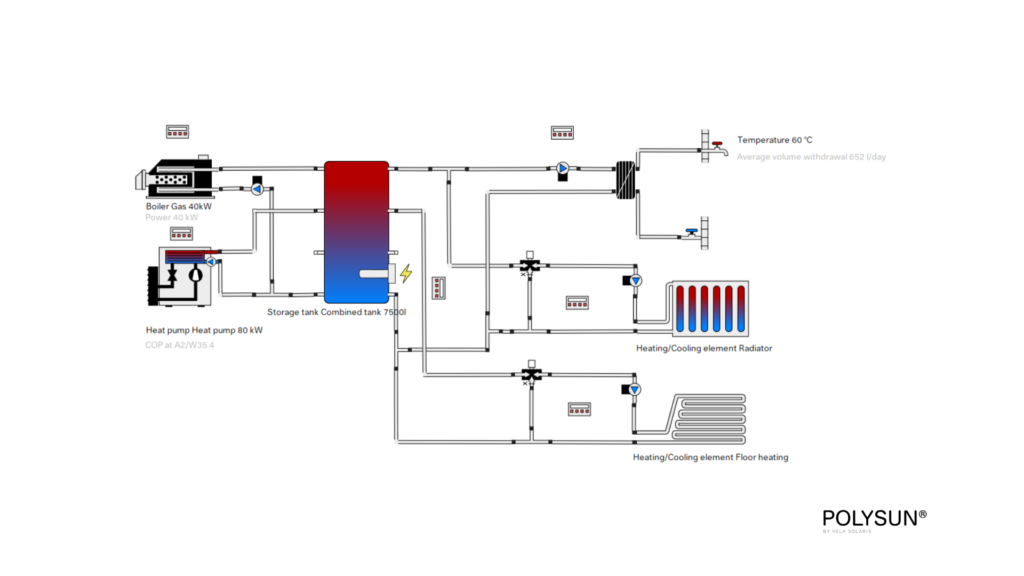
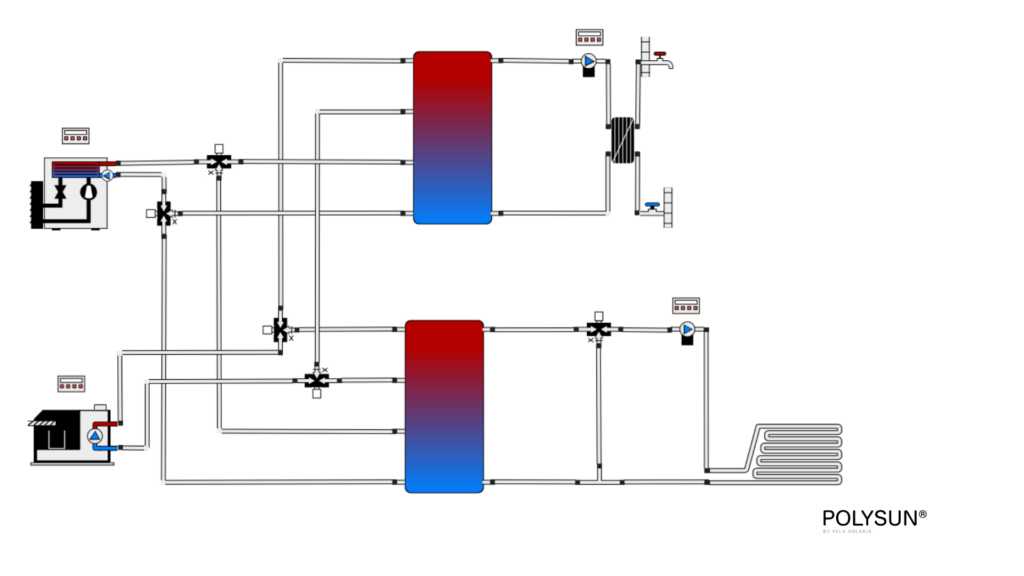
Diagram of Air Source Heat Pump with Pellet/Wood Heating
One possible solution to increase the use of renewable energy in the heating system is to use a pellet boiler as an alternative to a gas boiler. In this configuration, the heat pump is responsible for the base load, while the pellet heating system is activated during periods of low external temperatures or high demand. This setup significantly exceeds the GEG’s requirements, with renewable sources typically accounting for 80–95% of the total.
Firstly, the heat pump charges the buffer storage tank. The pellet boiler is connected to the top of the buffer tank and heats to 60–75 °C as required. This ensures sufficient output, even during periods of extreme cold or high demand for hot water.
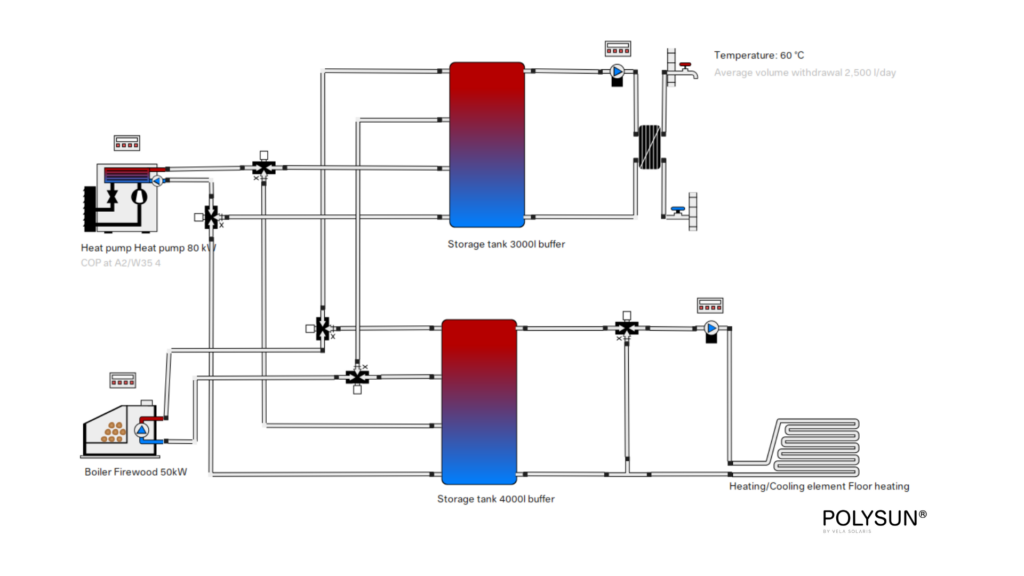
This diagram can also be used with wood boilers. To do this, simply replace the pellet boiler with a wood boiler:
How to Identify the Optimal Variant for a Specific Project or Application?
It is advisable to simulate different design layouts and optimise medium-sized heat pump systems. Polysun simulation software enables planners and energy contractors to efficiently generate various heat pump diagram layouts using our HVAC templates.
Since all desired requirements, such as integrating a cooling function or including additional generators (e.g., pellet boilers), must be correctly incorporated into the hydraulics, the hydraulic diagram can quickly become complex. Design or planning errors can incur significant costs, lead to a reduction in comfort, and extend the project’s payback period. For larger applications, such as apartment buildings, hotels, and hospitals, energy system simulation and design comparison can reduce costs by up to 40% compared to the standard design.
Polysun planning software provides over 1,000 proven hydraulic diagrams as templates. These templates can be adapted by project planners to suit their needs, and frequently used diagrams can be saved as user-defined templates for quick retrieval. Large customers develop recurring use cases collaboratively in a workshop and make them available to their teams with company templates that are parameterised for specific purposes. This approach ensures optimal planning for all of the customer’s projects.
FAQ
How does a buffer tank affect the COP (annual performance factor) of a heat pump in large systems?
A buffer tank increases the COP of heat pumps in large systems by:
• Reducing cycle times: Load fluctuations are balanced out, enabling longer, more efficient running times.
•Stabilizing operating conditions: Constant flow temperatures and minimized source fluctuations (e.g., in geothermal probes) improve efficiency.
Limitations: Heat losses: Incorrectly dimensioned or poorly designed tanks can reduce the COP.
Complexity: Unfavorable hydraulic integration can increase energy consumption. A properly designed buffer storage tank improves efficiency.
Tools such as Polysun support optimal hydraulic planning.
Are there buffer tanks with multiple zones/single-layer systems for hybrid systems
Are there buffer tanks with multiple zones/single-layer systems for hybrid systems?
Yes, buffer tanks with multiple zones or single-layer systems are available for hybrid systems and are used in large systems.
• Multi-zone buffer storage tanks: These storage tanks are divided into thermal zones (e.g., upper hot zone for domestic hot water, lower cooler zone for heating) to efficiently meet different temperature requirements. They optimize heat distribution in hybrid systems with multiple heat sources (e.g., heat pumps, gas boilers, CHP units).
Advantages:
• Flexibility in integrating different heat sources.
• Reduction of heat pump cycle times, which increases the COP.
Limitations:
• Higher costs and planning effort for multi-zone storage tanks.
• More complex hydraulics that must be precisely designed.
Multi-zone and single-layer buffer storage tanks increase the efficiency and flexibility of hybrid systems when they are adapted to specific requirements and optimally planned using tools such as Polysun.