
Publications
Hydraulic diagram 2 buffer tanks: Application areas and practical cases
In modern plant engineering, hydraulic diagrams featuring two or more buffer tanks are indispensable for HVAC planners and engineers when it comes to efficiently combining complex load profiles and multiple heat sources. This blog post explains when and why such solutions are needed, what advantages simulation results offer in planning, and highlights concrete use cases from practice.
Why use 2 buffer tanks or more?
There are many reasons: Modern buildings and systems need increasingly flexible energy flows and combine a wide range of heat sources—from solar thermal and geothermal to wastewater heat recovery. Simultaneously, there are rising demands for energy efficiency, installation conditions, and redundancy.
2 buffer tanks are typically implemented when:
- Total storage volume and site constraints are limiting. A single large tank often can’t be installed due to transport, available space, or ceiling load. Multiple smaller tanks are easier to integrate.
- Temperature layering and zoning are required. When separate temperature zones, sub-areas, or consumers/sources need to be hydraulically decoupled, buffer tanks with different temperature levels can be used.
- Multiple heat sources and load scenarios exist. In systems with solar thermal, heat pumps, combined heat and power (CHP), or process heat, there are diverse requirements for temperature and power. Multiple buffer tanks allow for modular separation (e.g., cascade storage).
- Flexibility, redundancy, and expandability are desired. Large plants allow individual tanks to be taken offline for maintenance. Additional tanks can be added later if more heating demand arises.
- Hydraulic separation for large flow rates. Dividing flows between several tanks can reduce hydraulic resistance.
Such planning cases for buffer tank sizing and heat pump sizing are common in large projects—schools, multi-family buildings, site developments, commercial premises, industrial processes, or district heating networks.
Application cases: hydraulic diagrams with 2 buffer tanks
Examples below show practical systems where hydraulic diagrams with two or more buffer tanks enable modular and simulation-ready design. The key differences in hydraulic integration are explained in “buffer tanks: parallel or in series.”
Hydraulic diagram heat pump with 2 buffer tanks: school project
A school with an attached gymnasium has increased daytime demand for heating and hot water, for sports and showers. There are also heating loads outside of these peak times.
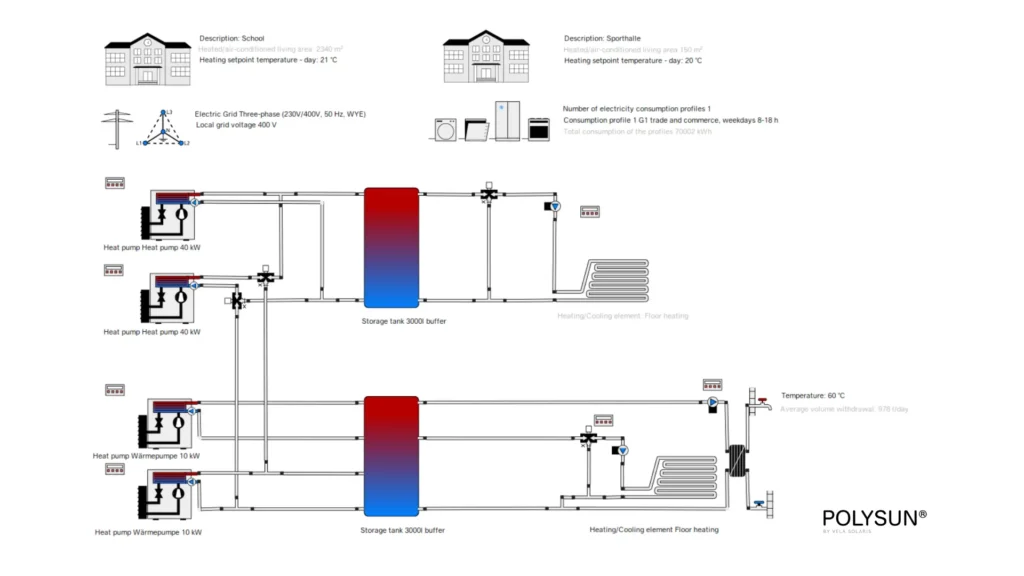
This hydraulic diagram with 2 buffer tanks and 4 heat pumps provides peak demand coverage, redundancy for maintenance, and optimized temperature layering between baseload and peak load. The first buffer tank supplies the school building with heat for regular operation; the second buffer tank provides hot water and gym heating during peak or elevated demand.
Hydraulic diagram for a commercial building with three buffer tanks
A commercial building requires process heat and space heating with widely differing temperature and capacity requirements.
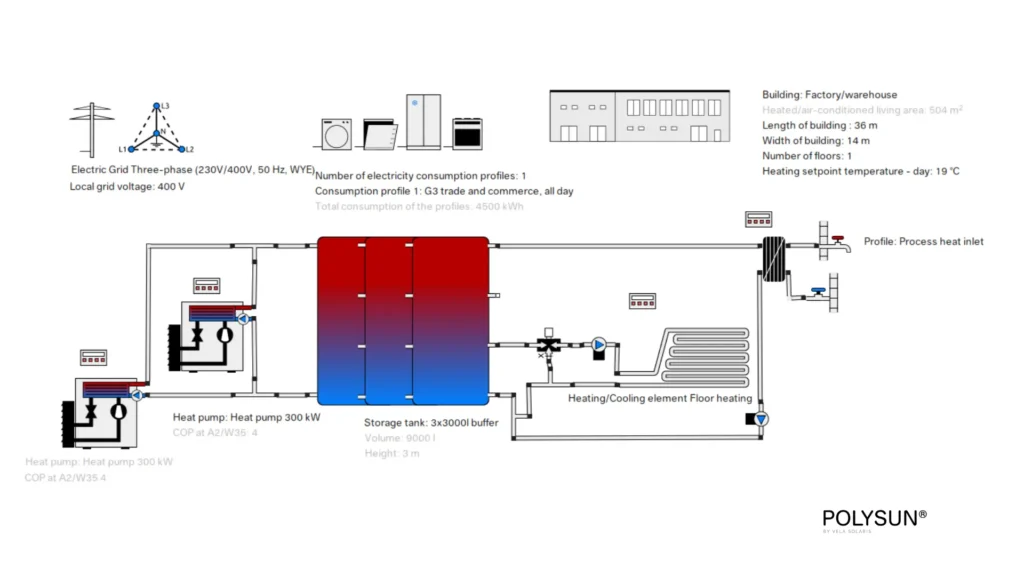
Two large heat pumps charge the three buffer tanks, ensuring optimal pump operation and delivery for varied temperature and load needs.
Multi-family building: hydraulic diagram heating with 2 buffer tanks
Several multi-family buildings are supplied by low-temperature district heating using multiple energy sources—groundwater wells, ground collectors, and PVT panels.
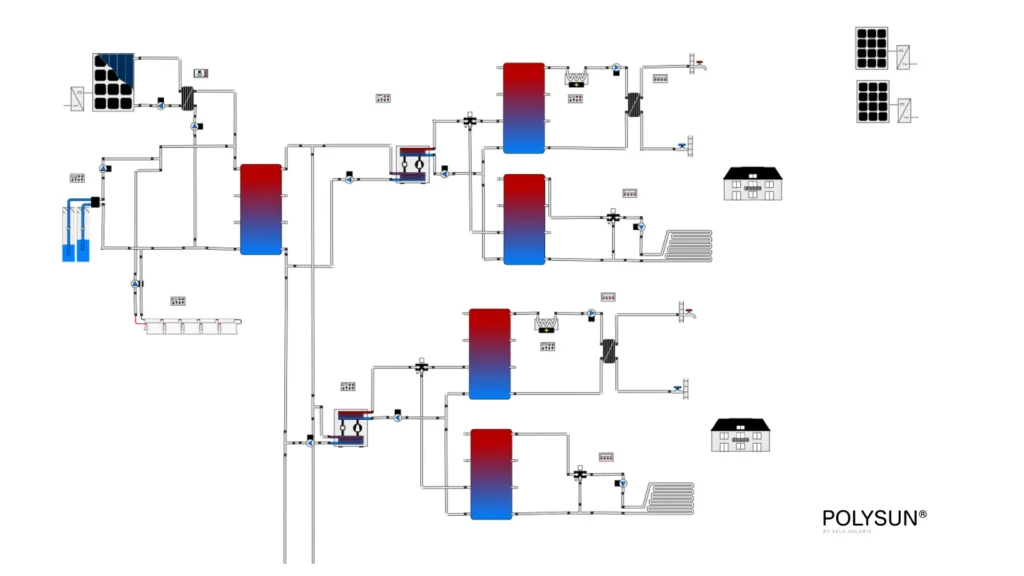
Each building has two buffer tanks for underfloor heating and domestic hot water, respectively. Every building features a heat pump for baseload and an electric instantaneous water heater to raise domestic hot water temperature as needed.
Limits of static planning approaches like Excel
Excel or static estimates quickly reach limits for such complex configurations because:
- Lack of system dynamics: Load profiles, fluctuations, partial load operation, and internal losses aren’t realistically captured.
- Hydraulic coupling and interactions: The flow distribution between buffer tanks and source/load circuits requires a coupled simulation, beyond Excel’s means.
- Temperature stratification and profiles: Layer quality changes during operation, affecting efficiency. Static models are too coarse for this.
- Control strategies and elements: Valves, switching units, pump controls, and flow distribution require comprehensive control modelling.
- Variant comparison: Automated scenarios and key figures are needed to evaluate different buffer tank configurations. Manual calculations with Excel are error-prone and cumbersome.
This is why modern planners rely on simulation software integrating hydraulic models, time-dependent dynamics, control strategies, and thermal interactions.
Conclusion and planner recommendations
A hydraulic diagram with two buffer tanks is no longer an exception, but standard for demanding projects—especially with high loads, multiple energy sources, or challenging user profiles. Without simulation-based planning, classic tools like Excel are quickly outmatched; only dynamic simulation can accurately capture complex system interactions.
Polysun offers transparency—optimal layout, sizing, and control strategy can save up to 40% in energy costs. It reliably prevent common mistakes like oversizing, inefficient tank arrangement, and hydraulic short-circuiting, which in large projects would otherwise require costly corrections. Unlike spreadsheet tools, Polysun visualizes all controls and load profiles under real operating conditions, enabling variant comparison and economic evaluation of complex designs.
With over 100 standard templates for hydraulic diagrams with two or more buffer tanks, Polysun offers planners a comfortable starting point. Templates are easily customized for specific projects, allowing for realistic simulation, variant creation, and targeted optimization.