
Energy-efficient renovation of buildings – Reliable Planning and Execution
eZeit Ingenieure
The Berlin-based engineering firm simulated the energy-efficient renovation of a large multi-family building using Polysun: A sustainable concept was implemented and funding was secured through precise simulation-based planning.
eZeit Ingenieure is a consulting and engineering firm specializing in architecture, building systems, and energy technology. Based in Berlin, the company focuses on energy-optimized, sustainable construction. This means holistic thinking, planning, financing, and implementation—from large-scale urban development projects down to thermal bridge details. Their services span all areas of residential and commercial construction, from single-family homes to large housing complexes and entire neighborhoods. Whether for new construction or retrofits, these experts place great value on customized concepts for economically optimized, energy-efficient building projects.
Challenges in the energy-efficient renovation of buildings: Example multi-family house
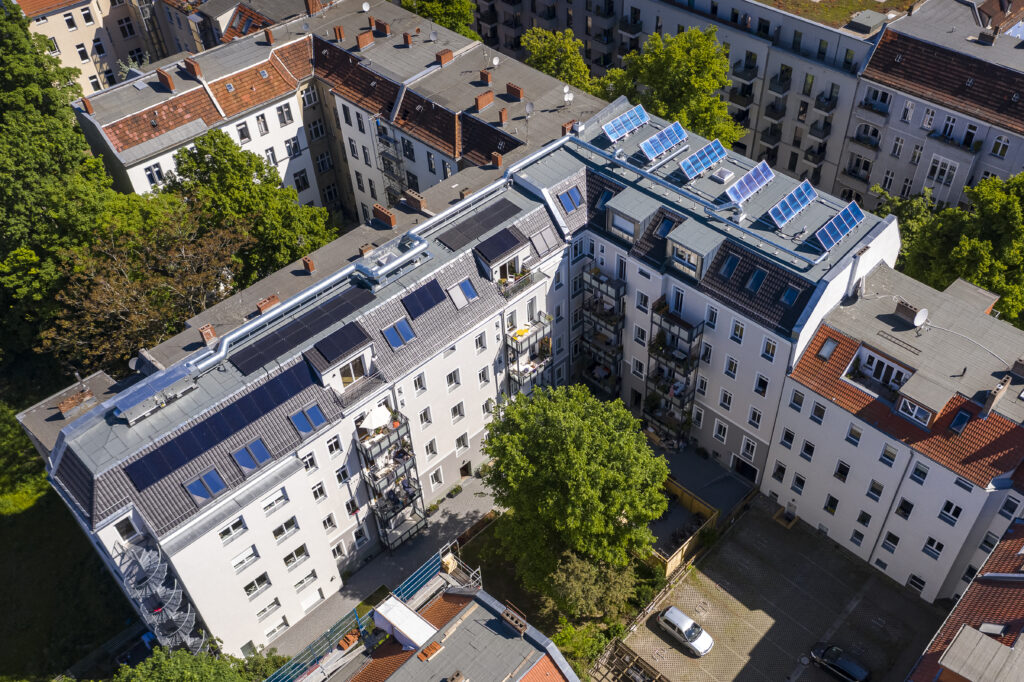
A Berlin multi-family building required an energy retrofit of the existing structure. The building, with approximately 25,800 square feet of living space, originally had 17 residential units. As part of the retrofit, an extension (3 units) and a new attic floor (4 units) were added, resulting in a total of seven new apartments.
Replacing gas-fired floor heaters with a modern central energy plant
The requirements were far from trivial. The piping network had to be renewed in a minimally invasive manner. The reason: existing chimney flues in the building were to remain in use, and the existing radiators were to be retained.
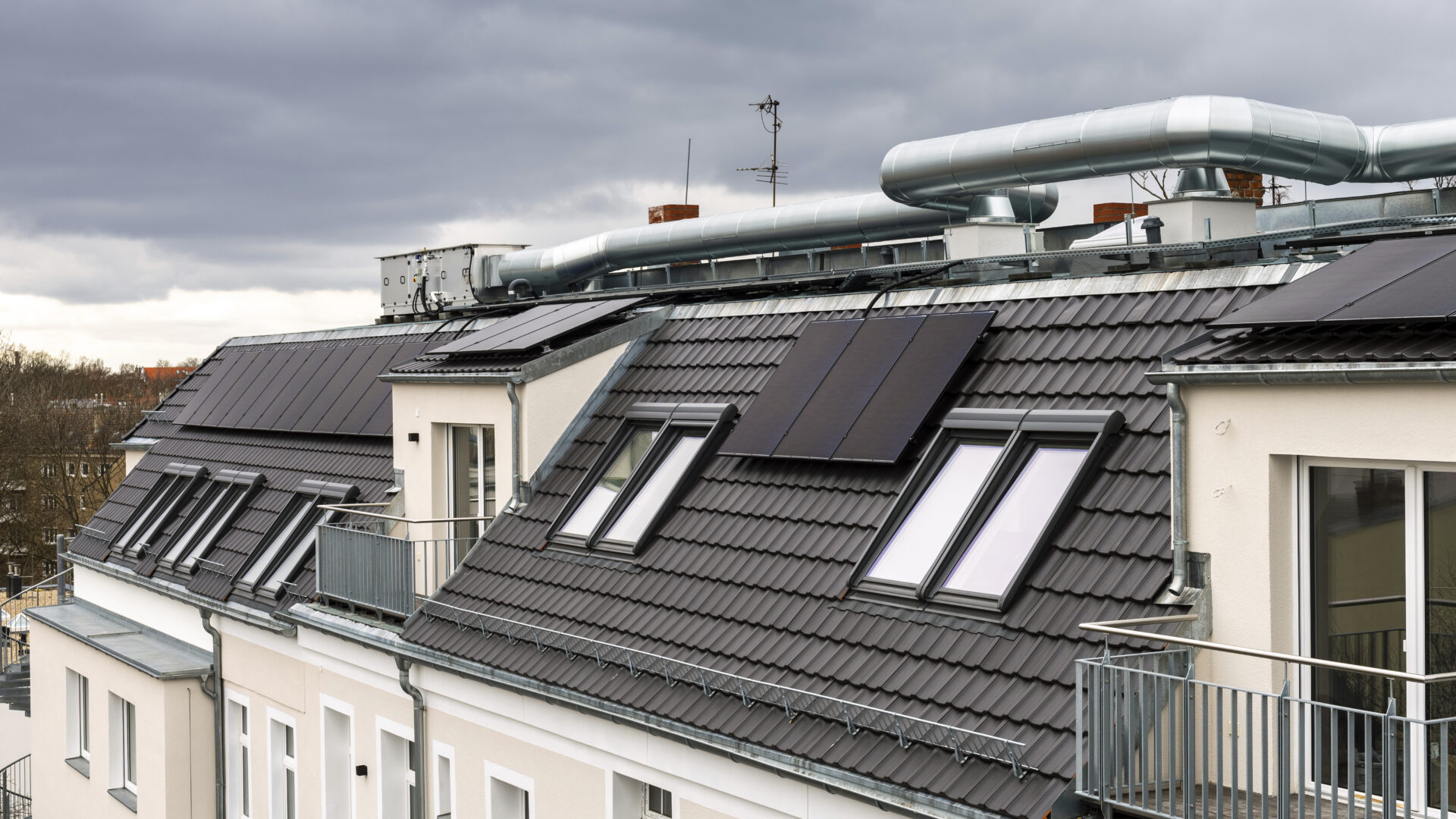
Specifically, the retrofit involved replacing the old gas-fired floor heating systems with a modern central energy plant. The energy concept included an exhaust air heat pump, a ground-source heat pump with nine deep boreholes, and a gas-fired peak load boiler, combined with solar thermal collectors and photovoltaic modules installed on the roof. For the installation of the mechanical, electrical, and plumbing (MEP) systems—including electrical installations—the existing chimney flues were successfully reused, eliminating the need for additional shafts in the existing structure. The radiators were also retained.
In line with eZeit Ingenieure’s philosophy, the energy retrofit was approached holistically. Only this approach ensures the building is future-ready. “The principle was that planning and subsequent retrofit should not focus solely on the building envelope. Only the precise interaction between the building envelope and building systems reliably achieves reductions in CO₂ emissions,” says Bernd Paarmann, an engineer specializing in building energy and information technology at the Berlin firm.
The consequence of this complexity: numerous decisions had to be made before the retrofit. Here, simulation-based planning, design, and optimization of the integrated energy systems using Polysun from Vela Solaris proved invaluable.
Optimizing energy demand and generation
With Polysun, Bernd Paarmann and his colleagues were able to input key parameters—such as building geometry, envelope, occupancy, and existing MEP systems. This enabled a precise, building-specific design of the building systems and energy technology. Site-specific factors, such as local weather data, were also incorporated.
To ensure cost-effective planning, the generation capacity was sized precisely to the project’s needs, avoiding oversizing. At the same time, the design had to reliably meet comfort requirements for domestic hot water and space heating/cooling. Polysun was instrumental in achieving this balance.
“We also used Polysun to calculate how future operating energy costs would compare to the unrenovated state and the old gas-fired floor heating systems,” says Paarmann. The focus was on delivering “affordable green energy.”
The “minimally invasive retrofit” aspect was also reliably simulated in Polysun. Since some existing chimney flues in the building could not be used and the addition of new shafts was to be avoided, the original separation of the heating network into high-temperature (existing radiators and domestic hot water) and low-temperature (surface heating in the new construction area) circuits had to be eliminated. This resulted in a single high-temperature hydronic circuit, which can be mixed down as needed.
Accurate Planning Enables Cost Savings in the Energy Retrofit of a Multi-Family Building
New system variants were added and simulated in Polysun to answer the question of whether the planned energy concept for the 1900-built multi-family building would still function under less-than-ideal conditions. It was crucial to ensure that the required seasonal performance factor (SPF) was still achieved, and to assess the impact on the share of renewable energy and the proportion of electricity versus fossil energy.
This last aspect was key: since the economic analysis of the energy and retrofit concept could include potential funding, the exact seasonal performance factors of the heat pump were simulated. The efficiency thus determined can make the project eligible for funding, making the retrofit more attractive for both owners and tenants.
Comparing Energy Costs: New vs. Old System Technology
“By using the simulation to determine the shares of various energy sources—electricity, gas, and ambient heat—we were able to forecast future energy costs in comparison to the old and new system technologies,” explains Paarmann. “This allowed us to clearly demonstrate to owners and tenants that, as the share of renewables in the German electricity mix continues to rise and CO₂ pricing increases, our energy concept is far more future-proof in terms of energy costs compared to continued gas operation.”
By substituting fossil gas with electricity and ambient heat, eZeit Ingenieure implemented a system concept that is prepared for the energy transition and associated price developments in Germany, enables economical operation, and achieves a small ecological footprint—meeting the target requirements for 2045.
Funding Basis: Demonstrating Seasonal Performance Factor via Simulation
Federal funding programs require a specific seasonal performance factor. For complex system configurations, proof must be provided through simulation. “For this project, we secured funding for the energy retrofit through simulation. These lower investment costs translate into a smaller increase in base rent for tenants.”
The simulation also enabled the Berlin engineers to assess necessary planning changes to the risers and the associated increase in temperature levels with respect to the criteria of renewable energy share, cost-effectiveness, and future energy costs. “With Polysun simulation, we could reliably ensure that the desired system could be implemented, would qualify for funding programs, and would guarantee economical operation,” concludes Bernd Paarmann, summarizing the successful use of Polysun.

Eckpunkte
Key points at a Glance
- Client: eZeit Ingenieure GmbH
- Sector: Architecture, Building Systems, and Energy Engineering Consulting
- Location: Berlin
Challenges
-
Simulation of the energy retrofit of a multi-family building
-
Complex requirements, such as simulating a minimally invasive retrofit
-
Demonstrating cost-effectiveness in the simulation
-
Providing proof of eligibility for funding through simulation
Product
Results
-
Accurate forecasts of energy cost development for new vs. old system technology; proof of funding eligibility provided
-
Cost-effective planning achieved: a win-win for tenants and owners
-
Minimally invasive retrofit reliably simulated
-
Long-term, sustainable system concept implemented

Get in touch