
Publications
Why Dynamic Simulation Beats a Pool Heat Pump Calculator for Large-Scale Pools
When planning the energy supply of swimming pools in hotels, leisure centres, or municipal indoor and outdoor pools, simple pool heat pump calculators—designed for single-family homes—quickly reach their limits. Unlike small-scale pool heating, larger facilities must integrate multiple energy sources, balance thermal loads across different uses, and ensure year-round efficiency. This is where dynamic simulation software such as Polysun comes in.
Polysun is not just a pool heat pump calculator. Instead, it offers a powerful simulation environment with an extensive catalogue of over 5,000 heat pump models and 7,300 solar thermal collectors. In addition, it provides ready-made templates for typical pool applications—from outdoor pools heated with solar thermal systems and heat pumps, to hotels with integrated geothermal energy heating, to indoor pools supplied by gas boilers or multi-source heat pumps.

Why dynamic simulation matters
For large swimming facilities, energy demand is shaped by many variables: fluctuating outdoor temperatures, opening hours, variable pool usage, and the interplay between several heating technologies. Traditional heat pump calculators only consider simple loads and constant conditions. For large pools, various factors must be considered by dynamic simulation models in heat pump sizing :
- Load profiles over time (hourly, daily, seasonal fluctuations)
- Interaction of multiple energy sources, such as solar heating panels for pools combined with heat pumps or gas boilers
- Water volumes are large, causing significant heat losses.
- Pools often interact with building heating and domestic hot water systems.
- Peak load coverage and dimensioning of storage tanks
- Efficiency gains from geothermal integration or low-temperature district heating
Dynamic simulation allows engineers to optimize multi-source systems, reduce operating costs, and ensure comfort year-round—something standard single-family pool heat pump calculators cannot achieve.
Four Application Scenarios with Polysun Templates
Polysun contains numerous pre-configured system templates, making it possible to model and optimise a wide variety of swimming pool heating concepts. Below are four key application cases, all supported by detailed hydraulic diagrams directly in the software.
Outdoor pool: solar thermal collectors with heat pump
In this setup, solar heating panels for the pool cover a large share of the heating demand during sunny periods. On cloudy days or in the shoulder seasons, the heat pump automatically provides backup energy. Dynamic simulation shows how to size both components so that solar yield is maximised and the pump only runs when needed. A photovoltaic installation can be easily added by the user, in order to meet the electricity consumption of the heat pump.
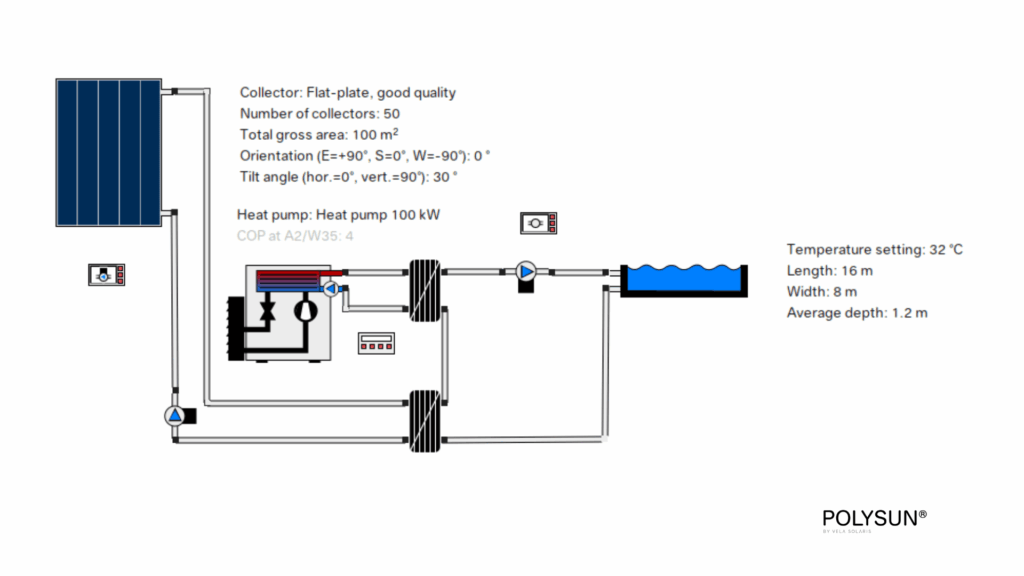
Benefits:
- Maximised use of solar energy.
- Reduced electricity consumption for the heat pump.
- Detailed hydraulic diagrams facilitate planning and installation.
Hotel with indoor pool, hot water, and underfloor heating (heat pump system)
Hotels often require an integrated energy supply: not only to heat the swimming pool, but also domestic hot water and space heating, e.g. underfloor heating or radiation heating. With Polysun, planners can simulate a geothermal heat pump supplying all these heating demands at once. PV panels are used for additional electricity to optimise self-consumption rate. This use case demonstrates the benefit of multi-consumer optimisation, ensuring both comfort and efficiency.
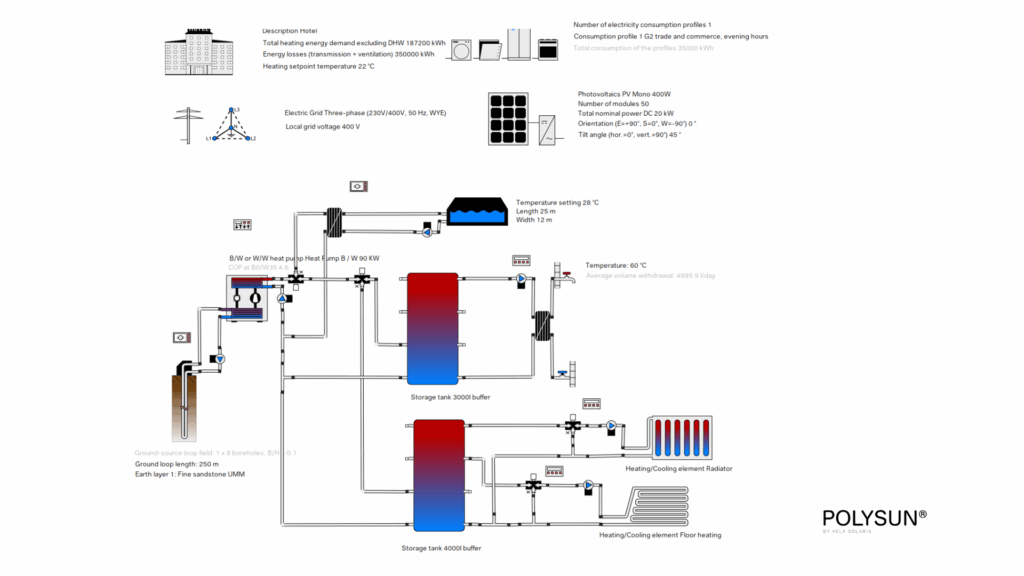
Benefits:
- Optimized multi-source system operation.
- Accurate sizing of heat pumps for pool and building.
- Reduced energy costs and peak demand.
Indoor pool with solar thermal and gas boiler backup
Some facilities prefer combining renewable energy with a conventional system for peak safety. Here, solar collectors contribute to heating the indoor pool water. When solar yield is insufficient, a gas boiler supplements the system. Polysun’s simulation provides insights into seasonal switching, fuel savings, and emission reduction compared to traditional boiler-only designs.
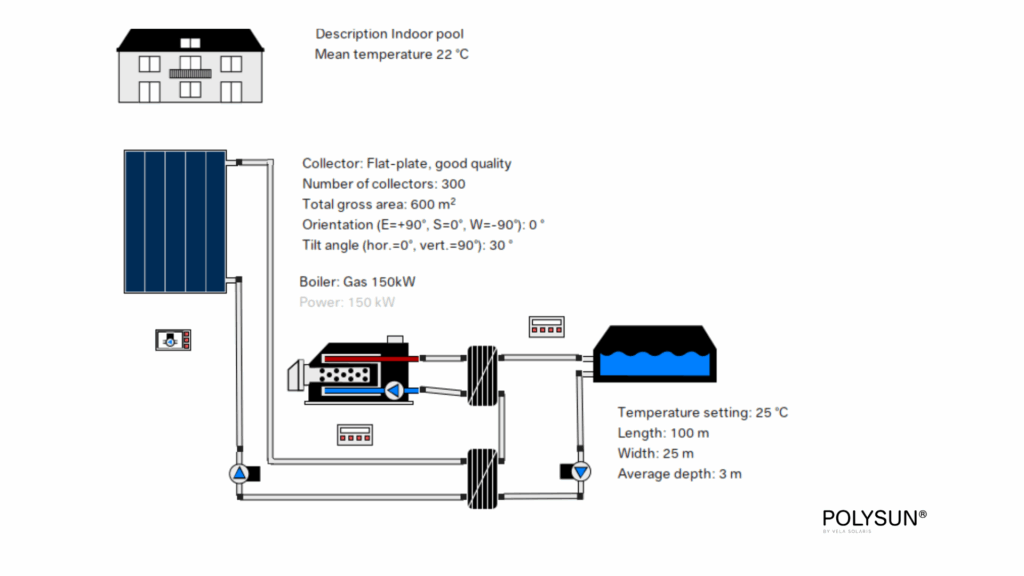
Benefits:
- Efficient solar energy utilization.
- Reduced fossil fuel consumption.
- Accurate seasonal energy demand prediction.
Indoor pool connected to a low-temperature district network with heat pump
A cutting-edge approach is connecting swimming pools to cold district heating networks. In this scenario, a heat pump extracts energy from the network to cover pool heating demand. Simulation ensures efficient operation at low system temperatures, while assessing interaction with other consumers and producers in the network.
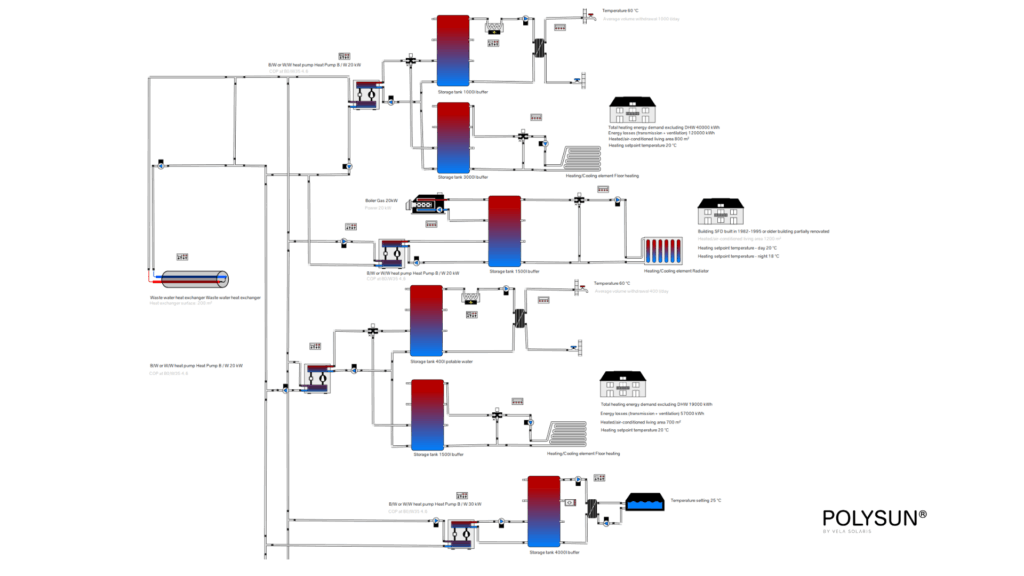
Benefits:
- Optimized use of district heating.
- Dynamic simulation ensures correct heat pump sizing.
- Cost-effective solution for large indoor pools.
The benefits of combining solar panels with heat pumps
Solar heating panels for pools are highly effective in summer but cannot guarantee full coverage across the year or during periods of poor weather. Heat pumps, on the other hand, provide reliable base and peak load coverage. By simulating these multi-source systems dynamically, engineers can quantify:
- The precise share of energy supplied by solar collectors
- The reduction in heat pump running hours and electricity demand
- Optimised storage and hydraulic configurations
- Long-term cost and emission savings
Why Polysun goes far beyond Pool Heat Pump Calculators
Unlike a pool heat pump calculator, Polysun delivers detailed simulations for complex systems. Residential-focused calculators typically assume constant loads and limited device combinations, which is insufficient for large facilities. Polysun ensures:
- Accurate system sizing thanks to dynamic annual simulations
- Optimisation of operating strategies for multiple energy sources
- Access to extensive manufacturer databases for realistic component selection
- For planners, municipalities, and hotel operators, this translates into better investment decisions and much higher efficiency in day-to-day operation.
Explore more features
- Learn more about heat pump sizing
- Explore integrated concepts using geothermal energy for heating
- Learn more about district heating and cooling systems
- For detailed documentation on swimming pool integration, see the user manual page —with dynamic pool heat pump simulation, only in Polysun