

Building cooling design: free cooling and active cooling
Many buildings require cooling as well as heating. But which design approach provides the most efficient supply at the lowest cost? Is it passive cooling via the ground, active cooling with a heat pump, or a combination of both?
With Polysun, you can compare different supply concepts and validate the sizing of the chiller before construction begins. The software shows which building cooling solution reliably ensures comfort, avoids oversizing and achieves the lowest life-cycle costs.
Why validate building cooling systems before construction?
The design of cooling systems is often based on rules of thumb and safety margins. This can result in systems that are oversized, incur unnecessary investment costs and operate inefficiently. At the same time, it remains unclear whether the chosen concept will reliably provide comfort, even in extreme weather conditions.
With Polysun, however, different system variants can be validated using real climate data and load profiles. The software calculates cooling loads, coverage shares and performance factors for every point in the year. This enables the most suitable concept to be identified early on and allows recommendations to be backed up with simulation results.
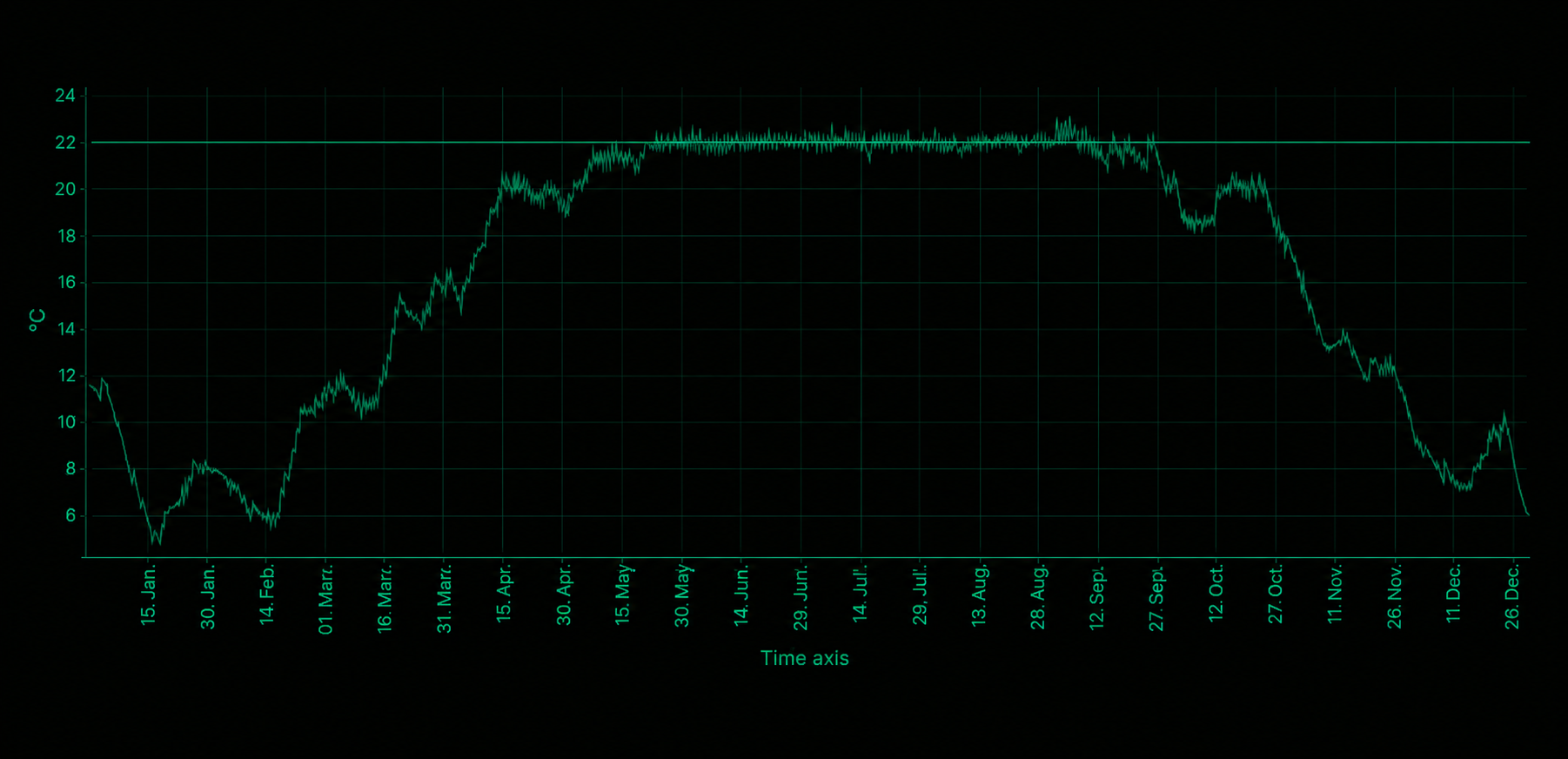

Comparing variants in hours instead of weeks
Various cooling concepts — purely passive, purely active, or hybrid — can be compared based on the same boundary conditions.

Avoid oversizing
Assumptions are being replaced by system-based validation. The simulation shows which chiller actually meets the demand—without unnecessary safety margins.

Heating and cooling operations in one simulation
Systems that need to provide both heating and cooling require a holistic approach. Polysun simulates both operating modes and shows how they are distributed throughout the year.
What typical building cooling applications does Polysun cover?

Polysun enables different design variants to be simulated and their operating behaviour to be compared under real operating conditions. Each variant is calculated using the same climate data and load profiles to ensure a fair and traceable comparison.
- Residential buildings: Is a reversible heat pump sufficient for both heating and cooling purposes? The simulation shows how heating and cooling are distributed throughout the year, and whether a single unit can meet both requirements.
- Office buildings: How much of the cooling load can be covered passively? Polysun determines the free cooling share via ground probes or outdoor air and calculates the required active backup capacity.
- Commercial and industrial buildings: How small can the chiller be? The simulation determines the optimal split between passive base load and active peak coverage.
- Data centres: How many hours of free cooling are possible at the site? Polysun shows the coverage share for a constant cooling demand and the required active reserve capacity.
Why do customers design building cooling with Polysun?
Free cooling: Evaluating passive cooling at the site
- Simulate usable free-cooling hours at the site
- Quantify the contribution of passive cooling
- Simulate long-term ground temperature (up to 25 years)
- Evaluate the effect of regeneration on heating efficiency

Heating and cooling: Holistic planning of complex systems
- Heating and cooling operations in an annual simulation
- Take shutdown periods and peak loads into account
- Link PV self-consumption with cooling operation
Data centers and industry: Modeling special cooling loads
- Import custom cooling load profiles (CSV)
- Simulate year-round cooling loads with constant demand
- Determine free cooling hours at the site

Comparing options: Supporting decisions with data
- Calculate CAPEX, OPEX, and CO₂ for various concepts
- Compare the life-cycle costs of different variants
- Document transparent results for clients

Versatile control options and precise system analysis
- Precise control with a wide range of control options.
- Analysis at any time of the year for all components, such as PVT collectors, geothermal probes, and ice storage systems.

Ground source probes and ice storage regeneration
- Determining the optimal probe length and number, as well as sizing the seasonal ice storage system
- Taking geological conditions into account
- Design for long-term efficiency over decades
Passive cooling (free cooling)
Passive cooling uses natural cold sources and does not require compressor operation. Polysun simulates the number of hours of usable free cooling at the site, calculates the coverage share that can be achieved, and indicates when active cooling becomes necessary. In Polysun, geothermal probes, dry coolers, wastewater heat exchangers and PV-thermal collectors can be used as, and simulated as, cold sources.
Simulation result: Polysun provides the share of the cooling load that can be covered passively and determines the threshold temperatures for switching to active cooling.


Active cooling (chiller / reversible heat pump)
Active cooling uses a refrigeration cycle to provide reliable cooling, even at high outdoor temperatures. Polysun simulates the operation of chillers and reversible heat pumps, calculates power consumption and determines the optimal capacity.
Simulation result: Polysun provides the required cooling capacity and annual power consumption in cooling mode, as well as the coefficient of performance.
Hybrid systems
In practice, a combination of both approaches is often optimal: passive cooling covers the base load and moderate cooling phases. Active cooling then takes over during peak loads or when outdoor temperatures are unfavourable. Polysun simulates these hybrid systems and determines the most cost-effective split.
Simulation result: Polysun provides the optimal capacity split between passive and active cooling, as well as comparing the investment and operating costs of both variants.
FAQ
Can Polysun determine whether passive cooling is sufficient for a project?
Yes. Polysun simulates how many hours per year passive cooling is sufficient at a given location, as well as indicating when temperature limits are exceeded. The software shows the proportion of passive cooling coverage and whether active cooling is required.
How is a reversible heat pump simulated in Polysun?
Polysun offers a dedicated catalogue of reversible air-to-water heat pumps, providing performance data for both heating and cooling operations. The programmable controller handles switching between operating modes based on outdoor temperature, room temperature, or defined time periods.
Which cooling systems can be modeled in Polysun?
Polysun supports: air-to-water heat pumps in cooling mode, reversible heat pumps (heating and cooling in one unit), brine-to-water heat pumps, and hybrid systems combining passive and active cooling.
Can Polysun simulate data centers or server rooms?
Yes. Cooling loads with a constant demand throughout the year can be imported as a CSV load profile or defined as a fixed profile. Polysun calculates the number of hours for which a free cooler can provide passive cooling and determines the necessary backup capacity for active cooling.
How does Polysun account for the regeneration of borehole fields through cooling?
When simulating the operation of brine-to-water heat pumps in summer, Polysun calculates the heat introduced into the ground. The programme simulates the long-term temperature development in the ground over a period of up to 25 years, which makes the impact of regeneration on heating efficiency visible.
Can custom cooling load profiles be imported?
Load profiles can be imported as a CSV file, for example from building simulations such as IDA ICE and EnergyPlus, or from measured data. Alternatively, standardised cooling load profiles are available for various building types.