
Publications
How to Calculate Heating Load from Consumption Data: A Professional Guide with Polysun
Planning a new energy system for buildings or districts requires precise determination of the heating load. Especially for large systems with a heating capacity of about 50 kW and/or a heated area of at least 1000 m², the heating load must be accurately determined to avoid costly oversizing, which can lead to comfort losses or expensive retrofits.

In this article, we demonstrate how to calculate the heating load from consumption data, with support from Polysun software. Polysun does not directly compute the heating load according to standards but allows estimation from consumption data or importing heating load profiles from specialized software solutions that comply with norms such as DIN EN 12831-1 (Europe), ASHRAE 183 (US), or CIBSE guidelines (UK). This enables Polysun to provide holistic energy system planning and optimization, including control strategies and components like heat pumps, solar thermal systems, or buffer storage. Unlike pure heating load calculators, Polysun offers the flexibility to optimize energy supply for specific project needs.
Note: Heating load calculation is a professional task. Even ambitious DIYers should have this calculation performed by qualified experts.
Why is Accurate Heating Load Calculation Important?
A precise heating load calculation is the foundation for efficient and cost-effective energy system planning. For large buildings like schools, hospitals, or commercial halls, which feature varying usage times, occupancy levels, and internal heat gains, generic assumptions fall short. Inaccurate calculations can lead to:
- Oversizing: Higher investment costs due to oversized components like heat pumps.
- Undersizing: Inadequate heat supply, resulting in comfort losses and costly retrofits.
To minimize these risks, a detailed calculation based on recognized standards—or a well-founded estimation when data is limited—is essential.
Methods for Estimating Heating Load from Consumption Data
When detailed building data is unavailable, estimating the heating load from consumption data is a valuable approach. This is especially useful in renovation projects where only heating bills or fuel consumption records are available. Polysun supports various methods for estimating heating load, offering different approaches and levels of accuracy.
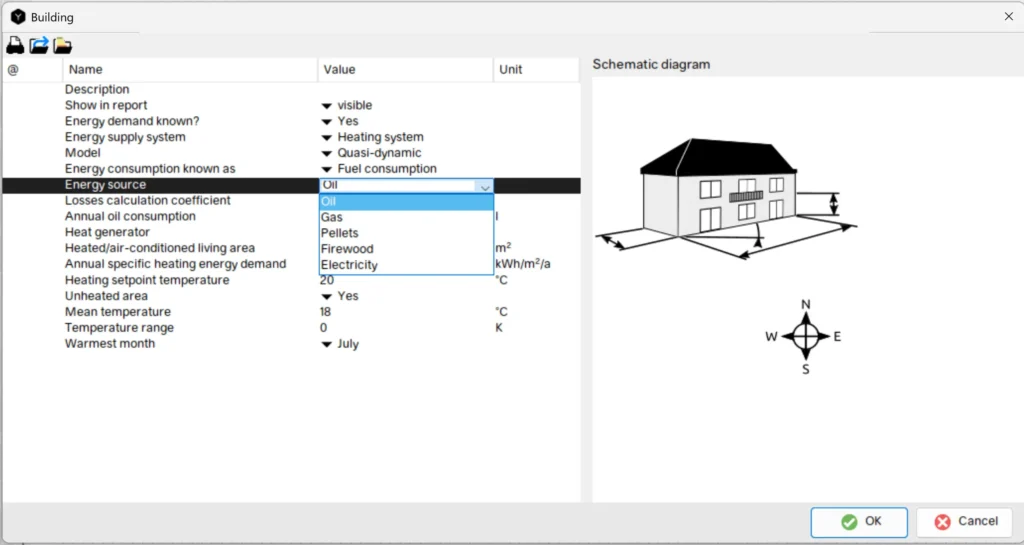
Heating load based on fuel consumption
The heating load is estimated by entering the annual fuel consumption (e.g. heating oil, gas, pellets).
Full-load hour method
The heating load can be estimated on the basis of the maximum output and the full load hours.

Dynamic model
If the building data, such as year of construction, materials, proportion of glass and other data, is available, Polysun has a dynamic model that can be used to calculate the heating load. However, this model is not DIN-EN-12831-1 compliant, as this standard calculation offers a higher accuracy of the heat load calculation.

The dynamic model is used to calculate the heating or cooling requirements of buildings, especially if the actual heat load of the building is not known and must therefore be calculated depending on the physical parameters of the building. It takes into account all essential aspects of a building’s thermal behaviour by including both heat losses (e.g. through transmission, ventilation and infiltration) and heat gains (e.g. through solar radiation, internal sources such as people, lighting and appliances).
Annual energy demand, monthly energy demand, hourly energy demand
In a case where the energy demand is known (e.g. from energy certificates or with a heating load calculator), this can be integrated into Polysun in annual, monthly, hourly and even 15-minute resolution.
Annual energy demand
If the annual energy demand is known, this can be used directly as the basis for determining the heating load.
Mothly energy demand
Similar to the annual demand, but with a monthly breakdown, which is suitable for buildings with seasonal fluctuations in heat demand.
Hourly energy demand
The aim of this model is to import heating and/or cooling demand for the building in the form of hourly or 15-minute values, either from meter readings or other software.
Presentation and Interpretation
After selecting a method and running the simulation, Polysun provides multiple result presentation options, such as hourly resolution, simulation analyses, or economic calculations. These tools support informed decision-making for system design.
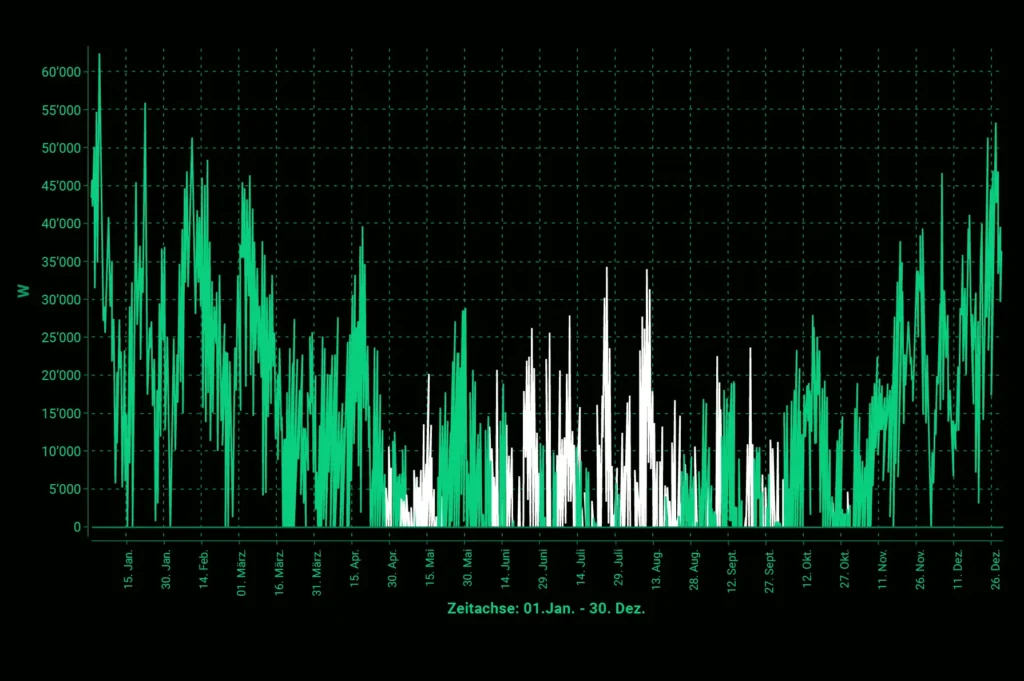
Note: These estimation methods offer quick guidance but do not replace detailed thermal load profiles calculated per standards like DIN EN 12831-1, ASHRAE 183, or CIBSE guidelines. They are particularly helpful when specific building properties are unavailable, though they provide only rough estimates.
Limits of Estimation Methods and Polysun’s Role in Planning
Estimating heating load from consumption data does not account for specific building envelope characteristics, such as insulation or window quality, making it suitable only as a preliminary assessment in early planning phases. For precise design, a detailed calculation according to standards like DIN EN 12831-1, ASHRAE 183, or CIBSE guidelines is preferred, especially for large or complex systems. Polysun enhances such calculations by importing heating load profiles from specialized software and integrating them into comprehensive system planning. This allows the design of complex energy systems for buildings like hospitals, schools, or industrial halls, as well as heating networks. Polysun enables you to design the optimal configuration of complex energy systems, for example a heat pump cascade. In this design, each heat pump is optimally sized based on the heat load and paired with correctly sized buffer storage. To plan this accurately, an accurate heat load calculation is essential.
Calculation According to the Norm
Standards like DIN EN 12831-1 (Germany), ASHRAE 183 (US), and CIBSE guidelines (UK) provide detailed procedures for calculating heating load, based on comprehensive building data such as construction year, materials, usage, and climatic conditions. These are especially suitable for larger systems, ensuring high accuracy. Other norms, like DIN EN 15378, offer less precise methods for initial estimates, relying on simplified assumptions (e.g., building age and square footage). These simpler approaches often fall short for complex buildings like hospitals or commercial properties due to their variable usage profiles and specific requirements.
Software Support for Heating Load Calculation According to Norms
Various software solutions are available for calculating heating load per standards like DIN EN 12831-1, ASHRAE 183, or CIBSE guidelines, each offering specialized functions. Polysun complements these tools by importing calculated profiles and enabling system-level simulations.
Conclusion
Accurate heating load calculation is critical for planning reliable, efficient, and economical energy systems. Detailed calculations per standards like DIN EN 12831-1, ASHRAE 183, or CIBSE guidelines deliver the most precise results, while estimating heating load from consumption data (e.g., via the full load hours method) provides a practical alternative when detailed data is lacking. Polysun supports planners by importing heating load data and optimizing energy supply variants through system simulation. With capabilities like economic evaluation of heat pumps, and heat pump sizing, Polysun is an indispensable tool for modern energy system planning.
Further information:
FAQ
Which Norms Apply for Heating Load Calculation?
Key norms for heating load calculation include:
DIN EN 12831-1 (EU): “Energy performance of buildings – Method for calculation of the design heat load”
ASHRAE 183 (US): “Peak Cooling and Heating Load Calculations in Buildings Except Low-Rise Residential Buildings”
CIBSE Guide A (UK): “Environmental Design,” providing detailed methods for heating load calculations
ISO 52016-1: “Energy performance of buildings – Energy needs for heating and cooling”
These standards provide detailed methods for determining heating load based on building characteristics and climatic conditions.