
Plate Heat Exchanger Design
A central component of many thermal systems is the plate heat exchanger, which ensures efficient heat transfer between different media. Polysun supports the precise plate heat exchanger design by taking into account key parameters such as heat transfer area, material properties, and flow conditions.
The plate heat exchanger design in Polysun helps determine the optimal size and configuration of the heat exchanger to achieve the desired performance with minimal losses and pressure drops. This enables planners to reduce costs, improve operational reliability, and increase the overall energy efficiency of the system.
Thanks to Polysun’s flexible modeling capabilities, both internal and external heat exchangers can be realistically represented and integrated into a wide variety of system types. This provides users with a solid foundation for informed technical decisions and economical planning.
Design with Plate Heat Exchanger Component
Polysun makes available some types of systems with internal heat exchangers and others with external heat exchangers. The transfer rate of the exchanger is higher when the surface area of transfer is larger (that means the overall surface area of the heat exchanger), the thinner the walls of the tubes and the greater the conductivity of the material of which the heat exchanger tube is made of. Finally the fluid velocity in the tube is important, which depends on the flow rate. The number of “parallel heat exchanger coils” indicates how many exchangers are used in parallel (for example arranged one in another).
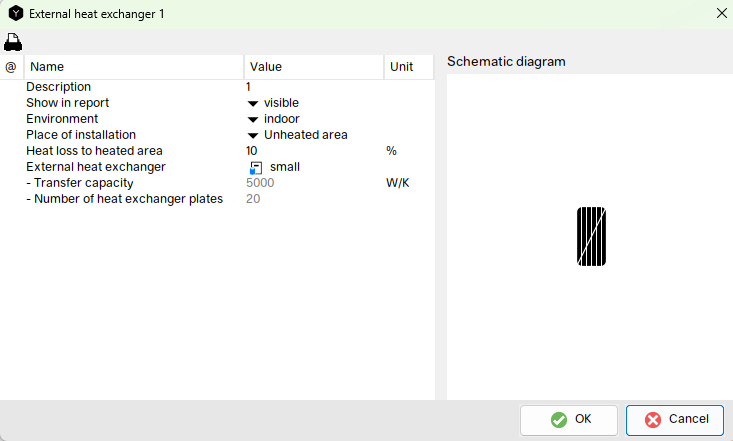
In an external heat exchanger a “fixed entry height” or a “variable entry height” (of a stratifier lance) may be chosen. It is possible to define the lowest position or the highest position of the stratifier lance. Curiously the optimum height of the stratifier lance is not the highest layer, but at about ¾ of the tank height. It results that in the upper part of the tank there is no “perfect” stratification, but heat losses are not as high at the top cover. The stratifier lance should reach at least the level for daily consumption requirements.
The product of the thermal transmission coefficient k [W/m2/K] multiplied by the transfer surface A [m2] gives the thermal transfer rate of the heat exchanger, which results in the order of thousands of W/K. The parameter Δt indicates that which is (or should be) the difference in hot water temperature between the collector and the tank, in order to transfer to the tank by means of the exchanger the power density of 500 W/m2. This parameter depends on the transfer rate and the surface area of the collector.
The volumetric flow rate on the collector side can be determined by means of the flow rate. The volumetric flow rate on the tank side is determined by the fact that the capacity flow rate (= flow rate multiplied by the heat capacity of the fluid) is the same on both sides of the heat exchanger. If a glycol mix is being used in the collector loop, but only water in the tank, the two volumetric flow rates are not the same.
Plate Heat Exchanger in the Consumption Loop
The use of the heat exchanger in the consumption loop doesn’t only regard the fact that heat needs to be transferred in the most efficient way possible, but also that the desired water temperature needs to be reached. For this reason pump regulation in respect to the tank of the heat exchanger is provided for, in such a way that the user can directly obtain water at the desired temperature.
The temperature that needs to be found in the upper part of the tank in order to obtain the desired water temperature is indicated in the lowest line of the dialogue under “minimum tank temperature required”. It depends on the temperature of hot-cold water, transfer rate and nominal flow rate. The nominal flow rate indicates the maximum quantity of hot water received per unit of time. The corresponding “withdrawal power” is indicated, too.
Which fluids (primary and secondary side) can I use with a plate heat exchanger in Polysun?
In plate heat exchanger design with Polysun, various fluids such as water, brine, or antifreeze can be used. The software automatically accounts for physical properties like density, heat capacity, and viscosity in the calculation.
What flow rate is required?
For plate heat exchanger design, the flow rate is calculated based on the required heat output and temperature difference. A higher flow rate increases heat transfer but also raises pressure drop and pumping effort.
How do I select the heat transfer area and coefficient?
The required heat transfer area depends on the heat transfer coefficient (k-value), which is determined by the fluid, flow velocity, and plate geometry. Polysun provides predefined values and also includes safety margins for realistic operating conditions.
Which standards and safety factors should be considered?
Plate heat exchangers must comply with standards such as EN 1148 and ISO 9001, as well as pressure equipment regulations (PED). A safety margin of 10–20 % is typically applied during design to account for load fluctuations or aging.
How do I account for partial load operation and variable load profiles?
Plate heat exchangers remain efficient under partial load as long as flow rate and temperature difference are adjusted. In Polysun, variable load profiles can be simulated to reliably assess performance under different operating conditions.