
Standard Templates for optimal HVAC Design
Polysun provides a versatile range of standard templates, including specialized HVAC design templates, offering an efficient and practical foundation for simulating solar systems, hybrid energy systems, and heating, ventilation, and air conditioning (HVAC) setups. These templates cover a wide spectrum—from simple domestic hot water systems to space heating, pool heating, and complex combinations with heat pumps or photovoltaics. By selecting appropriate HVAC design templates, users can quickly adapt system design, hydraulic configurations, and controls to project-specific requirements. This enables Polysun to deliver realistic and precise simulations, reducing planning time and providing a solid basis for informed decision-making.
When a custom configuration is needed, Polysun supports the step-by-step modification or expansion of HVAC design templates—ideal for complex systems with multiple circuits, common in HVAC applications. The simulation provides detailed results to accurately analyze and optimize system efficiency, solar coverage, and heating demand. As a result, Polysun is an indispensable tool for HVAC planners, engineers, and energy consultants in the digital design of modern solar thermal, hybrid, and HVAC systems.
Choosing the Right HVAC Design Template
We recommend starting your system design with one of Polysun’s standard templates, such as an HVAC design template. Application-specific templates are available for the following use cases:
- Single-family homes
- District planning & heating networks
- Multi-family housing
- Hotels
- Industrial sites
- Commercial buildings
- Pools & wellness facilities
- Hospitals
- Schools
- Kindergartens
These standard templates, including HVAC design templates, can be found in the main window under the filters for application fields, categories, and components.
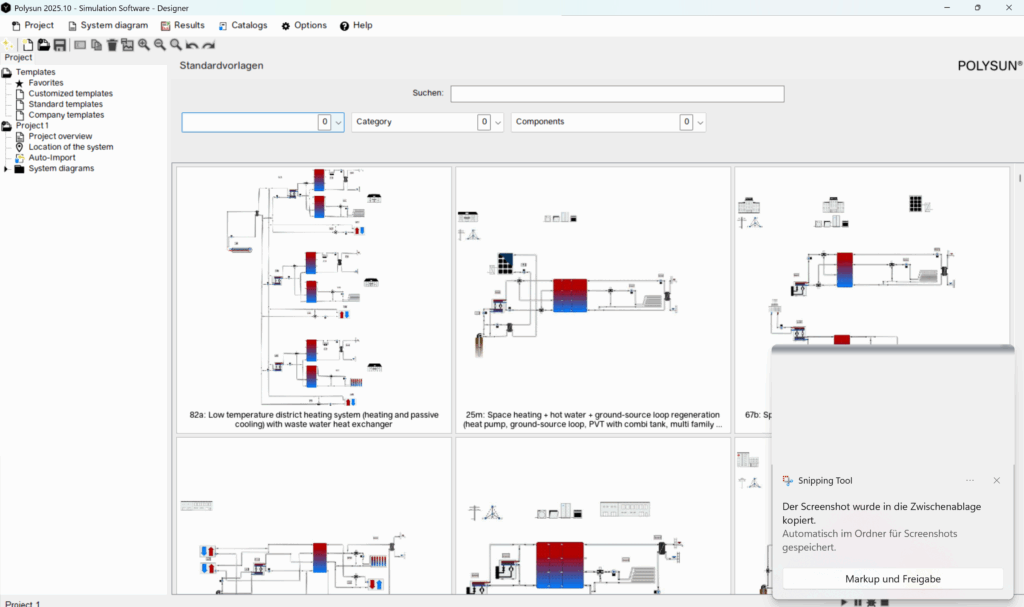
The templates can be selected thematically based on the following categories:
- Heat pump cascade
- Bivalent systems
- Parallel buffer storage
- Serial buffer storage
- District heating network
- District heating supply
- Renovation of existing buildings
- New construction
- Large-scale heat pump
- Waste heat recovery for data centers
- Industrial waste heat recovery
- Waste heat recovery
Power-to-heat - Geothermal ground source loop
- Geothermal collector
- Domestic hot water
- Heating
- Cooling
- Electricity generation
- Minergie (energy efficiency standard)
- Process heat
- Self-consumption optimization
- Free cooling
- Fresh water station
- Combined storage
- District heating feed-in
As a third option, you can filter based on the components present in the hydraulic schematic. These include:
- Air-to-water heat pump
- Water-to-water or brine-to-water heat pump
- Wastewater heat exchanger
- Battery
- Ice storage with spiral heat exchanger
- Energy sink/source
- Geothermal probe
- eTank
- External heat exchanger
- GeoCollect ground storage
- Groundwater probe
- Boiler
- Solar collector
- Air-to-water heat exchanger
- Fan
- Photovoltaic system
- PVT collector
- Swimming pool
The HVAC design template you choose should closely match the technical specifications of the system you are planning. The key parameters to consider when selecting the appropriate HVAC design template include:
- Type of system: Monovalent system, district heating, process heat
- Demand (domestic hot water, heating, and/or pool)
- Energy generation (solar collector, PVT, heat pump) and energy storage (buffer storage, combined storage, ice storage) of the system
Adapting a Template
As soon as the template is chosen, it shall be adjusted in accordance to the project requirements. There are two possible cases:
- The chosen template has the same or very similar configuration to the real system;
- the chosen template includes only some parts which correspond to the real system.
In the first case, the hydraulic configuration of the template shall be adjusted to the real system, thus some components as well as controllers can be added or deleted. All the components of the system have to be carefully checked for compliance with the technical specification of the real system. For example, type/model of the boiler, solar collector, etc.
The settings of the building and the building type must be checked. For example:
- type of the building, which influences building losses;
- size of the building, which determines the heating area;
- size and type of the windows, which determine solar gains.
Domestic hot water and heating systems must also be checked. For example, the following parameters shall be considered:
- required temperature and the flow-rate of the water;
- the required volume of the hot water;
- the temperature of the cold water shall be set according to the location in the cold water tap component. More detailed information about the cold water can be found in the chapter Cold Water;
The system with a pool might require different switching times for the three-way valve, which is connected to the pool loop.
When the parameters of the main system components have been checked, the next step is to size the equipment in accordance to the given load. At this design stage the rules of thumb might be very helpful, such as:
- Storage tank shall be approximately 50/100 l per square meter of the flat-plate solar collector;
- Flat-plate heat exchanger shall be in the range of 0.05 to 0.08 m2 per square meter of the flat-plate solar collector;
Please note, that the volume heated up by the auxiliary heater shall be big enough to satisfy the DHW demand entirely.
If it is required, new controllers shall be added and set up. The easiest way to set up a new controller is to find a similar technical configuration in another template, copy controller to the designed system and make changes according to the given technical specifications.
After you have completed all the above steps, the first simulation can be run.
In the second case, the task is more difficult: to build a complex new system, which would work right away. Therefore, it is recommended to build the system step by step using the hydraulic components (collector loop, auxiliary heater loop, heating loop), starting from the one available in the template and gradually adding the rest. In order to make the first loop work, a load is required (DHW, space heating, pool). Therefore, one of the loads shall be added to the first loop. After that, the controlling strategy can be set up and then the simulation can be run in order to check if this part of the system works. The components shall be added one after another, until the planned system has been designed. Using the suggested procedure, it will be easier to detect problem zones, which might block the simulation (e.g. missing controlling inputs, too complex hydraulics, etc.).
The main aim is to design all hydraulic connections and set up all the controllers. It makes sense to start from the part of the template, which corresponds to the real system (e.g. solar collector loop).
Once the final hydraulic layout of the system has been designed, you can size the system according to the recommendations of the first case.
System Optimization and Analysis of Results
As soon as all abovementioned steps have been implemented, the simulation can be started in order to size all components correctly and to optimize the controlling strategy. First, the analysis of the results has to be done. The most important parameters of the solar thermal system are: solar fraction (a ratio of the generated solar energy to the total generated energy) and the ratio of the solar energy yield (Qsol) to the available energy onto collector aperture area (Esol). Using the key figures, the effectiveness of the solar energy utilisation and the level of the auxiliary energy consumption can be estimated.
If the energy requirements are not met, the size of the equipment has to be checked (size of the collector field and/or storage tank and/or auxiliary heaters) and the controlling strategy. Be aware, that the controlling strategy has to be optimized depending on the system location (climate data), type of load (temperature of the DHW, type of the space heating system (floor heating or radiator)) and energy goals (e.g. solar fraction). The following controller settings must be checked, since not always the default settings are suitable for specific projects:
- availability times of auxiliary heater/s;
- sensor positions.

If the system works well and the energy demand is covered, you can try to increase the solar fraction and collector efficiency by reducing auxiliary energy (e.g. reducing the availability of the auxiliary heater and auxiliary energy volume in the storage tank).
Another factor that should be considered during the system analysis is the stagnation temperature of the solar collector. It can be checked in the solar collector component results for each individual case. There are two important outputs: stagnation time and maximum temperature of the collector field.
