
Energy Sink/Source Thermal Modeling: Heat & Cooling Simulation
The Energy Sink/Source module enables the thermal modeling of processes where inlet and outlet temperatures, as well as power input or output, are specified within defined parameters. This allows for the simulation of various processes such as heat absorption, heat dissipation, cold absorption, and cold dissipation within the energy system. Common examples of such applications include waste heat recovery, process cooling, server room cooling, and the integration of energy into heating networks.
When configuring the module, you can select either a version with or without an integrated pump. If the integrated pump option is chosen, the module operates at the calculated nominal flow rate. In this scenario, modulation of the flow rate is not possible, meaning the flow rate cannot be freely adjusted.
For simulation, you can choose between two models: the Standard Model and the Constant Power Model.
Energy Sink/Source without a profile
If the Energy Sink/Source module is selected without a profile, the module calculates for the entire year using the entered values for inlet temperature, outlet temperature, and specified power.
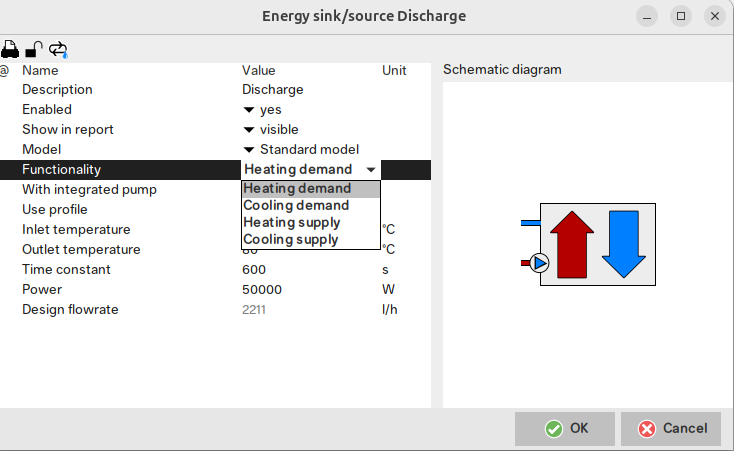
The components function can be set through the table property ‘Functionality’. Such a property, defines the type of energy exchange modeled by the component, that can be:
- Heating demand (e.g., process heating demand, building heating demand, DHW).
- Cooling demand (e.g., process cooling demand, building cooling demand, server cooling)
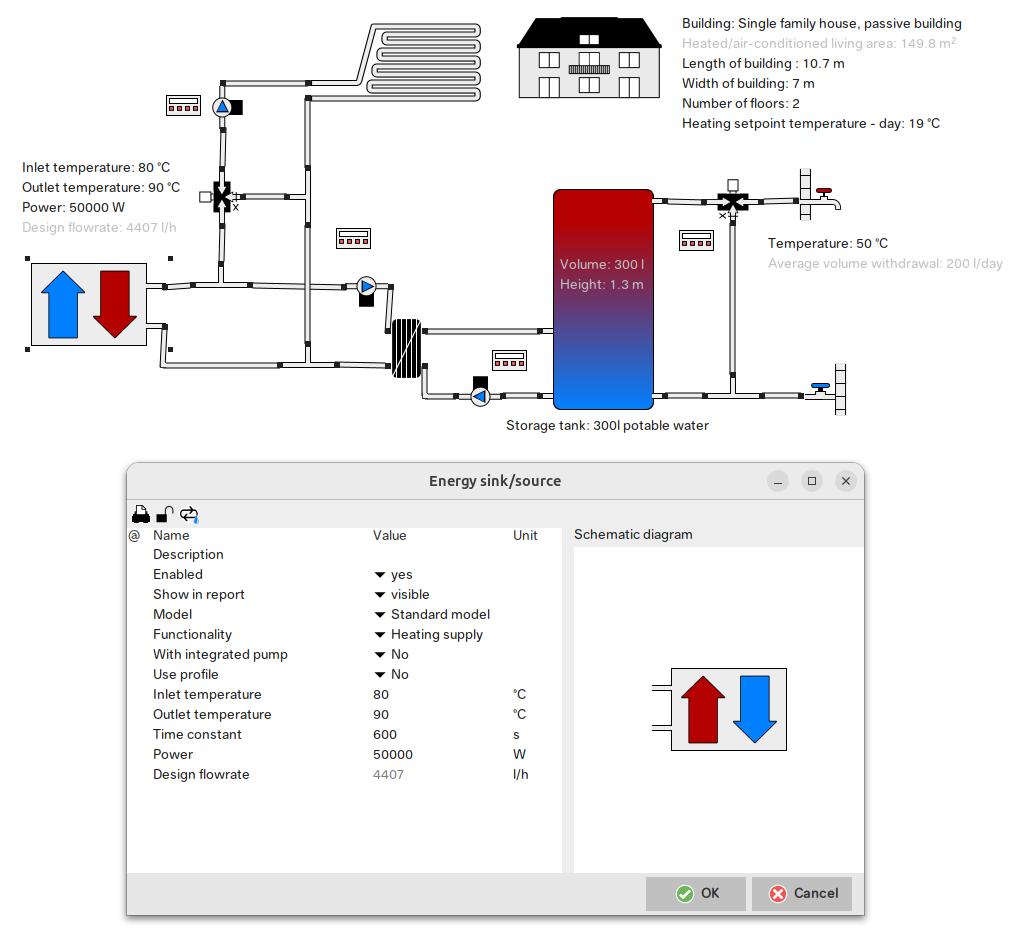
- Heating supply (e.g., generic heat generator, district heating, waste process heat)
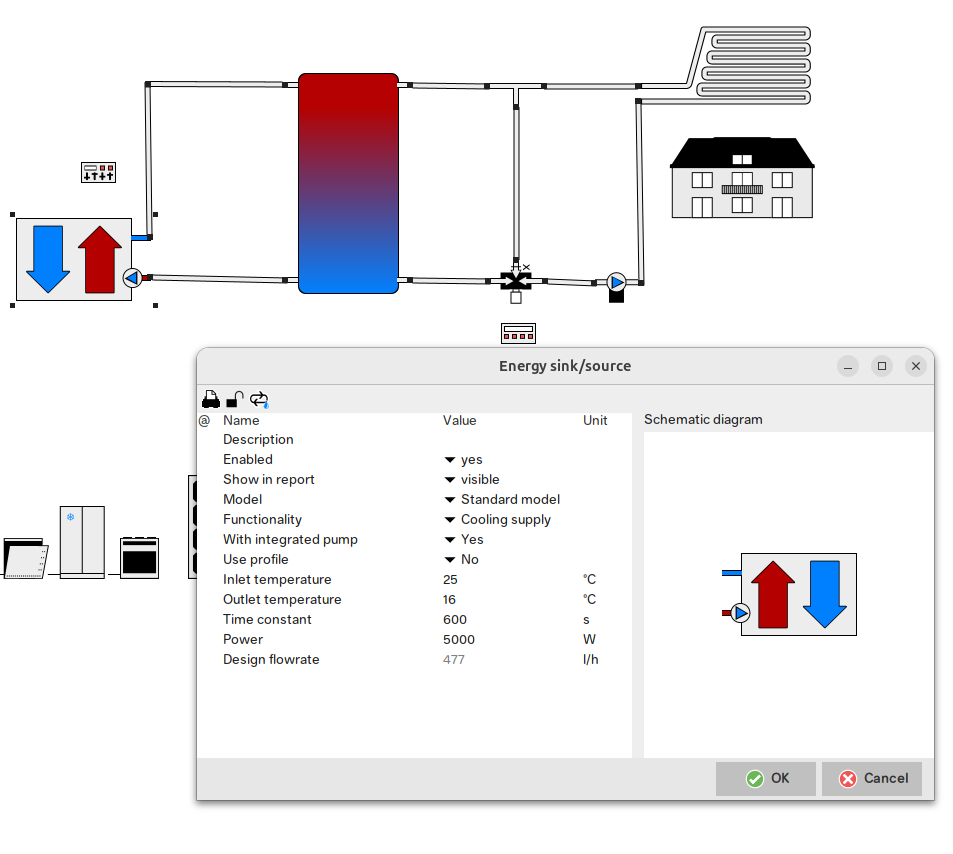
- Cooling supply (e.g., generic cold generator, district cooling, waste process cold)
Energy Sink/Source with a profile
A profile can be added to the Energy Sink/Source module. Within this profile, the inlet and outlet temperatures can be defined for any time interval. The calculation then follows the principles of either the Standard Model or the Constant Power Model, depending on the model selected by the user.
Similarly to the case without profile, different configurations can be chosen in the form of profile types:
- Heating and cooling demand (combined profile that simulates both a heating and cooling demand)
- Heating demand
- Cooling demand
- Heating supply
- Cooling supply
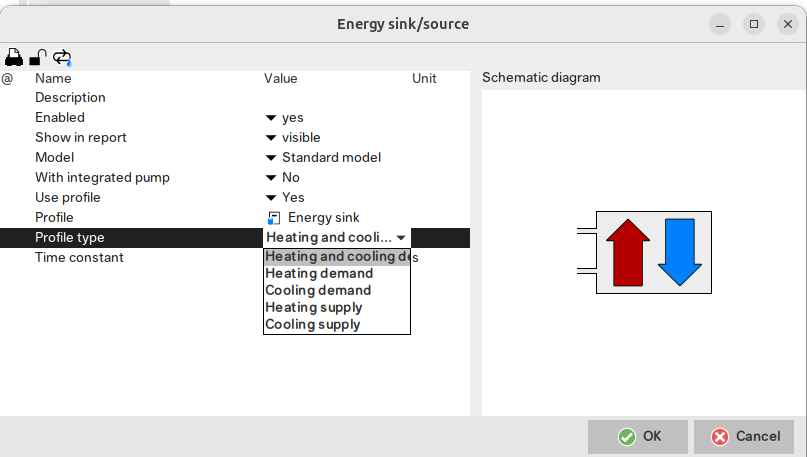
Funcionality – Profile type
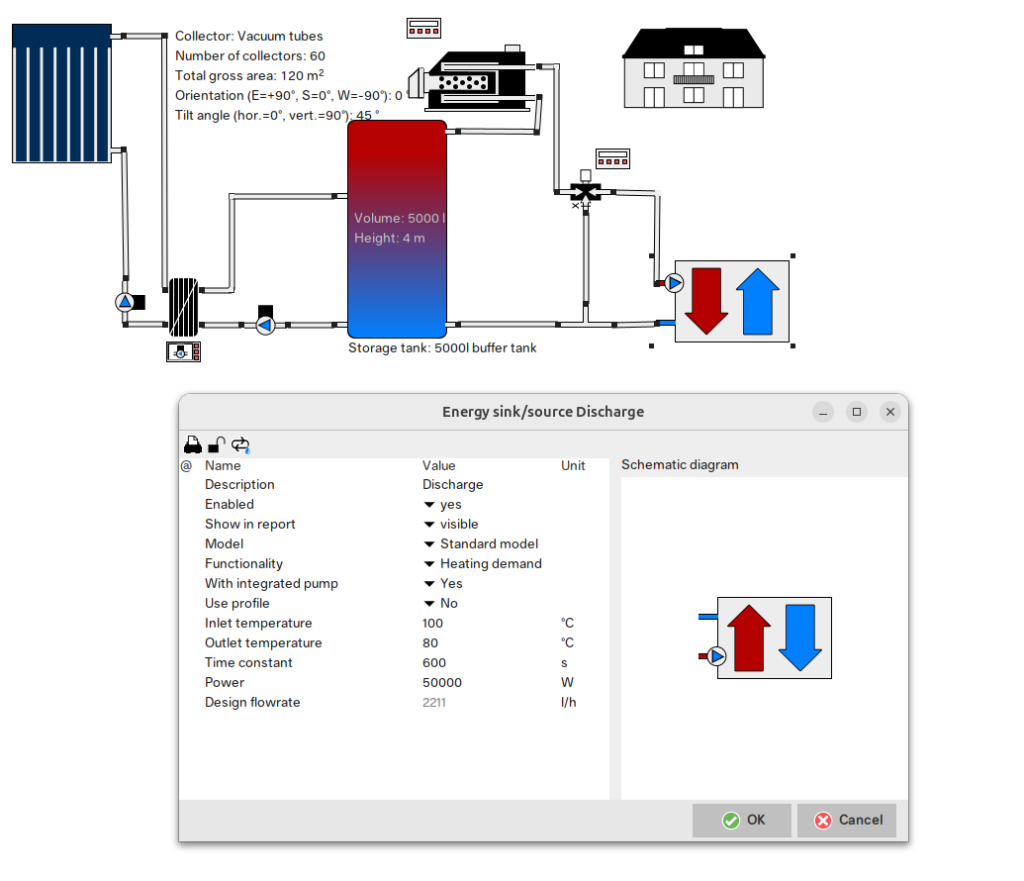
Heating Demand
In this configuration, the thermal power is released from the fluid to the energy sink/source component, thus the inlet design temperature must be higher than the outlet design temperature.
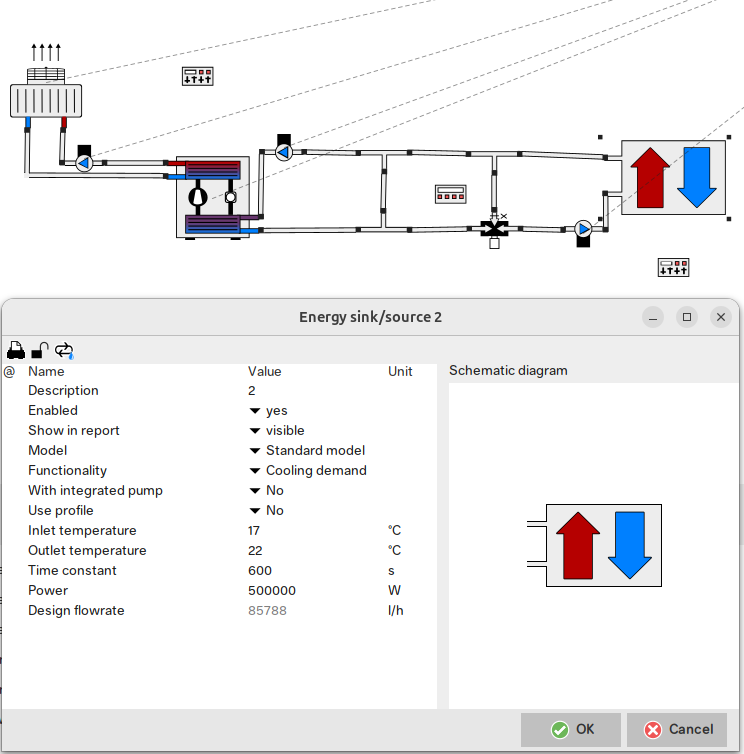
Cooling demand
The thermal power is flowing from the energy sink/source component to the system fluid, thus the inlet design temperature must be lower than the outlet design temperature.
Heating Supply
The thermal power is flowing from the energy sink/source component to the system fluid, thus the inlet design temperature must be lower than the outlet design temperature.
Cooling Supply
When this functionality is set, the thermal power is released from the fluid to the energy sink/source component, thus the inlet design temperature must be higher than the outlet design temperature.
Standard Model
In the standard model, the actual outlet temperature is always equal the design outlet temperature:
\(T_{out} = T_{out,set}\)
If the actual inlet temperature deviates from the design inlet temperature, the power output/input changes accordingly:
\(\dot {Q} = \dot {V} \cdot (e_{out} – e_{in})\)
Where \(e\) is the volumetric specific energy of the fluid \([J/m^{3}]\), function of the temperature:
\(e_{out} = e(T_{out})\)
\(e_{in} = e(T_{in})\)
and \(\dot {V}\) is the actual flow rate flowing in the component. If the pump regulating the energy sink source refers to the design flow rate of the energy sink source, then:
\(\dot V = \frac {\dot {Q}_{set}}{\left| e_{out,set} – e_{in,set} \right|}\)
Constant Power
In the constant power model, the temperature difference between outlet and inlet temperature is always constant and equal to the design delta T. If the inlet temperature deviates from the set inlet temperature, then the outlet temperature deviates accordingly so that the delta T does not change. Differently from the standard model, in the constant model the transferred/released power is calculated as difference between the set power and the power deficit:
\(\dot{Q} = \dot{Q}_{set}-\dot{Q}_{def}\)
\(\dot{Q}_{def} = \dot{V}_{nom} \cdot (e_{in}-e_{in,set})\)
and \(\dot {V}\) is the design flow rate of the energy sink source, then:
\(\dot{V}_{nom} = \frac{\dot{Q}_{set}}{e_{out,set}-e_{in,set}}\)
How does the Energy Sink/Source module improve the design of heating and cooling systems?
How does the Energy Sink/Source module improve the design of heating and cooling systems? The Energy Sink/Source module allows precise thermal modeling by defining inlet and outlet temperatures and power input/output, ensuring accurate simulation of processes like waste heat recovery, process cooling, or district heating integration. This helps optimize system sizing, efficiency, and performance for applications like server room cooling or building heating.
Can I customize the Energy Sink/Source module for specific time-based energy demands?
Yes, the module supports profiles where you can define inlet and outlet temperatures for any time interval, allowing tailored simulations for varying demands, such as combined heating and cooling profiles or specific process requirements like server cooling or district energy systems.