
Cooling Demand Calculation Analogous to Cooling Degree Days
The degree-hour model can be applied not only to assess heating demand but also to determine cooling demand. As with the heating model, the base temperature is compared to the outdoor temperature to calculate the cooling demand using available data. For each hour, the necessary thermal energy is computed to maintain the desired indoor temperature. This building model is particularly suitable when detailed building data is unavailable. Polysun also offers alternative approaches to incorporate cooling energy demand into the design of energy systems.
Entering Energy Demand
To calculate the cooling demand using the degree-hour model, building consumption data is required. Polysun offers four different input options for this purpose:
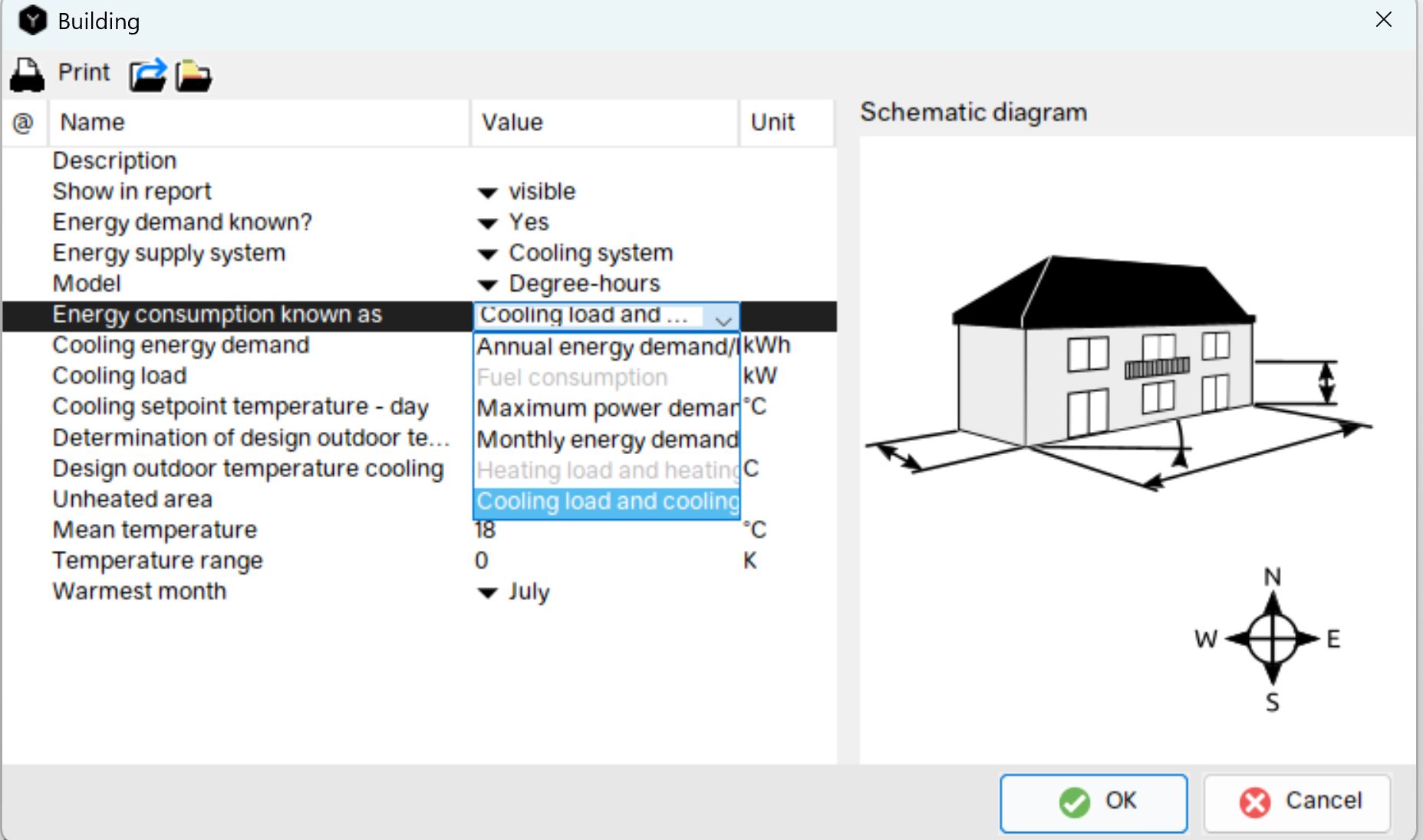
Annual energy demand/losses
The annual cooling demand is specified in kWh. This model is suitable, for example, when the cooling demand is known or has been calculated elsewhere.
Monthly energy demand/losses
As for the annual energy demand, this definition method allows an energy amount in kWh to be specified, but the input must be provided separately for each month. This approach is particularly suitable for buildings whose cooling demand deviates from the typical seasonal distribution.
Maximum power demand
For this selection, the maximum power demand must be entered.
The maximum possible internal heat gains are calculated based on user-defined specifications:
<p><p><p><p><p><p dir=”auto”>\(Q_{gain,max} = Q_{dem,max} \cdot c_{gains}\)
Here, \(Q_{dem,max}\) is the defined maximum power demand of the building, and \(c_{gains}\) is the gain calculation coefficient.
In the next step, the UA value is calculated, taking into account the maximum outdoor temperature and the set indoor temperature:
\(UA = \frac {Q_{gain,max}} {T_{amb,max} – T_{set}}\)
From this, the heat gains are calculated, but only for outdoor temperatures that exceed the target indoor temperature:
\(Q_{gain}[h] = \frac{UA \cdot (T_{amb} [h] – T_{set})} {1000}\)
\(Q_{gain} = \sum Q_{gain}[h]\)
The cooling load is then calculated from the heat gains and the gain calculation coefficient:
\(Q_{dem,cooling} = \frac{Q_{gain}}{c_{gain}}\)
Cooling load and cooling energy demand
For this building model, the cooling load is applied at the design outdoor temperature. For example, 75 kW cooling load is applied at 32 °C. This design outdoor temperature cooling can be derived from the location or entered manually. The cooling energy demand is then distributed automatically throughout the year based on the outdoor temperature.
Once the method has been selected and the necessary information entered, Polysun will obtain the required building data. The simulation can then be run.
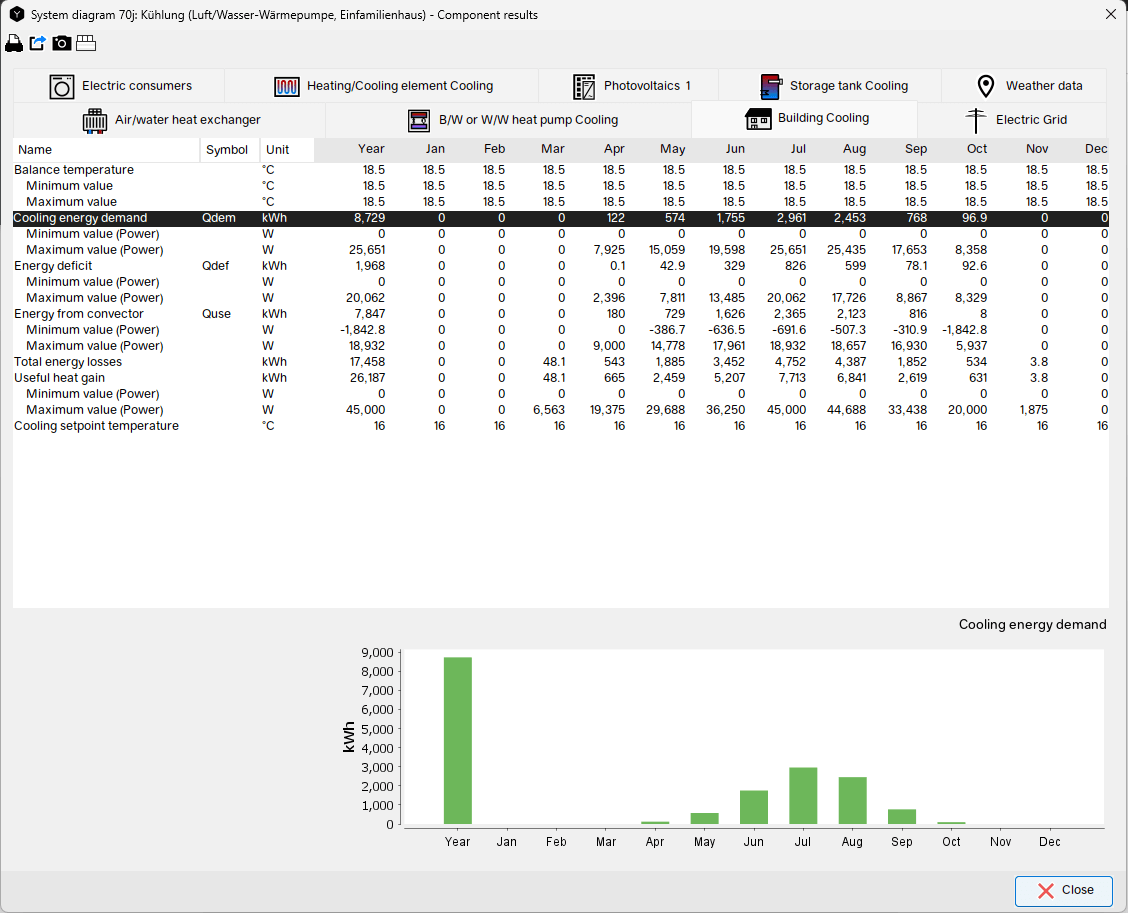
The results can be displayed at various resolutions, including monthly and hourly values, as well as timestep values.
Calculating Cooling Energy Demand: Methods and UA Value Differences
For all types of energy demand input, the cooling energy demand and energy gains are either directly queried in the building’s context menu or calculated from user inputs (e.g., maximum power demand). The method for calculating the cooling energy demand is analogous to that for the heating energy demand, with the formulas described in detail.
Cooling vs. Heating Demand Calculation: UA Value Calculation Based on Heat Gains and Losses
The cooling demand is calculated based on the building’s heat gains. Heating demand, in contrast, is determined by heat losses. An example below illustrates how the UA value calculation for cooling energy demand differs from that for heating energy demand.
Cooling load: \(UA_b = \frac{Q_{gain} * 1000} {Sum_{T_{diff}}}\)
Heating load: \(UA_b = \frac{Q_{loss} * 1000} {Sum_{T_{diff}}}\)
Selection of Heat Gains
The cooling energy demand can be influenced by the selection of heat gains. If the heat gains are set to “high,” the user can define the base temperature themselves. If the “normal” setting is chosen, Polysun calculates the base temperature, just as it does for the heating model.
Energy Deficit
The energy deficit is calculated as the difference between the cooling energy demand and the cooling provided by the convector:
\(Q_{def} = Q_{dem,cooling} – Q_{conv}\)
A warning appears if the calculated energy demand is not met and one or both of the following scenarios occurs:
- The energy deficit exceeds 50% of the energy demand for a total of 12 hours in at least 10 consecutive periods
or
- The energy deficit exceeds 30% of the energy demand for a total of 24 hours in at least 5 consecutive periods
Is Polysun able to consider complex multi-energy source systems?
Yes, Polysun is designed to simulate and optimize complex energy systems integrating multiple sources. Technologies such as heat pumps, photovoltaics, solar thermal, batteries, cogeneration units, geothermal probes, pellet boilers, and others can be configured and combined within a single project. Polysun provides numerous templates and supports customized design of energy systems, facilitating the planning, comparison, and optimization of holistic and hybrid energy solutions for buildings and districts. This functionality enables modeling of integrated systems for electricity, heating, cooling, and domestic hot water, ensuring reliable and energy-efficient performance.