
Calculating Space Heating Demand for Optimal HVAC Design
The Dynamic Model is used to estimate the space heating or cooling demand of buildings, particularly when the actual heating demand of the building is unknown and must therefore be determined based on the building’s physical parameters. It accounts for all essential aspects of a building’s thermal behavior by incorporating both heat losses (e.g., through transmission, ventilation, and infiltration) and heat gains (e.g., from solar radiation, internal sources such as people, lighting, and equipment).
The building icon represents either heated or cooled spaces (the living area to be heated, including the walls), unheated spaces (such as garages, basements, or technical rooms where the heating system can be installed), or both. The heated/cooled spaces can be simulated using various building models. This allows for a more accurate approximation of the actual space heating demand.
The Dynamic Model enables the definition of the building using adjustable standard dimensions and a wide selection of building types from a catalog (which in turn represent numerous international standard building types).
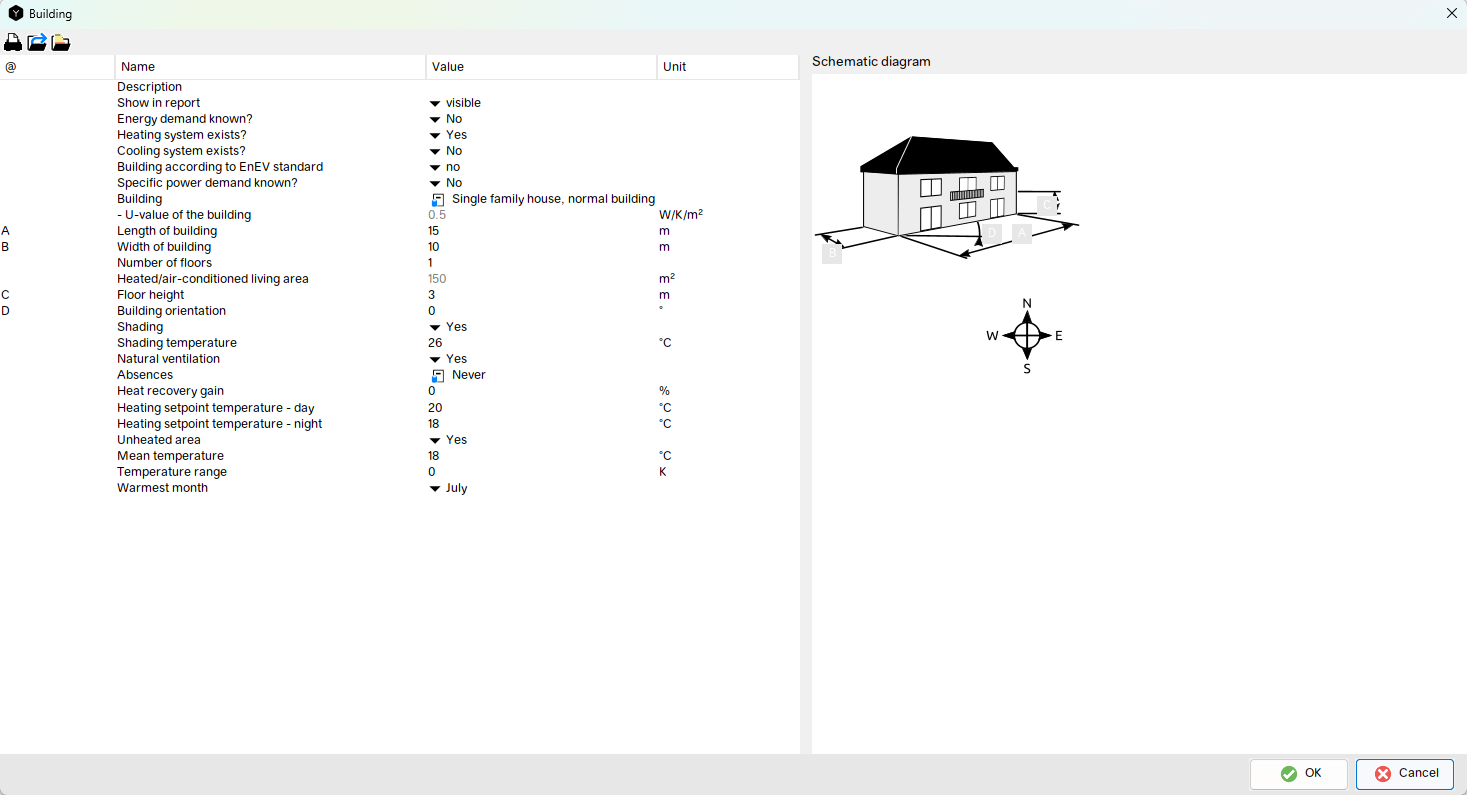
The building properties can be modified in the catalog. When doing so, ensure the U-value is adjusted accordingly. The U-value applies to the entire building, including doors and windows.
Dynamic Model: Simplified Space Heating Demand Calculation
Integrated into the simulation algorithm of Polysun is a dynamic calculation of the building’s thermal space heating demand, based on the heating/cooling energy balance equation, presented here in a simplified form:
\(HG – HL = MCp \cdot \frac{\Delta T}{\Delta t}\)
\(HG\) = Heat gain [W]
\(HL\) = Heat loss [W]
\(MCp\) = Heat capacity [J/K]
\(\Delta T\) = Temperature change per time step in the building [K]
\(\Delta t\) = Time step [s]
This equation accounts for passive heat gains from the sun, body heat from occupants living in the building, air exchange rates, the type of lighting, and the presence of electrical appliances. The window-to-wall ratio (WWR) allows for consideration of the impact of the glazing type used. Depending on the windows selected, this is reflected in the SHGC value (Solar Heat Gain Coefficient).
Dynamic Model: Primary and Secondary Parameters
The entered building parameters are divided into primary and secondary parameters:
Primary Parameters for Heating Load Calculation
Geometry: Building length (\(l \)), width (\(w \)), number of floors (\(N_{f} \)), and floor height (\(H_{f} \)) define the size and shape of the building.
Orientation: The building orientation (\(O \)) relative to north influences the solar gains.
Building Properties:
- The U-value (\(U \)) is the heat transfer coefficient of the building envelope (W/k/m²).
- The specific heating load (\(SP_{b} \)) indicates the required heating power per unit area (W/m²).
- The heat capacity (\(C_b\)) describes the building’s ability to store heat (kJ/K/m2).
- The g-value (\(g \)) is the solar energy transmission coefficient of windows and indicates the proportion of solar radiation that passes through.
Ventilation and Infiltration:
- The air change rate (\(ACH \)) indicates how often the air is exchanged per hour (1/h).
- The air infiltration rate (\(AINF \)) describes the air entry into the building via leaks in the building envelope (1/h).
- The specific heat capacity of the air \(c_{p,a}\).
- The air humidity \(\rho_a\).
Internal Heat Gains:
- Specific internal heat gains from lighting (\(q_{light} \)), appliances (\(q_{equip1} \), \(Q_{equip2} \)), and people (\(q_{people} \)) are given in W/m².
- Internal heat gains from certain appliances per floor (\(Q_{equip2} \)) are given in W.
Shading: The shading temperature (\(T_{shade} \)), indicates the room temperature at which shading should be switched on.
Building setpoint temperature: The setpoint temperature for daytime operation (\(T_{set,d} \)) and nighttime operation (\(T_{set,n} \)) is determined.
Weather Data: The minimum ambient temperature (\(T_{amb,min} \)) is used for heating load calculations.
Secondary Parameters for Heating Load Calculation
Building area: \(A_{b} = l \cdot w \)
Building volume: \(V = A_{b} \cdot N_{f} \cdot H_{f} \)
UA Value: A Key Parameter in Building Heating Load Calculations
The UA value (W/K) is a key parameter, particularly in calculating heat losses. It indicates how much heat is lost through the entire building envelope when there is a temperature difference of one Kelvin between the indoor and outdoor temperatures.
Polysun provides two calculation approaches to determine the UA value of the building:
Unknown Specific Energy Demand
If the specific energy demand is not known, the U-value of the building is used for the calculations.
\(UA_b = U_b \cdot A_{ext}\), where \(A_{ext}\) is the exterior surface area of the building and \(U_b\) is the U-value of the building.
Known Specific Energy Demand
If the specific energy demand is known, the specific energy demand \(SP_b\) of the building is used instead of the U-value.
\(UA_b = \frac{(Q_{gain} – Q_{vent} – Q_{inf} + SP_b \cdot A_b \cdot n_f) \cdot 0.7}{(T_{set} – T_{amb})}\)
Building Heat Loss Formulas in Detail
Transmission losses
Transmission losses are the amount of heat lost through the entire building envelope. They are caused by the temperature difference between the inside temperature of the building and the outside temperature. These are calculated using the following formula:
- \(Q_{amb} =UA_b \cdot (T_b – T_{amb})\)
Here, \(T_b \) represents the building temperature, and \(T_{amb} \) denotes the ambient temperature.
This formula accounts for heat escaping through walls, windows, and other structural elements.
Ventilation losses
Ventilation losses occur when warm indoor air escapes through windows, doors, or ventilation systems and is replaced by colder outside air. To calculate these losses, the building volume, the air change rate (ACH, air changes per hour), the air density, the specific heat capacity of air, and the temperature difference between inside and outside are taken into account:
- \(Q_{loss, vent} = V_b * \rho_a * c_{p,a} * \frac{ACH}{3600} * (T_{set}-T_{amb,min}) * (1 – \frac{HR}{100})\)
When specifying controlled ventilation, the air exchange rate indicates how often the entire air volume is replaced per hour. The amount of heat that can be recovered through an air-to-air heat exchanger is typically around 50 percent. This value can also be entered in Polysun (in the heat recovery parameter \(HR\)).
Infiltration losses
Infiltration losses occur due to uncontrolled air exchange through leaks in the building envelope (e.g., joints, cracks, and window frames). Even when no active ventilation takes place, cold outdoor air enters the building and must be heated. For the calculation, similar to ventilation losses, the building volume, air density, specific heat capacity of air, infiltration rate (\(AINF_{corrected}\)), and the temperature difference between indoors and outdoors are used:
- \(Q_{loss, inf} = V_b \cdot \rho_a \cdot c_{p,a} \cdot \frac{AINF_{corrected}}{3600} \cdot (T_{set,d} – T_{amb,min})\)
By selecting natural ventilation in the building context menu, it is possible to adjust the infiltration rate \(AINF_{corrected}\) to account for natural ventilation. If “Natural Ventilation” is set to “Yes,” the infiltration rate \(AINF_{corrected}\) is increased by a fixed value of 5. Natural ventilation is activated as soon as the outdoor temperature reaches at least 22 °C and the building temperature exceeds the outdoor temperature:
\(AINF_{corrected} = AINF + 5 [1/h]\)
Heat Gains Calculation: Solar and Internal Heat Gains
Solar Gains
The solar heat gain (\(Q_{Solar}\)) is calculated for each facade (east, west, north, south), with the total solar gain resulting from the sum of the gains from all facades:
- \(Q_{Solar} = Q_{Solar,E} + Q_{Solar,W} + Q_{Solar,N} + Q_{Solar,S} \).
Example calculation for the EAST facade:
\(Q_{Solar,E} = q_{Solar,E} \cdot WWE \cdot w \cdot h_f \cdot n_f \cdot g\), where the glass proportion facing east is considered as \(WWE\) and \(q_{Solar,E}\) represents the specific solar heat gains.
If shading is selected as “yes”, the solar heat gains are converted by a factor of 0.6 as soon as the building temperature is above the shading temperature, \(T_{shade}\).
Internal Heat Gains:
- Lighting: \(Q_{light} = q_{light} \cdot A_{b} \)
- Appliances: \(Q_{equip} = q_{equip1} \cdot A_{b} + N_{f} \cdot Q_{equip2} \)
- People: \(Q_{people} = q_{people} \cdot A_{b} \)
- Total internal heat gains: \(Q_{gain} = Q_{light} + Q_{equip} + Q_{people} \)
The placement of thermal components in relation to the building is of great importance. Three locations are available for this purpose: outside the building, in a heated room, or in an unheated room within the building. Polysun allows a project to be designed with more than one building. If the storage tank is placed inside the building, it must be specified in which room it is installed, i.e., whether in a heated or an unheated room. If the storage tank is placed in an unheated room, the percentage of heat loss to the heated rooms can be defined.

For components installed within the heated area, the heat losses are included in the building’s heat balance. The thermal balance takes into account the actual thermal gains and losses. The diagram below illustrates how heat losses from thermal components affect the building’s heat balance, depending on the temperature level at which these losses occur.

The heat losses to the unheated space are calculated according to the following approach:
- If the room temperature is lower than the set-point temperature \(T_{set}\) + 1℃, the heat losses cover part of the heating demand (so-called recoverable losses QR).
- If the room temperature is above the set-point temperature \(T_{set}\) + 1℃ but below the cooling set-point temperature \(T_{C}\), the heat losses cannot be used within the building (so-called non-recoverable losses QNR).
- Finally, if the room temperature exceeds the cooling set-point temperature \(T_{C}\), the heat losses further increase the overheating of the building and therefore raise the cooling demand QCD.
Treatment of unheated areas
Unheated areas can be activated in the building context menu. The temperature of the unheated area can either be defined as a constant value or as a temperature range between the lowest and highest temperature over the course of the year. The month with the highest outdoor temperature should be selected according to the system’s location.
\(Q_{storage,room,recover}\): Part of the heat loss that is recovered from the unheated zone and supplied to the living area.
\(\Delta Q_{living,area}\): Temperature difference between unheated zone and heated living area. This determines whether losses reduce or increase the heating demand.
Unheated spaces also have an additional possible function within thermal systems: they can serve as a heat source for an exhaust air heat pump. These exhaust air heat pumps are described in detail in the chapter Exhaust Air Heat Pumps.
Building’s space heating demand
The space heating demand is considered covered once the building temperature is within 1 °C of the set-point temperature, ensuring a stable indoor climate:
- \(T_b > T_{set} – 1\)
The energy balance equation for the building’s demand consists of energy losses due to ventilation, infiltration losses, and transmission losses through the building envelope. Solar and internal heat gains reduce the heating demand. The window-to-wall ratio (WWR) also allows the influence of the glazing type to be considered by entering the g-value (Solar Heat Gain Coefficient):
- \(Q_{dem,heating} = max(0, -Q_{loss,vent,set}-Q_{loss,inf,set}-Q_{amb,set}-Q_{Solar}-Q_{gain})\)
Energy Deficit
The energy deficit (\(Q_{def}\)) describes the difference between the calculated space heating demand of a building and the actual energy supplied by the heating system. In the context of Polysun, the energy deficit is calculated as the difference between the heating demand (\(Q_{dem,heating}\)) and the energy delivered by the heating element (\(Q_{conv}\)):
- \(Q_{def} = Q_{dem,heating} – Q_{conv}\)
The warning “Building energy demand not covered” appears if the energy deficit is greater than 0 over a period of more than 6 hours.
In which project scenarios or building types is the Dynamic Model recommended instead of a fixed demand entry?
The Dynamic Building Model in Polysun should be used primarily when the actual space heating demand of a building is unknown and must be estimated from the building’s physical properties and characteristics. If the space heating demand is already known—whether as hourly, monthly, or annual values—it is preferable to enter this data directly into Polysun using either the Hourly model, Degree-hours model or the Quasi-dynamic model, which are designed to work with predefined demand profiles