
Air To Water Heat Exchanger
In Polysun, the air-to-water heat exchanger plays a key role when modeling systems that transfer heat between ambient air and water – such as in air-to-water heat pumps or other heating and cooling applications. This component enables both the use of outdoor air as a heat source and the release of heat into the air, depending on the operating mode. The calculation is based on the NTU method, taking into account design temperatures, air and water flow rates, and nominal capacity. While latent heat (moisture) is not considered, Polysun provides a detailed year-round simulation, making it possible to evaluate performance under realistic operating conditions and identify efficiency losses at an early stage.
What is an Air To Water Heat Exchanger?
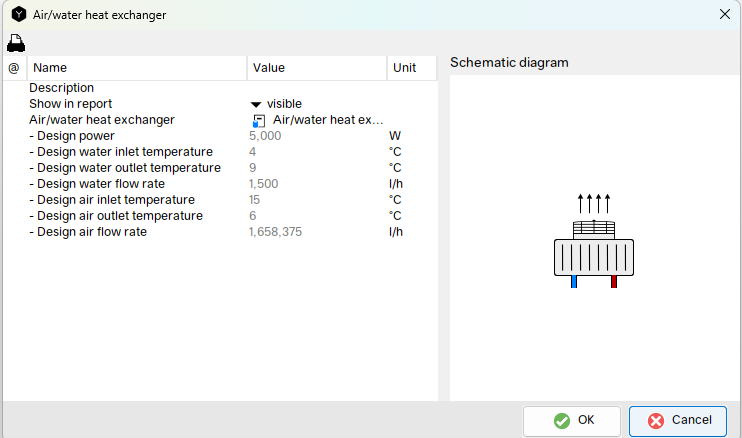
The air-to-water heat exchanger is a thermal component that transfers heat energy between a fluid and the surrounding air. This heat transfer can occur in both directions: from the liquid in a pipe to the ambient air, or from the ambient air to the liquid in a pipe. Thus, the ambient air can serve as either a heat source or a heat sink. The direction of heat transfer is determined by the temperatures of the liquid and the ambient air. This component is compatible with various technologies, such as water-to-water heat pumps and both compressor-driven and thermally driven cooling units. For more information on calculating air-to-water heat exchangers, please refer to the next chapter.
Air To Water Heat Exchanger calculations
Polysun calculates the performance of an air-to-water heat exchanger using the detailed NTU method. This numerical approach accounts for the specific characteristics of the heat exchanger, such as design temperatures, air and water flow rates, and design performance. However, it simplifies the calculations by assuming no latent heat (humidity) is present in the air.
The calculation of the air-water heat exchanger involves the following steps:
- Determining the heat transfer coefficient (UA value): This value characterizes the heat exchanger’s ability to transfer heat between air and water.
- Calculating the number of transfer units (NTU): The NTU indicates how effectively the heat exchanger transfers the available sensible heat. It is derived from the UA value and the specific heat capacities of the media.
- Determining the efficiency and maximum heat transfer: Based on the NTU values, the heat exchanger’s efficiency is calculated, showing how much of the maximum possible sensible heat is actually transferred.
- Calculating actual performance under operating conditions: Considering the calculated temperatures and efficiency, Polysun determines the actual heat transfer occurring under specific operating conditions.
Detailed Simulation Analysis for Year-Round Performance:
A significant strength of Polysun lies in conducting detailed simulation analysis. This feature enables the assessment of the operating temperatures of the air-water heat exchanger at any time of the year. By factoring in seasonal fluctuations in outdoor temperatures and the resulting temperature differences between air and water, a comprehensive understanding of the system’s performance over the entire year is obtained.
Advantages of Simulation Analysis:
- System Design Optimization: Simulation results can be used to optimize the dimensioning of the heat exchanger and the overall system configuration.
- Early Detection of Potential Issues: Possible weaknesses or inefficiencies can be identified and addressed early.
- Energy Efficiency Prediction: Simulations enable estimates of energy consumption and related operating costs.
Note: The assumption that no latent heat is present in the air simplifies the calculation. In high humidity conditions, this may lead to deviations from actual values.