
Combined Heat and Power – CHP System Design
With Polysun, CHP systems can be realistically simulated and optimized. The software supports planners and engineers in CHP system design for single-family homes, multi-family buildings, and industrial plants. Technical aspects such as power modulation, efficiency, and control strategies are comprehensively taken into account. With Polysun, cogeneration systems (CHP, combined heat and power, co-generators) can be simulated and analyzed, making it a powerful tool for CHP plant simulation.
CHP System Design in Polsun
Polysun also provides for the simulation of cogenerators. Cogenerators work on the cogeneration principle to simultaneously generate both heat and electricity. Cogenerators are mainly used in decentralised energy supply systems for single or multi-family houses as well as for industrial plants.
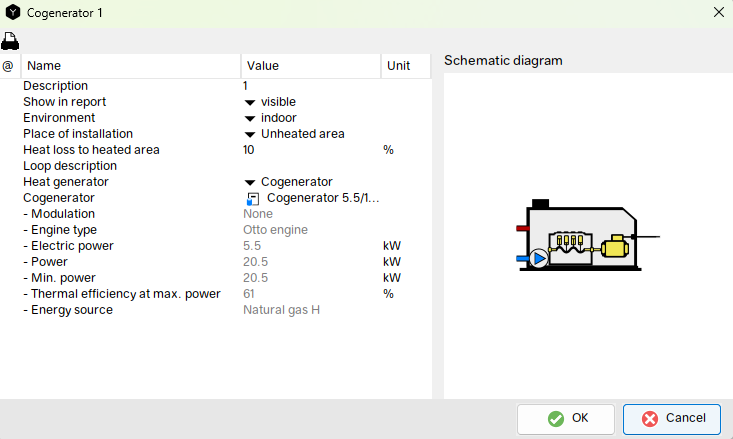
Power Modulation
A great number of cogenerators are non-modulating, on/off devices. As soon as a request is received from the controller, the cogenerator increases its output to a specific operating point, converting the fuel energy input into heat and electricity at a fixed ratio. In addition to these, cogenerator models also exist that can be operated within a given range by modulating their power output. Output modulation makes it possible to positively affect cycle behaviour and service life which, in turn, can have a positive impact on key factors such as maintenance intervals and economic viability.
In the catalog, the power range of the respective cogenerator may be defined by means of two reference points, the maximum and minimum operating point based on the fuel power input. The fuel power input, the thermal efficiency value as well as the electrical efficiency value are required for each reference point. Should it not be possible for the cogenerator to be operated in modulating mode, matching minimum and maximum values should be entered.
Depending on the selected modulation, the model performs its calculations based on the fixed power data or interpolates between the two reference points as needed.
Operation
Basically, a cogenerator can be operated in two distinct modes: the heat-driven operation mode and the power driven operation mode. When operated in the heat-driven operation mode, the cogenerator strictly operates to meet the specified heating energy demand. The electrical energy output is either used to cover self-consumption needs or fed into the public grid. In the power-driven operation mode, the device is operated based on electricity demand. It must, however, be ensured that the heat output may be directly or indirectly decreased at any time by means of appropriate tank modules. Should this not be the case, the surplus heat must be dissipated by means of appropriate emergency cooling devices. This, however, negatively affects the system’s overall efficiency and should, therefore, be avoided as far as possible. Thus, an interesting alternative is provided by combined operation, whereby priority is given to meeting the specified heating demand while simultaneously attempting to supply the most possible amount of electrical energy so that no excess heat is dissipated unused to the environment.
In Polysun, the cogenerator’s operation mode may be defined by selecting the appropriate control mode. The programmable controller makes it possible to operate the cogenerator both according to heat and electricity demand or based on any combination of these.
Controller for the simulation of Cogeneration Systems (CHP systems)
The component “cogenerator” may be operated both through the heat generator controller as well as by means of the programmable controller. It should be noted that for the heat generator controller only (and directly) the heat-driven operation mode is available as a default setting. Alternatively, only the status or additionally the cogenerator’s controlled output may be selected for the corresponding modulating operation. It should also be noted that a cogenerator may only be operated in controlled mode if the relevant reference points have been appropriately parameterized in the database; otherwise, despite the controlled operation having been selected, the cogenerator will not operate in modulating mode.
Next to the control mode, an additional output is available for the programmable controller that may alternatively be set to “1” (heat-driven operation mode) or “2” (power-driven operation mode). As in the preceding case, both the status and the controlled power output must be selected. The control mode allows the user to define whether the requested output is a thermal (1) or electrical (2) output. Accordingly, the model performs its calculations with thermal or electrical values from the database. The third available control mode is the “0” mode. If this is active, the cogenerator will operate in non-modulating mode, even if essentially it could also operate in modulating mode. This makes it possible to study the influence of modulation.
Table: Cogenerator settings in the programmable controller
| Description | Control value | Additional controller outputs | Function description |
| Fixed maximum power | 0 | – | The cogenerator runs at the maximum power level |
| Heat-driven operation | 1 | “Controlled power heat generator“ | The cogenerator delivers, as far as possible, the desired thermal power set via the “Controlled power heat generator“ controller value. (default mode) |
| Electrically-driven operation | 2 | “Controlled power heat generator“ | The cogenerator supplies, as far as possible, the desired electrical power set via the “Controlled power heat generator“ controller value. |
What is meant by “CHP plant simulation”
A CHP plant simulation is a computational model used to predict the electricity and heat production of a cogeneration system over a defined period (e.g., one year). It helps evaluate system behavior under different load profiles, calculate efficiency, and assess economic feasibility (cost vs. return).
How is CHP system design for multi-family buildings carried out?
In the simulation of a CHP system for a multi-family building, the annual heat and electricity demand (load profiles) is first analyzed. Based on this, planners can estimate the expected full-load operating hours and determine the required electrical and thermal capacity for proper dimensioning. The goal is to achieve the right balance between capital costs, efficiency, and self-consumption of electricity.
How does the efficiency of a cogeneration system affect simulation results and costs?
The electrical and thermal efficiency of a CHP system determines how much usable energy is produced from the fuel input. In CHP plant simulation, efficiency directly impacts fuel costs, generated electricity and heat, as well as overall profitability and payback time. Higher efficiencies improve economic performance but are often associated with higher investment costs.
Which fuel types and module variants should be considered in CHP system simulation?
Planners often explore various fuel options in cogeneration system simulations (e.g., natural gas, biogas, wood, oil) along with different CHP module configurations (electrical/thermal output), sizes, and operating strategies. The choice of fuel and module variant significantly affects efficiency, emissions, and cost performance.
How is the economic viability of a simulated CHP system calculated in Polysun?
In Polysun, the economic performance of a CHP system design is calculated based on detailed simulation results. In addition to technical metrics such as generated heat and electricity, the software accounts for investment costs, ongoing operational costs (e.g., fuel, maintenance), and revenues from self-consumption or grid feed-in. Subsidy schemes can also be integrated. Using built-in evaluations such as payback period, net present value, or specific energy costs, Polysun provides a transparent and traceable economic analysis for different CHP plant simulation scenarios.