
The GeoCollect component is an earth thermal energy collector. The model is composed of different earth elements, that are arranged around a heat exchanger. The heat exchanger transfers thermal energy from the ground and the surrounding environment to a utility, usually a heat pump.
GeoCollect – Physical paramters and geometry
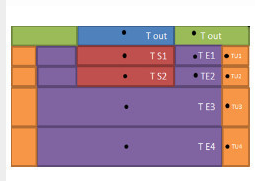
The component is divided into two sub-components:
- GeoCollect Earth tank – The whole tank surrounding the heat exchanger
- Heat exchanger earth tank – The heat exchanger inside the earth tank
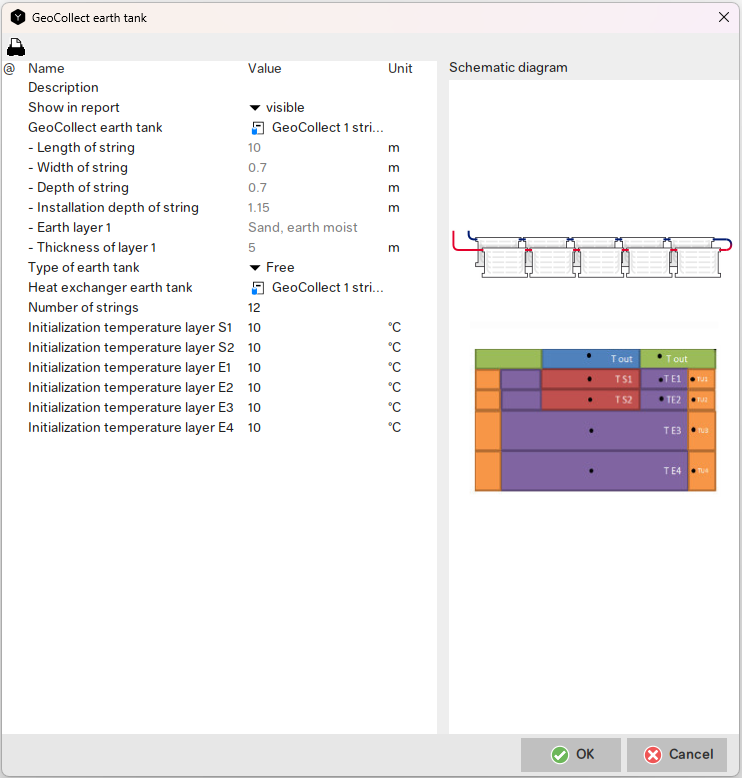
GeoCollect earth tank
The following parameters are defined in the catalog:
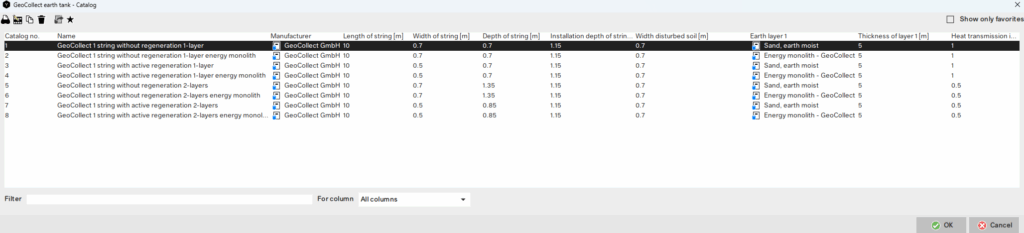
| Parameter | Einheit | Symbol |
| Length of string | m | \(L \) |
| Width of string | m | \(w \) |
| Depth string | m | \(H \) |
| Installation depth of string | m | \(h \)j |
| Width disturbed soil | m | \(t_E \) |
| Thickness of layer 1 | m | \(h_1 \) |
| Heat transmission in layer S1 | \(S_{t1} \) |
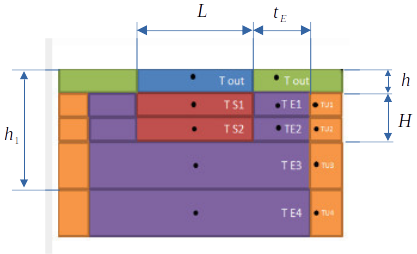
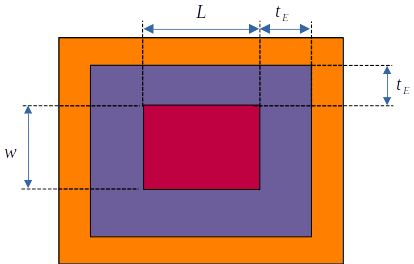
The first six parameters of the catalog define the geometry of the GeoCollect earth tank component. Heat transmission in layer S1 \(S_{t1} \) represents the distribution of the heat exchanger between the two layers \(S_1\) and \(S_2\). For instance value of \(S_{t1} \) = 0.4 represents, that 40% of the surface of the heat exchanger is installed in the layer $ latex S_1} while 60% is installed in the layer \(S_2\).
GeoCollect earth tank elements
The different elements composing the earth tank are shown in these figures:
- S1 and S2 \(\rightarrow\) red: the heat exchanger is installed in these elements
- out \(\rightarrow\) blue and green: the ambient elements above the heat exchanger
- E1, E2, E3, E4 \(\rightarrow \) purple: disturbed soil
- U1, U2, U3, U4 \(\rightarrow \) orange: undisturbed soil
In the column “Earth Layer 1” the material for the first earth layer is selected. This concerns the elements E1, E2, E3, S1 and S2
The second earth layer is composed only of the element E4. The material of said earth layer is fixed to be the material with the ID 146: “humid sand”. The thickness of this layer is set to 5 meters.
The material, that is chosen for the “Earth layer 1”, also defines the composition of the elements U1 to U4. Contrary to the other elements, the temperature for the U elements is not only influenced by the chosen geometry and material, but also by the location of the project.
The ambient elements above the GeoCollect (the blue and green “out” elements) depend on the type of earth tank: it can be placed beneath a building or under the free ground. This can be defined trough the property “Type of earth tank”.
If the type of earth tank is set to “beneath building”, the blue “out” elements correspond to the storage room of the building. On the other hand, if the type of earth tank is set to “Free” , the blue “out” elements correspond to the exterior environment at the chosen location. The green “out” elements however always correspond to the exterior environment. In conclusion, the type of installation of the GeoCollect earth tank defines the environment above the S1 element, thus directly influencing the thermal energy exchange with the surroundings.
Heat exchanger parameters
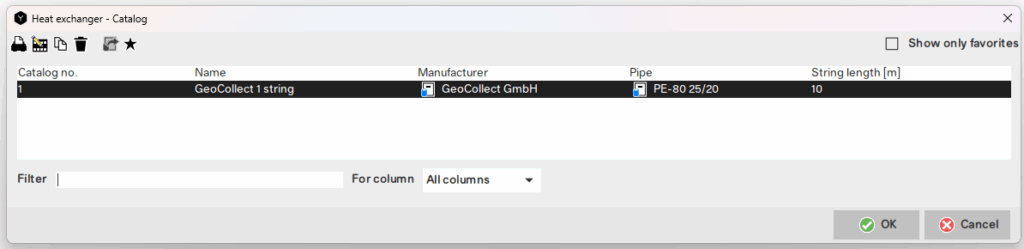
The parameters of the GeoCollect heat exchanger catalog are shown below:
| Parameter | Einheit | Symbol |
| Number of strings | \(N\) | |
| String length | \(m \) | \(l_s\) |
| Initialization temperature layer S1 | \(° C\) | \(T_{0,S1}\) |
| Initialization temperature layer S2 | \(° C\) | \(T_{0,S2}\) |
| Initialization temperature layer E1 | \(° C\) | \(T_{0,E1}\) |
| Initialization temperature layer E2 | \(° C\) | \(T_{0,E2}\) |
| Initialization temperature layer E3 | \(° C\) | \(T_{0,E3}\) |
| Initialization temperature layer E4 | \(° C\) | \(T_{0,E4}\) |
Note that the string length \(l_s\) is the effective length of the heat exchanger, the design value of which is 10 meters. On the other hand, the length of string \(L \) is the length of the elements S1 and S2 in which the heat exchanger is installed.
GeoCollect thermal energy balance
During operation, a thermal power exchange occurs between the different elements of the earth tank:
- \(q_{U1, E1} \) Thermal power exchange between U1 and E1
- \(q_{E1, S1} \) Thermal power exchange between E1 and S1
- \(q_{S2, S1} \) Thermal power exchange between S2 and S1
- \(q_{U2, E2} \) Thermal power exchange between U2 and E2
- \(q_{E2, E1} \) Thermal power exchange between E2 and E1
- \(q_{E2, S2} \) Thermal power exchange between E2 and S2
- \(q_{U3, E3} \) Thermal power exchange between U3 and E3
- \(q_{E3, E2} \) Thermal power exchange between E3 and E2
- \(q_{E3, S2} \) Thermal power exchange between E3 and S2
- \(q_{U4, E4} \) Thermal power exchange between U4 and E4
- \(q_{E4, E3} \) Thermal power exchange between E4 and E3
- \(q_{S1, A1} \) Thermal power exchange between S1 and the blue ambient element above
- \(q_{E1, A2} \) Thermal power exchange between E1 and the green ambient element above
- \(q_{HEX, S1} \) Thermal power exchange between HEX fluid element und S1
- \(q_{HEX, S2} \) Thermal power exchange between HEX fluid element S2
All the thermal power exchanges except the last two in the list are calculated as follows
\(q_{i,j} = k_{i,j} \cdot A_{i,j} \cdot (T_i – T_j) \)
Where \(k_{i,j}\) is the heat transfer coefficient [W/m2K] between the elements i and j, and \(A_{i,j} \) is the corresponding area.
As an example, the thermal power exchange between the Elements U3 and E3:
\(q_{U3,E3} = k_{U3,E3} \cdot A_{U3,E3} \cdot (T_{U3} – T_{E3}) \)
The \(k_{i,j}\) values for the GeoCollect earth tank are defined as follows:
- \(k_{U1, E1} = 8.1 W/m^2K \)
- \(k_{E1, S1} = 175.2 W/m^2K \)
- \(k_{S2, S1} = 17.9 W/m^2K \)
- \(k_{U2, E2} = 8.1 W/m^2K \)
- \(k_{E2, E1} = 8.4 W/m^2K \)
- \(k_{E2, S2} = 175.2 W/m^2K \)
- \(k_{U3, E3} = 1 W/m^2K \)
- \(k_{E3, E2} = 8.4 W/m^2K \)
- \(k_{U4, E4}= 0.6 W/m^2K \)
- \(k_{E4, E3} = 3.7 W/m^2K \)
- \(k_{S1, A1} = 3 W/m^2K \)
- \(k_{E1, A2} = 3 W/m^2K \)
The heat exchange between the two HEX and the S elements is defined as:
\(q_{HEX, Si} = \frac{T_{HEX}-T_{Si}}{R_{HEX, Si}} \)
The thermal resistance is calculated as:
\(R_{HEX, Si} = R_{HEX} + \frac{1}{KA_{HEX, Si}} + R_{Si} \)
Where:
- RHEX is the internal thermal resistance of the geometry corresponding to the heat exchanger.
- RSi is the thermal resistance of the material that surrounds the heat exchanger.
\(R_{Si} = \frac{1}{\frac{A_{Si}}{t_{Si}} \cdot \lambda_{Si}} \)
- \(\frac {A_{Si}}{t_{Si}} \) is the surface to thickness ratio of the Si element in contact with the heat exchanger
- \(\lambda_{Si} \) is the thermal conductivity of the material composing the elements Si
The thermal conductance between the heat exchanger and the Si elements is:
\(KA_{HEX,S1} = KA_{HEX,S2} = \frac{2\pi\frac{l_s}{2}}{ln(1 + \frac{t_{pipe}}{r_{in}})} \cdot \lambda_{pipe} \)
Where:
- \(\frac{l_s}{2} \) is half of the string length
- \(\lambda_{pipe} \) is the thermal conductivity of the material composing the HEX pipe
- \(t_{pipe} \) is the thickness of the HEX pipe
- \(r_{in} \) is the radius of the HEX pipe
Results
The thermal energy balances in the GeoCollect component are grouped into three results, that are available in the component results tab:
- Energyy flow to GeoCollect: The total thermal energy flowing to the elements S1 and S2, defined as:
\(q_{Geo} = q_{E1, S1} + q_{E2, S2} + q_{E3, S2} + q_{S1, A1} + q_{S1, HEX} + q_{S2, HEX} \)
Where qSI, HEX is the thermal power balance between the Si element and the heat exchanger.
- Energy flow to soil: Total thermal energy flowing to the Ei elements, defined as
\(q_{Soil} = q_{U1, E1} + q_{U2, E2} + q_{U3, E3} + q_{U4, E4} + q_{E1, A2} \)
- Total energy flow:
\(q_{tot} = q_{Geo} + q_{Soil}\)