
Understanding Water-to-Water Heat Pumps: Modeling, Design, and Features
A groundwater heat pump uses the relatively constant groundwater temperatures throughout the year to provide an efficient heat supply. Polysun Designer enables you to model this system in detail, incorporating hydraulic connections, performance data and practical control options. This page provides information on modelling, designing and the special features of water/water heat pumps, including two-stage operation, fault messages and importing data using reference points.
Hydraulic connections and heating power calculation
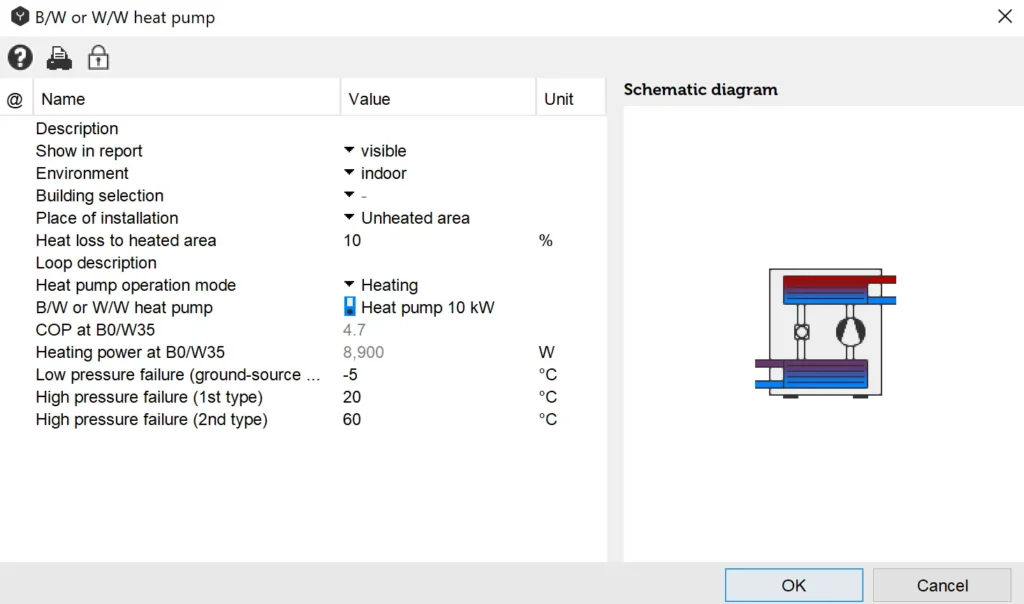
A water-to-water or brine-to-water heat pump is a component fitted with four hydraulic connections. The calculations of heating power and absorbed power are based on a so-called “Scattered data interpolation“. This also enables unknown interpolation nodes to be omitted, which may result in less accurate results. As with air/water heat pumps start-up losses will not be considered for water/water heat pumps either. Besides the supplied amount of energy the calculated coefficient of performance takes into account only the amount of energy absorbed by the compressor.
When configuring a system care should always be taken to ensure that brine temperature at the heat-pump input (Ts) is always lower that the inlet temperature (Tv) in the heating loop.
A realistic heat pump control can be reproduced by means of the minimum operation time and the minimum idle time.
Catalog Data with Reference Points from a File
The data format for the definition of reference points in a profile file is as follows:
#Name der Heat pump;;;;
#Evaporator[°C];Condenser[°C];Heating power[W];Electrical power[W]; Cooling power[W]
-5;35;14800;3700;0
0;35;17200;3600;0…
…
Optionally, the cooling power may be also indicated. Where this is greater than 0, the internal losses of the heat pump will be taken into consideration in the simulation.
Internal losses HP = cooling power + electrical power – heating power
Two-Stage Water/Water Heat Pump
A two-stage water/water heat pump works on the same principle as a two-stage air/water heat pump.
Its operation is based on the standard water/water heat pump model.
Two-stage operation is only considered in case of heating.
In the database or in the profile file, reference points are entered for the full power; the format is the same as for a standard water/water heat pump.
What does the warning message ‘Maximum fluid temperature (hot water side) exceeded’ mean?
This warning message indicates that the temperature of the water entering the heat pump is higher than the maximum permitted setting.
With S/W or W/W heat pumps, the inlet temperature (hot water side) can be set under high pressure fault (2nd type). If this temperature is exceeded, the heat pump switches to fault mode and stops producing heat to prevent damage. As soon as the inlet temperature in the heat pump falls below the set limit temperature again, the heat pump will resume producing heat.
Can groundwater heat pumps also be used for cooling?
Yes, many systems are designed to be bivalent and can also be used for passive or active cooling in summer by transferring heat from the building to the groundwater via the heat pump.