
Heat Demand Estimation with Polysun
To design an optimal HVAC system, energy demand must be accurately interpreted to ensure proper system sizing. One option for assessing heat demand is the quasi-dynamic model. It captures a building’s thermal performance by integrating static energy consumption data with dynamic factors, such as internal heat gains, external temperature variations, and thermal mass. The quasi-dynamic model is particularly well-suited for sizing heating systems in scenarios where existing consumption data is available and simulations incorporating dynamic thermal properties are required.
Input Options for Building Energy Consumption Data
To calculate your building’s heat demand using the quasi-dynamic model, specific information about the building is required. Four different input options are available:
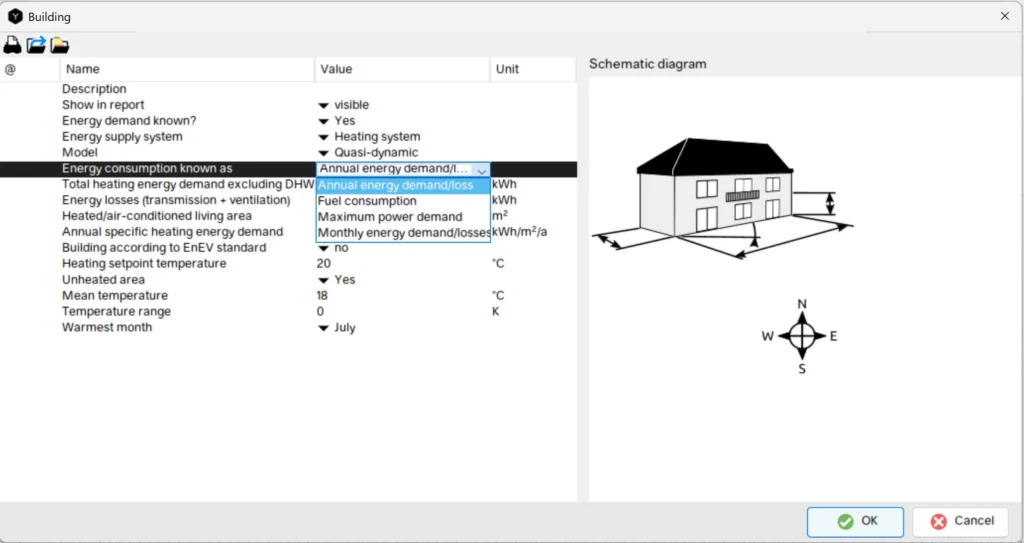
Anual energy demand/loss
The annual heating demand is specified in kWh. This model is suitable, for example, when the heating demand is known or has been calculated elsewhere.
Monthly energy demand/losses
Same as for the Anual energy demand/loss, this approach allows the specification of an energy quantity in kWh, but the input must be entered separately for each month. This method is particularly suitable for buildings with heating demands that deviate from typical seasonal patterns.
Fuel consumption
The annual heating demand is defined based on the consumption of a specific energy carrier. This option should only be selected when no other building information is available. Particularly for existing buildings, an initial estimate can be made using available heating cost statements. It is critical to note that this method incorporates minimal information about the building envelope. In Polysun, you can choose from five different energy carriers, with the respective standard billing units applied.
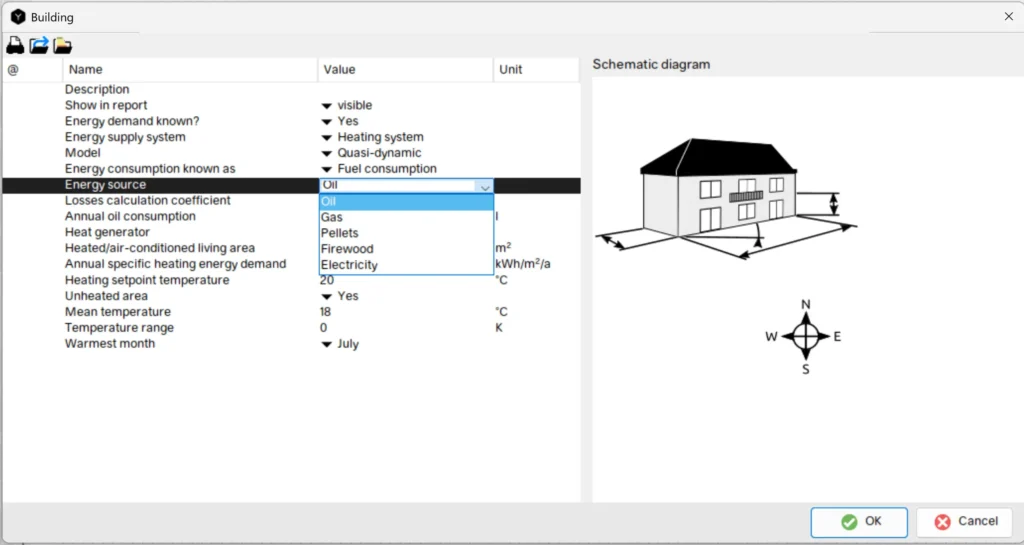
After selecting the energy carrier and entering the corresponding consumption amount, the efficiency of the heat generator relevant to the fuel consumption is designated as either “new” or “old.” This selection impacts the calculation of the effective heating demand. For example, the heating demand for gas is calculated using the following formula, where 37,800 represents a conversion factor in kJ/m³:
\(Q_{dem,heating} = \frac{37800}{3600} * Fuel_{consumption}*\eta_{fuel}\)
For new heat generators, the efficiency is used as a conversion factor \(\eta_{fuel} = 0.85\), while for older heat generators (approximately 20 years or older), \(\eta_{fuel} = 0.6\) applies.
It should be noted that this approach only estimates the efficiency to derive an approximate heating demand. The component used for heat generation in the simulation may have a different efficiency, which can then be found in the component results.
Additionally, heat losses and gains are calculated using the loss calculation coefficient \(c_{loss}\), which is set to a default value of 3. Depending on the building’s insulation or internal heat gains, this value can be adjusted individually:
\(Q_{loss} = Q_{dem,heating} *c_{loss}\)
Maximum power demand
With this selection, the UA-value is determined from the ratio of the maximum power demand to the heated area. Depending on this UA-value, a factor for the losses, \(f_{loss}\), is set. Example:
\(\frac{ Q_{dem,max}}{A_b}\leq30:\)
\(UA_b = 2A_b0.13\)
\(f_{loss} = 7\)
Next, the required energy to maintain the room temperature is determined, comparing the current outdoor temperature with the minimum outdoor temperature of the year:
If the current outdoor temperature is lower than the minimum outdoor temperature of the year + 2 K, the maximum power demand is required.
If the current outdoor temperature is lower than the balance temperature \(T_{bal}\), the following applies:
\(Q_{dem}'[h] =\left( \frac{Q_{dem,max}}{(T_{amb,min}-T_{bal})}*(T_{amb}[h]-T_{amb,min})+Q_{dem,max}\right)*1.3\)
\(Q_{loss}'[h] = Q_{dem}'[h]*f_{loss}\)
\(Q_{dem,heating} = \sum{Q_{dem}'[h]}\)
\(Q_{loss}'[h] = Q_{dem}'[h]*f_{loss}\)
Understanding Heating Demand and Energy Losses: Fundamentals for Simulation
For all options of entering the heating energy demand, the specification of the total heating energy demand (excluding domestic hot water) and the energy losses (transmission + ventilation) is either requested directly in the building’s context menu or these parameters are calculated from the inputs, as described above.
Energy Losses (Transmission + Ventilation):
Transmission losses occur when heat is transferred from a warmer body to a colder one through solid barriers such as exterior walls or window surfaces. Polysun calculates these losses as follows:
\(Q_{loss} = Q_{dem}\) +internal gains
where \(Q_{loss}\) represents energy losses (transmission + ventilation) and \(Q_{dem}\) is the heating demand.
Here, \(Q_{loss}\) represents the energy losses (transmission + ventilation), and \(Q_{dem}\) is the heating demand. The energy losses (transmission + ventilation) take into account all internal gains, such as solar gains through windows, heat emitted by appliances, and people. These gains are considered as part of the total annual heat losses, including the heating demand.
If a ratio of 1:1 between heating demand and losses is chosen, this implies that no internal gains are present — an assumption that is rarely realistic. Therefore, the tooltip at this point indicates that the energy losses should be two to eight times greater than the heating demand. This hint is based on empirical values.
Quasi-Dynamic Model Assumptions: Heat Gains and Building Mass
Internal Heat Gains
The internal heat gains (\(Q_{gain}\)) include all heat sources within the building, e.g. from electrical appliances or occupants. They are generally estimated based on the heated living area (\(A_b\)) using a specific value of 5 W/m²:
\(Q_{gain} = 5 * A_b\)
Thermal Building Mass
The thermal mass of the building (\(TM_b\)) is assumed to be twice the heated living area and is calculated with a specific heat capacity of 750 kJ/kg·K. A factor of 1000 is applied for the conversion from joules.:
\(TM_b = 2 * A_b * 750 * 1000\)
Temperaturdifferenzen und Wärmedurchgangskoeffizient (UA-Wert)
The difference between the set room temperature (\(T_{set}\)) and the outdoor temperature (\(T_{amb}\)) is calculated on an hourly basis, provided that the outdoor temperature is below the set room temperature.
\(T_{diff}[h] = T_{set}-T_{amb}[h]\)
\(Sum_{T_{diff}} = \sum T_{diff}[h]\)
The coefficient \(UA_b\) quantifies the heat losses of the building. It is derived from the total energy losses (\(Q_{loss}\)) and the cumulative temperature difference:
\(UA_b = \frac{Q_{loss} * 1000} {Sum_{T_{diff}}}\)
The balance temperature is the minimum outdoor temperature at which the transmission losses of the building are lower than the internal heat gains:
\(if~~ UA_b*(T_{set}-T_{amb}[h]) < Q_{gains}\)
\(T_{bal} = min(T_{bal},T_{amb})\)
Hourly Heating Demand, Energy Losses, and Gains
If the outdoor temperature is below the balance temperature, the heating demand is calculated as follows:
\(Q_{dem,0}[h] = 2Q_{dem,heating}\frac{(T_{bal}-T_{amb}[h])}{(T_{bal} – T_{min,amb})^2}\)
\(Sum_{Q_{dem,0}} = \sum Q_{dem,0}[h]\)
\(Q_{dem}[h] = Q_{dem,0}[h] * \frac{Q_{dem,heating}}{Sum_{Q_{dem,0}}}\)
Energy Losses Calculation Formula
The hourly energy losses (\(Q_{loss,0}[h]\)) are calculated from the heat transfer coefficient and the temperature difference:
\(Q_{loss,0}[h] = UA_b*(T_{set} – T_{amb}[h])\)
\(sum_{Q_{loss,0}} = \sum Q_{loss,0}[h]\)
\(Q_{loss}[h] = Q_{loss,0}[h] * \frac{Q_{loss}}{Sum_{Q_{loss,0}}}\)
Energy Gains Calculation Formula
The hourly energy gains are derived from the difference between hourly losses and hourly heating demand:
\(Q_{gains}[h] = Q_{loss,0}[h]-Q_{dem}[h]\)
Energy Deficit
The energy deficit (\(Q_{def}\)) describes the difference between the calculated heating demand of a building and the energy actually supplied by the heating system. In the context of Polysun, the energy deficit is calculated as the difference between the heating demand (\(Q_{dem}\)) and the energy delivered by the heating element (\(Q_{conv}\)):
\(Q_{def} = Q_{dem}-Q_{conv}\)
The warning “Building energy demand not covered” is displayed if the energy deficit remains positive for more than 6 hours.
What is heat demand calculation and why is it important for heating system design?
Heat demand calculation determines how much heating energy your building needs to maintain comfortable indoor temperatures.
Accurate calculations are essential for designing energy-efficient heating systems, ensuring your system is neither oversized (causing higher costs and frequent cycling) nor undersized (leading to discomfort and inadequate heating).
Can Polysun handle both new and existing buildings?
Yes, Polysun can simulate both new and existing buildings. You can select from various models depending on the information available, such as known annual demand, fuel consumption, or detailed hourly profiles.
What is heat demand calculation and why is it important for building energy systems?
A heat demand calculation determines the thermal energy required for space heating, taking into account peak and annual energy needs. Polysun offers various methods of consider heat demand to ensure proper sizing of heating equipment.
In Polysun, heat demand can be interpreted using consumption data, measured or calculated data, or physical building parameters with the dynamic model.